


Moderation of breastfeeding effects on the IQ by genetic variation in fatty acid metabolism
- PMID: 17984066
- PMCID: PMC2141867
- DOI: 10.1073/pnas.0704292104
Moderation of breastfeeding effects on the IQ by genetic variation in fatty acid metabolism
Abstract
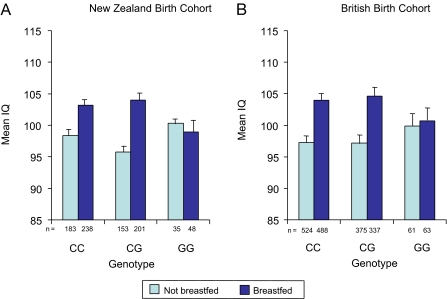
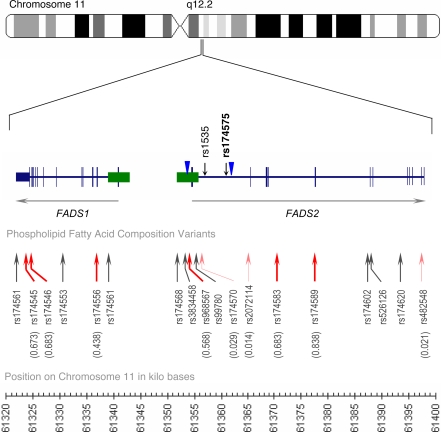
Children's intellectual development is influenced by both genetic inheritance and environmental experiences. Breastfeeding is one of the earliest such postnatal experiences. Breastfed children attain higher IQ scores than children not fed breast milk, presumably because of the fatty acids uniquely available in breast milk. Here we show that the association between breastfeeding and IQ is moderated by a genetic variant in FADS2, a gene involved in the genetic control of fatty acid pathways. We confirmed this gene-environment interaction in two birth cohorts, and we ruled out alternative explanations of the finding involving gene-exposure correlation, intrauterine growth, social class, and maternal cognitive ability, as well as maternal genotype effects on breastfeeding and breast milk. The finding shows that environmental exposures can be used to uncover novel candidate genes in complex phenotypes. It also shows that genes may work via the environment to shape the IQ, helping to close the nature versus nurture debate.
Conflict of interest statement
The authors declare no conflict of interest.
Figures
References
-
- Gould SJ. The Mismeasure of Man. New York: Norton; 1981.
-
- Herrnstein RJ, Murray C. The Bell Curve. New York: Free Press; 1994.
-
- Gray JR, Thompson PM. Nat Rev Neurosci. 2004;5:471–482. - PubMed
-
- Bouchard TJ, McGue M. Science. 1981;212:1055–1059. - PubMed
-
- Plomin R, DeFries JC, McClearn GE, McGuffin P. Behavioural Genetics. New York: Freeman; 2000.
Publication types
MeSH terms
Substances
Grants and funding
LinkOut - more resources
Full Text Sources
Other Literature Sources
Medical
