Clinical Trial
. 2008 Jan;52(1):312-20.
doi: 10.1128/AAC.00467-07. Epub 2007 Nov 5.

Hepatitis B virus e antigen loss during adefovir dipivoxil therapy is associated with enhanced virus-specific CD4+ T-cell reactivity

Affiliations
Clinical Trial

Hepatitis B virus e antigen loss during adefovir dipivoxil therapy is associated with enhanced virus-specific CD4+ T-cell reactivity

Helen Cooksley et al. Antimicrob Agents Chemother. 2008 Jan.

Abstract

Weak T-cell reactivity to hepatitis B virus (HBV) is thought to be the dominant cause for chronic HBV infection. Treatment with adefovir dipivoxil (ADV) increases the rate of HBV e antigen (HBeAg) loss; however, the immune mechanisms associated with this treatment response are not understood. Serial analysis of HBV-specific CD4+ T-cell reactivity was performed during 48 weeks of therapy with ADV and correlated with treatment outcome for 19 HBeAg-positive patients receiving ADV (n = 13) or the placebo (n = 6). We tested T-cell reactivity to HBV at seven protocol time points by proliferation, cytokine production, and enzyme-linked immunospot assays. A panel of serum cytokines was quantitated by cytokine bead array. ADV-treated patients showed increased CD4+ T-cell responses to HBV and lower serum levels of cytokines compared to those of placebo-treated patients. Enhanced CD4+ T-cell reactivity to HBV, which peaked at treatment week 16, was confined to a subgroup of ADV-treated patients who achieved greater viral suppression (5.3 +/- 0.3 log(10) copies/ml [mean +/- standard error of the mean {SEM}] serum HBV DNA reduction from baseline) and HBeAg loss, but not to ADV-treated patients with moderate (3.4 +/- 0.2 log(10) copies/ml [mean +/- SEM]) viremia reduction who remained HBeAg positive or to patients receiving the placebo. In conclusion, T-cell reactivity to HBV increases in a proportion of ADV-treated patients and is associated with greater suppression of HBV replication and HBeAg loss.


Figures
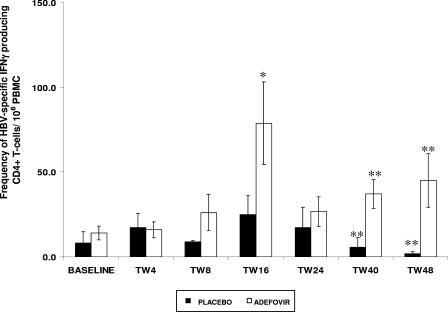
FIG. 1.
FIG. 1.
Comparison of CD4+ T-cell reactivity to HBcAg in patients receiving ADV or the placebo. *, there was a significant increase in the frequencies of IFN-γ-producing CD4+ T cells at TW16 compared to baseline values for ADV-treated patients (P = 0.03). **, at TW40 and TW48, patients receiving ADV had significantly higher frequencies of IFN-γ-producing CD4+ T cells than did patients receiving placebos (P = 0.03). The bars represent means ± SEMs.
FIG. 2.
FIG. 2.
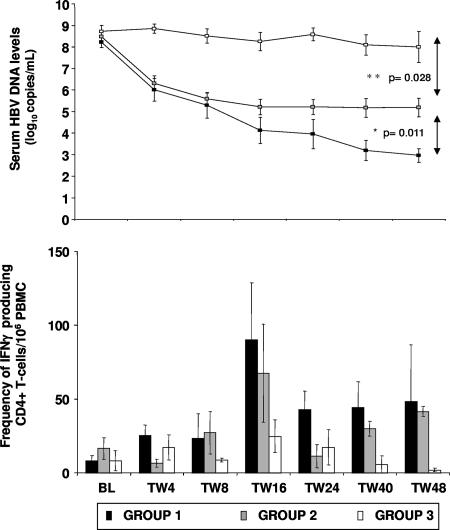
Relationship between serum HBV DNA levels and the frequency of virus-specific CD4+ T cells during the study period for the three groups of patients presented in Table 2. *, patients in group 1 had significantly lower HBV DNA levels at TW48 than did patients in groups 2 (P = 0.011) and 3 (P = 0.003). **, patients in group 2 had significantly lower HBV DNA levels at TW48 than did patients in group 3 (P = 0.028). The bars represent the means ± SEMs for the frequency of HBV-specific CD4+ T cells. Error bars indicate standard deviations.
FIG. 3.
FIG. 3.
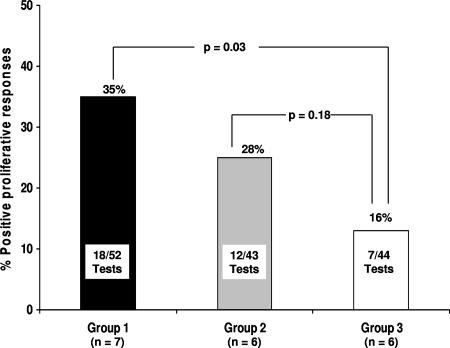
HBcAg-specific T-cell proliferation according to virological response. Patients in group 1 had a higher number of positive tests results for T-cell proliferation to HBcAg than did patients in group 3 (P = 0.03).
FIG.4.
FIG.4.
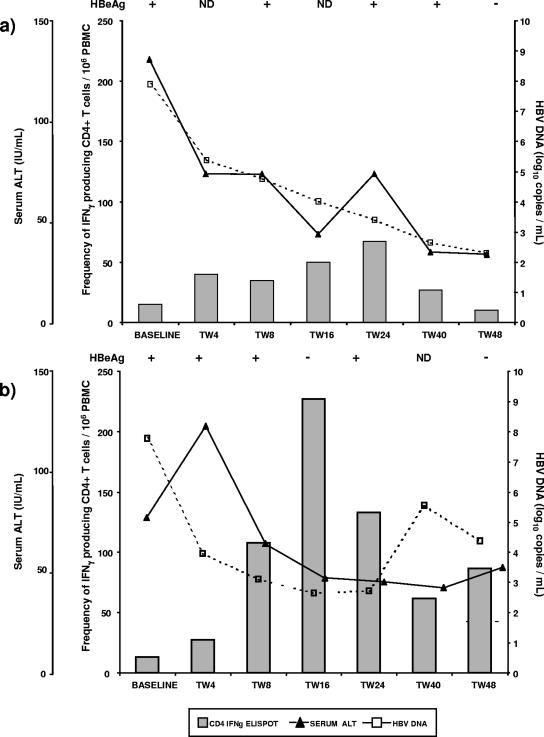
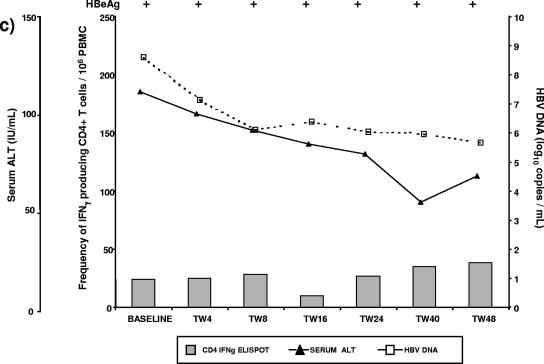
Time course analysis of serum ALT levels, virological parameters, and the frequency of IFN-γ-producing CD4+ T cells during the study period. (a and b) For two representative patients from group 1, an increased frequency of IFN-γ-producing CD4+ T cells preceded or coincided with HBeAg loss, without ALT flare. (c) A representative patient from group, who received ADV treatment, but had moderate reduction in viremia, remained HBeAg+ and showed no increase in the frequency of virus-specific, IFN-γ-producing T cells. IFNγ, IFN-γ; ND, not determined.
FIG.4.
FIG.4.
Time course analysis of serum ALT levels, virological parameters, and the frequency of IFN-γ-producing CD4+ T cells during the study period. (a and b) For two representative patients from group 1, an increased frequency of IFN-γ-producing CD4+ T cells preceded or coincided with HBeAg loss, without ALT flare. (c) A representative patient from group, who received ADV treatment, but had moderate reduction in viremia, remained HBeAg+ and showed no increase in the frequency of virus-specific, IFN-γ-producing T cells. IFNγ, IFN-γ; ND, not determined.
FIG. 5.
FIG. 5.
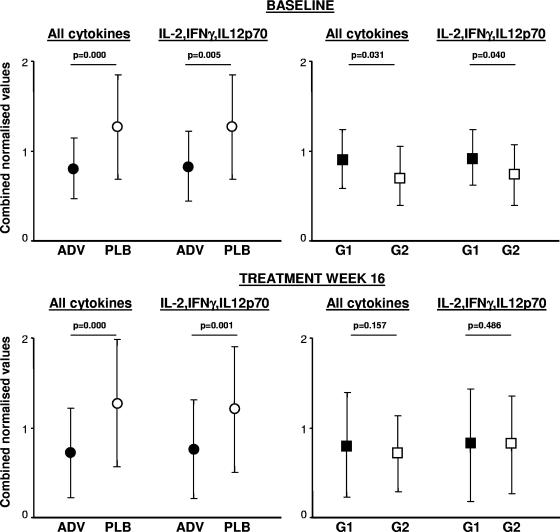
Comparison of serum cytokine profiles using cluster analysis of normalized values. The levels of all cytokines measured, or measured separately for IL-12p70, IFN-γ, and IL-2, were significantly higher in the placebo (PLB)-treated group than in the ADV-treated group. At TW16, the difference was even more apparent between PLB- and ADV-treated groups, while there was no difference between the two ADV-treated subgroups with or without HBeAg loss (group 1 [G1] or group 2 [G2], respectively). Error bars indicate standard deviations.

References

    1. Boni, C., A. Bertoletti, A. Penna, A. Cavalli, M. Pilli, S. Urbani, P. Scognamiglio, R. Boehme, R. Panebianco, F. Fiaccadori, and C. Ferrari. 1998. Lamivudine treatment can restore T cell responsiveness in chronic hepatitis B. J. Clin. Investig. 102:968-975. - PMC - PubMed
    1. Boni, C., A. Penna, A. Bertoletti, V. Lamonaca, I. Rapti, G. Missale, M. Pilli, S. Urbani, A. Cavalli, S. Cerioni, R. Panebianco, J. Jenkins, and C. Ferrari. 2003. Transient restoration of anti-viral T cell responses induced by lamivudine therapy in chronic hepatitis B. J. Hepatol. 39:595-605. - PubMed
    1. Chisari, F. V. 2000. Rous-Whipple award lecture. Viruses, immunity, and cancer: lessons from hepatitis B. Am. J. Pathol. 156:1117-1132. - PMC - PubMed
    1. Chisari, F. V., and C. Ferrari. 1995. Hepatitis B virus immunopathogenesis. Annu. Rev. Immunol. 13:29-60. - PubMed
    1. de Franchis, R., A. Hadengue, G. Lau, D. Lavanchy, A. Lok, N. McIntyre, A. Mele, G. Paumgartner, A. Pietrangelo, J. Rodes, W. Rosenberg, D. Valla, and the EASL Jury. 2003. EASL Consensus Conference on Hepatitis B: consensus statement. J. Hepatol. 39(Suppl. 1):S3-S25. - PubMed

Publication types

MeSH terms