. 2007 Nov 6:2:24.
doi: 10.1186/1749-8104-2-24.

Left-right olfactory asymmetry results from antagonistic functions of voltage-activated calcium channels and the Raw repeat protein OLRN-1 in C. elegans

Affiliations

Left-right olfactory asymmetry results from antagonistic functions of voltage-activated calcium channels and the Raw repeat protein OLRN-1 in C. elegans

Sarah L Bauer Huang et al. Neural Dev. .

Abstract

Background: The left and right AWC olfactory neurons in Caenorhabditis elegans differ in their functions and in their expression of chemosensory receptor genes; in each animal, one AWC randomly takes on one identity, designated AWCOFF, and the contralateral AWC becomes AWCON. Signaling between AWC neurons induces left-right asymmetry through a gap junction network and a claudin-related protein, which inhibit a calcium-regulated MAP kinase pathway in the neuron that becomes AWCON.

Results: We show here that the asymmetry gene olrn-1 acts downstream of the gap junction and claudin genes to inhibit the calcium-MAP kinase pathway in AWCON. OLRN-1, a protein with potential membrane-association domains, is related to the Drosophila Raw protein, a negative regulator of JNK mitogen-activated protein (MAP) kinase signaling. olrn-1 opposes the action of two voltage-activated calcium channel homologs, unc-2 (CaV2) and egl-19 (CaV1), which act together to stimulate the calcium/calmodulin-dependent kinase CaMKII and the MAP kinase pathway. Calcium channel activity is essential in AWCOFF, and the two AWC neurons coordinate left-right asymmetry using signals from the calcium channels and signals from olrn-1.

Conclusion: olrn-1 and voltage-activated calcium channels are mediators and targets of AWC signaling that act at the transition between a multicellular signaling network and cell-autonomous execution of the decision. We suggest that the asymmetry decision in AWC results from the intercellular coupling of voltage-regulated channels, whose cross-regulation generates distinct calcium signals in the left and right AWC neurons. The interpretation of these signals by the kinase cascade initiates the sustained difference between the two cells.


Figures
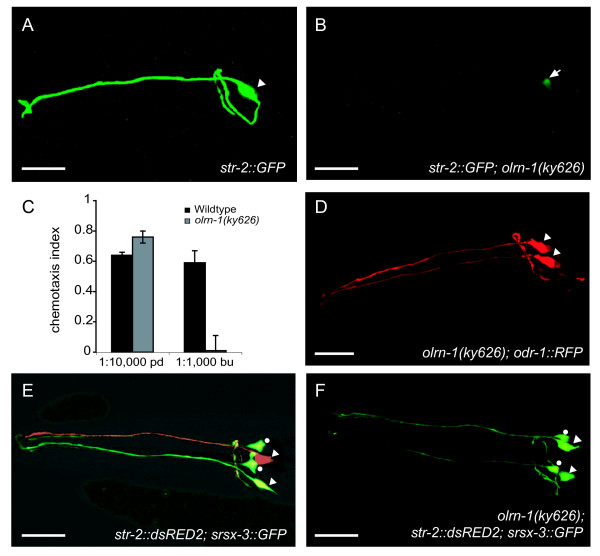
Figure 1
Figure 1
olrn-1 mutants have two AWCOFF neurons. (a,b) str-2::GFP expression in (a) wild type and (b) olrn-1(ky626) animals. Arrowhead, AWC; arrow, dim str-2::GFP expression in ASI. (c) Chemotaxis of wild-type and olrn-1(ky626) animals to the AWCOFF sensed odorant 2,3-pentanedione (pd) and the AWCON sensed odorant butanone (bu). A chemotaxis index of 1 indicates that 100% of animals approached the odorant, while a chemotaxis index of 0 represents random behavior. Error bars indicate standard error of the mean. (d) odr-1::DsRed is expressed in both AWC neurons (arrowheads) of olrn-1 mutants, a pattern identical to the wild-type pattern. (e,f) str-2::DsRed; srsx-3::GFP expression in (e) wild type and (f) olrn-1(ky626) mutant animals. Arrowheads indicate AWCs; dots indicate AWBs. Scale bars, 20 μm. Images are stacked confocal images.
Figure 2
Figure 2
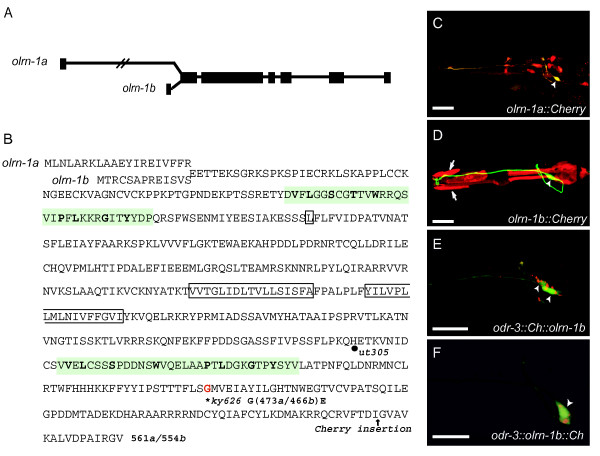
olrn-1 encodes a protein with Raw repeats and potential transmembrane domains. (a) Genomic structure of olrn-1, showing alternative first exons for a and b isoforms, whose 5' ends are separated by 3.8 kb. (b) Translation of olrn-1, showing alternative first exons for olrn-1a and olrn-1b isoforms. Two short repeats shared with Drosophila Raw are highlighted in green with conserved residues in bold type; potential transmembrane domains are boxed. The location of the splice acceptor site (fourth exon) mutated in ut305 and the residue mutated in olrn-1(ky626) (G 473a/466b E) are marked. Arrow marks the carboxy-terminal insertion site of Cherry in odr-3::olrn-1b::Ch (f). (c) Expression of olrn-1a::Cherry promoter fusion. Arrowhead indicates Cherry expression in AWC neuron expressing str-2::GFP. (d) Expression of olrn-1b::Cherry promoter fusion in non-neuronal cells. Arrows, hypodermal cells. The pharynx is a prominent site of expression. Arrowhead, no Cherry expression in AWC neuron expressing str-2::GFP. (e) Expression of amino-terminally tagged odr-3::Cherry::olrn-1b in an L4 olrn-1(ky626) animal. odr-3::Cherry::olrn-1b is excluded from the nucleus and is punctate in the axon and dendrite. (f) Expression of carboxy-terminally tagged odr-3::olrn-1b::Cherry in an L4 ky626 animal. odr-3::olrn-1b::Cherry is excluded from the nucleus, and is punctate in the axon and dendrite. Arrowheads, AWC cell bodies. Scale bars, 20 μm. Images are stacked confocal images.
Figure 3
Figure 3
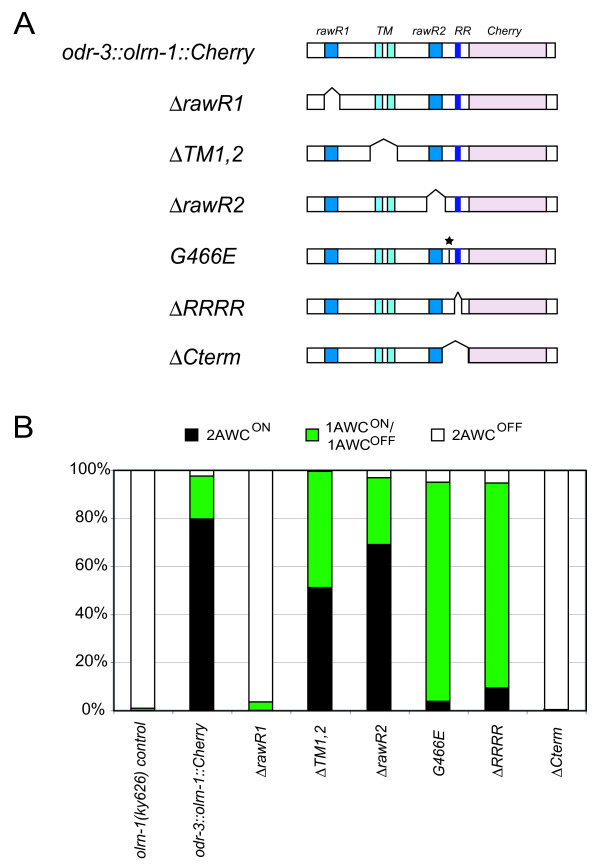
Structure-function analysis of odr-3::olrn-1::Cherry. (a) Mutants generated in odr-3::olrn-1b::Cherry affected Raw repeats (ΔrawR1, ΔrawR2), potential transmembrane domains (ΔTM1,2), the four adjacent arginines (ΔRRRR), and a carboxy-terminal region (ΔCterm). The ky626 mutation (G466E) was also introduced. (b) Phenotypes of ky626 animals expressing odr-3:olrn-1b::Cherry transgenes. olrn-1(ky626) control is at left. All transgenes except ΔCterm showed significant rescue compared to nontransgenic sibling controls; all transgenes except rawR2 were significantly less active than intact odr-3::olrn-1b::Cherry (P < 0.008 by Fisher exact test or Chi square test as appropriate; 0.008 was used as the significance level based on the conservative Bonferroni correction for six comparisons; n > 100 rescued animals per clone, from at least two independent transgenic lines that showed similar degrees of rescue (Table 3)).
Figure 4
Figure 4
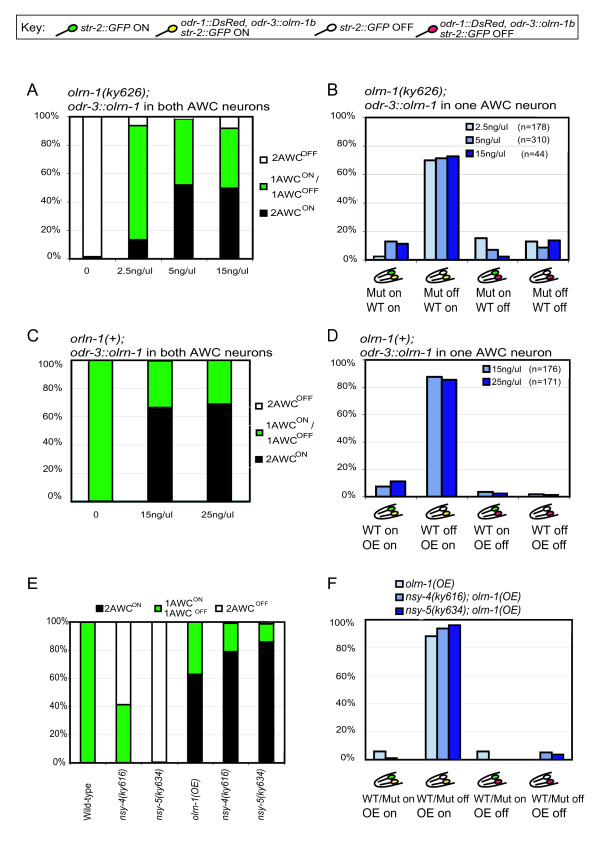
olrn-1 mosaic analysis. (a) Rescue of olrn-1(ky626) by odr-3::olrn-1b injected at 2.5 ng/μl, 5 ng/μl, or 15 ng/μl with odr-1::DsRed. (b) AWC phenotypes of mosaic olrn-1(ky626) animals that express odr-3::olrn-1b odr-1::dsRed transgene in one AWC. (c) Phenotypes in wild-type animals overexpressing odr-3::olrn-1b injected at 15 ng/μl or 25 ng/μl with odr-1::DsRed. (d) AWC phenotypes of wild-type mosaic animals that overexpress odr-3::olrn-1b in one AWC. For statistical analysis, see Materials and methods. (e) Phenotypes of nsy-4 olrn-1(OE) and nsy-5 olrn-1(OE) strains and controls. (f) AWC phenotypes of mosaic animals that express odr-3::olrn-1b in one AWC in nsy-4 or nsy-5 mutant backgrounds.
Figure 5
Figure 5
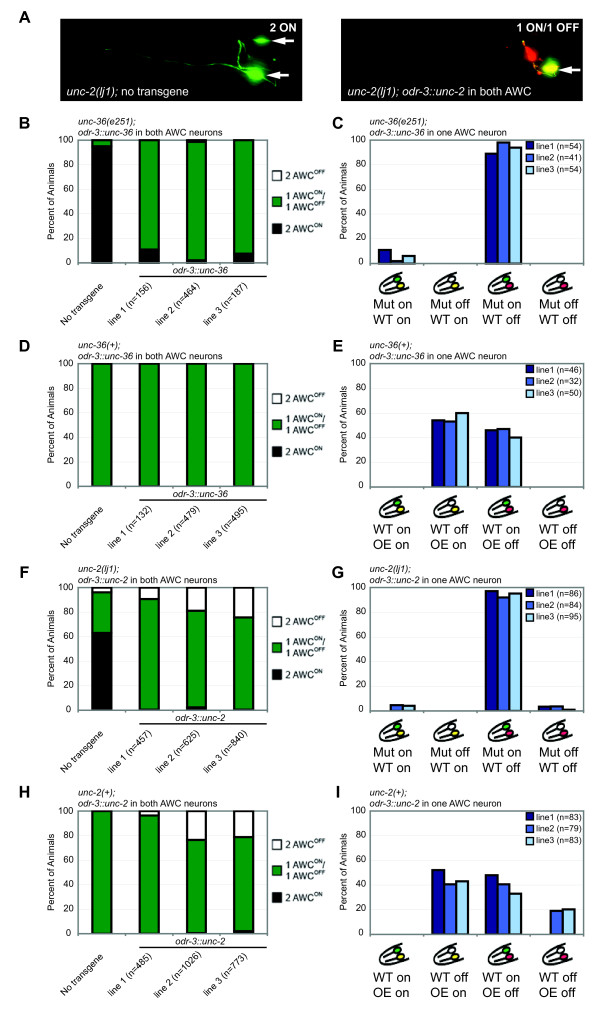
Mosaic analysis of the unc-36/unc-2 calcium channel genes. (a) Rescue of unc-2(lj1) by [odr-3::unc-2, odr-1::dsRed] array. Green, str-2::GFP expression; red, odr-1::dsRED expression. Arrows point to AWCON neurons. (b) Rescue of unc-36(e251) phenotypes in three [odr-3::unc-36, odr-1::dsRed] transgenic lines. (c) AWC phenotypes of unc-36 mosaic animals that express odr-3::unc-36 in one AWC. (d) The three [odr-3::unc-36, odr-1::dsRed] transgenes from (b) were introduced into a wild-type background. (e) AWC phenotypes of wild-type mosaic animals that overexpress odr-3::unc-36 in one AWC. (f) Rescue of unc-2(lj1) phenotypes in three Ex [odr-3::unc-2, odr-1::dsRed] transgenic lines. (g) AWC phenotypes of unc-2 mosaic animals that express odr-3::unc-2 in one AWC. (h) The three [odr-3::unc-2, odr-1::dsRed] transgenes from (f) were introduced into a wild-type background. (i) AWC phenotypes of wild-type mosaic animals that overexpress odr-3::unc-2 in one AWC. n, number of animals scored. For statistical analysis, see Materials and methods.
Figure 6
Figure 6
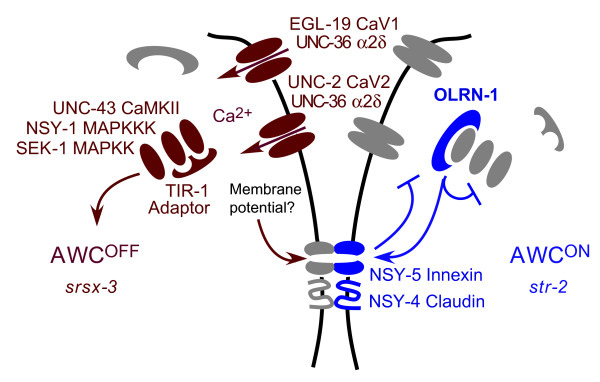
Model for calcium channel function and OLRN-1 in the AWCON/AWCOFFdecision. All genes are expressed both in the left and in the right AWCs; color is used to indicate the cell in which each gene product is more active. The future AWCOFF transmits a signal to AWCON via NSY-5 gap junctions between AWC and other cells and NSY-4 claudins. This signal might be membrane potential. In AWCON, the signal suppresses the UNC-2 (CaV2) and EGL-19 (CaV1) voltage-activated calcium channels and allows high OLRN-1 activity. OLRN-1 inhibits the UNC-43 (CaMKII)/NSY-1/SEK-1 kinase cascade cell-autonomously within AWCON. A feedback signal from the calcium channels and OLRN-1 is transmitted from AWCON back to AWCOFF.

References

    1. Troemel ER, Chou JH, Dwyer ND, Colbert HA, Bargmann CI. Divergent seven transmembrane receptors are candidate chemosensory receptors in C. elegans. Cell. 1995;83:207–218. doi: 10.1016/0092-8674(95)90162-0. - DOI - PubMed
    1. Yu S, Avery L, Baude E, Garbers DL. Guanylyl cyclase expression in specific sensory neurons: a new family of chemosensory receptors. Proc Natl Acad Sci U S A. 1997;94:3384–3387. doi: 10.1073/pnas.94.7.3384. - DOI - PMC - PubMed
    1. Pierce-Shimomura JT, Faumont S, Gaston MR, Pearson BJ, Lockery SR. The homeobox gene lim-6 is required for distinct chemosensory representations in C. elegans. Nature. 2001;410:694–698. doi: 10.1038/35070575. - DOI - PubMed
    1. Johnston RJ, Jr., Chang S, Etchberger JF, Ortiz CO, Hobert O. MicroRNAs acting in a double-negative feedback loop to control a neuronal cell fate decision. Proc Natl Acad Sci U S A. 2005;102:12449–12454. doi: 10.1073/pnas.0505530102. - DOI - PMC - PubMed
    1. Troemel ER, Sagasti A, Bargmann CI. Lateral signaling mediated by axon contact and calcium entry regulates asymmetric odorant receptor expression in C. elegans. Cell. 1999;99:387–398. doi: 10.1016/S0092-8674(00)81525-1. - DOI - PubMed

Publication types

MeSH terms