


Evidence for adaptive design in human gaze preference
- PMID: 17986435
- PMCID: PMC2562398
- DOI: 10.1098/rspb.2007.1073
Evidence for adaptive design in human gaze preference
Abstract
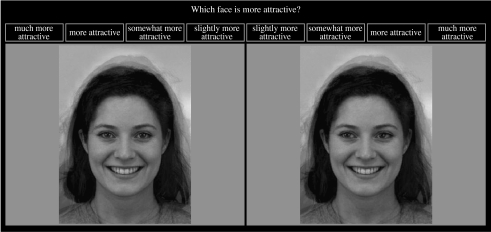
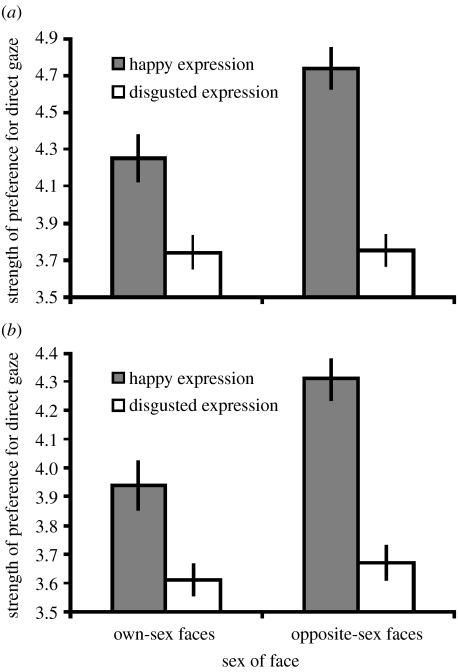
Many studies have investigated the physical cues that influence face preferences. By contrast, relatively few studies have investigated the effects of facial cues to the direction and valence of others' social interest (i.e. gaze direction and facial expressions) on face preferences. Here we found that participants demonstrated stronger preferences for direct gaze when judging the attractiveness of happy faces than that of disgusted faces, and that this effect of expression on the strength of attraction to direct gaze was particularly pronounced for judgements of opposite-sex faces (study 1). By contrast, no such opposite-sex bias in preferences for direct gaze was observed when participants judged the same faces for likeability (study 2). Collectively, these findings for a context-sensitive opposite-sex bias in preferences for perceiver-directed smiles, but not perceiver-directed disgust, suggest gaze preference functions, at least in part, to facilitate efficient allocation of mating effort, and evince adaptive design in the perceptual mechanisms that underpin face preferences.
Figures
References
-
- Adams R.B, Jr, Kleck R.E. Perceived gaze direction and the processing of facial displays of emotion. Psychol. Sci. 2003;141:644–647. doi:10.1046/j.0956-7976.2003.psci_1479.x - DOI - PubMed
-
- Clark, A. P. 2005 Cues of receptivity influence judgements of attractiveness. Paper presented at the Annual Meeting of the International Human Behavior and Evolution Society, Austin, Texas, June 2005
-
- Conway C.A, Jones B.C, DeBruine L.M, Welling L.L.M, Law Smith M.J, Perrett D.I, Sharp M, Al-Dujaili E.A.S. Salience of emotional displays of danger and contagion in faces is enhanced when progesterone levels are raised. Horm. Behav. 2007;51:202–206. doi:10.1016/j.yhbeh.2006.10.002 - DOI - PubMed
-
- DeBruine L.M. Facial resemblance increases the attractiveness of same-sex faces more than other-sex faces. Proc. R. Soc. B. 2004;271:2085–2090. doi:10.1098/rspb.2004.2824 - DOI - PMC - PubMed
-
- DeBruine L.M. Trustworthy but not lust-worthy: context-specific effects of facial resemblance. Proc. R. Soc. B. 2005;272:919–922. doi:10.1098/rspb.2004.3003 - DOI - PMC - PubMed
Publication types
MeSH terms
LinkOut - more resources
Full Text Sources
