


PairsDB atlas of protein sequence space
- PMID: 17986464
- PMCID: PMC2238971
- DOI: 10.1093/nar/gkm879
PairsDB atlas of protein sequence space
Abstract
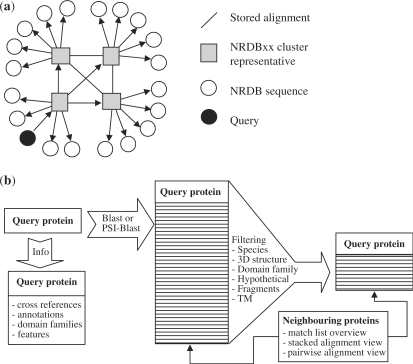
Sequence similarity/database searching is a cornerstone of molecular biology. PairsDB is a database intended to make exploring protein sequences and their similarity relationships quick and easy. Behind PairsDB is a comprehensive collection of protein sequences and BLAST and PSI-BLAST alignments between them. Instead of running BLAST or PSI-BLAST individually on each request, results are retrieved instantaneously from a database of pre-computed alignments. Filtering options allow you to find a set of sequences satisfying a set of criteria-for example, all human proteins with solved structure and without transmembrane segments. PairsDB is continually updated and covers all sequences in Uniprot. The data is stored in a MySQL relational database. Data files will be made available for download at ftp://nic.funet.fi/pub/sci/molbio. PairsDB can also be accessed interactively at http://pairsdb.csc.fi. PairsDB data is a valuable platform to build various downstream automated analysis pipelines. For example, the graph of all-against-all similarity relationships is the starting point for clustering protein families, delineating domains, improving alignment accuracy by consistency measures, and defining orthologous genes. Moreover, query-anchored stacked sequence alignments, profiles and consensus sequences are useful in studies of sequence conservation patterns for clues about possible functional sites.
Figures
References
-
- Promponas VJ, Enright AJ, Tsoka S, Kreil D, Leroy C, Hamodrakas S, Sander C, Ouzounis CA. CAST: an iterative algorithm for the complexity analysis of sequence tracts. Complexity analysis of sequence tracts. Bioinformatics. 2000;16:915–922. - PubMed
-
- Krogh A, Larsson B, von Heijne G, Sonnhammer EL. Predicting transmembrane protein topology with a hidden Markov model: application to complete genomes. J. Mol. Biol. 2001;305:567–580. - PubMed
-
- Lupas A, van Dyke M, Stock J. Predicting coiled coils from protein sequences. Science. 1991;252:1162–1164. - PubMed
-
- Heger A, Holm L. Exhaustive enumeration of protein domain families. J. Mol. Biol. 2003;328:749–767. - PubMed
Publication types
MeSH terms
Grants and funding
LinkOut - more resources
Full Text Sources
Research Materials
