Controlled Clinical Trial
. 2008 May;33(6):1239-51.
doi: 10.1038/sj.npp.1301528. Epub 2007 Nov 7.

Mechanisms of dopaminergic and serotonergic neurotransmission in Tourette syndrome: clues from an in vivo neurochemistry study with PET

Affiliations
Controlled Clinical Trial

Mechanisms of dopaminergic and serotonergic neurotransmission in Tourette syndrome: clues from an in vivo neurochemistry study with PET

Dean F Wong et al. Neuropsychopharmacology. 2008 May.

Abstract

Tourette syndrome (TS) is a neuropsychiatric disorder with childhood onset characterized by motor and phonic tics. Obsessive-compulsive disorder (OCD) is often concomitant with TS. Dysfunctional tonic and phasic dopamine (DA) and serotonin (5-HT) metabolism may play a role in the pathophysiology of TS. We simultaneously measured the density, affinity, and brain distribution of dopamine D2 receptors (D2-R's), dopamine transporter binding potential (BP), and amphetamine-induced dopamine release (DA(rel)) in 14 adults with TS and 10 normal adult controls. We also measured the brain distribution and BP of serotonin 5-HT2A receptors (5-HT2AR), and serotonin transporter (SERT) BP, in 11 subjects with TS and 10 normal control subjects. As compared with controls, DA rel was significantly increased in the ventral striatum among subjects with TS. Adults with TS+OCD exhibited a significant D(2)-R increase in left ventral striatum. SERT BP in midbrain and caudate/putamen was significantly increased in adults with TS (TS+OCD and TS-OCD). In three subjects with TS+OCD, in whom D2-R, 5-HT2AR, and SERT were measured within a 12-month period, there was a weakly significant elevation of DA rel and 5-HT2A BP, when compared with TS-OCD subjects and normal controls. The current study confirms, with a larger sample size and higher resolution PET scanning, our earlier report that elevated DA rel is a primary defect in TS. The finding of decreased SERT BP, and the possible elevation in 5-HT2AR in individuals with TS who had increased DA rel, suggest a condition of increased phasic DA rel modulated by low 5-HT in concomitant OCD.


Figures

Figure 1
Figure 1. Dopamine Receptor Bmax and KD in Subjects with Tourette Syndrome and Normal Controls
Receptor density (Bmax)and affinity (KD)were measured using the Transient Equilibrium Method (TEM; Farde et al, 1989), in subjects with TS and normal controls. The TEM method showed significant contrasts for Bmax and KD in the putamen, indicated by the double asterices ventral striatum. We also see weakly significant contrasts in the ventral striatum, indicated by the single asterices.
Figure 2
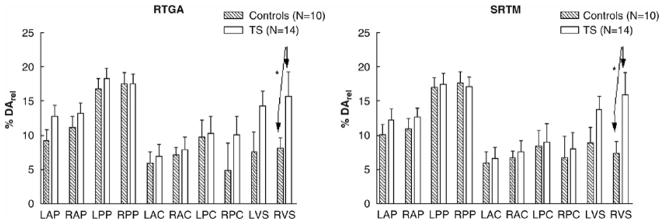
Figure 2. DArel in Subjects with Tourette Syndrome and Normal Controls by the SRTM and RTGA Methods
Dopamine release (DArel) is calculated using 2 mathematical modeling methods: the simplified reference tissue method (SRTM) (Lammerstma and Hume, 1996), and the reference tissue graphical analysis (RTGA) (Logan et al, 1996). Both methods demonstrate a significant elevation (approximately 50%) of DArel in the left and right ventral striatum, in subjects with Tourette syndrome (TS), as compared with normal controls. (Brackets indicate significant contrasts; p < 0.05.)
Figure 3
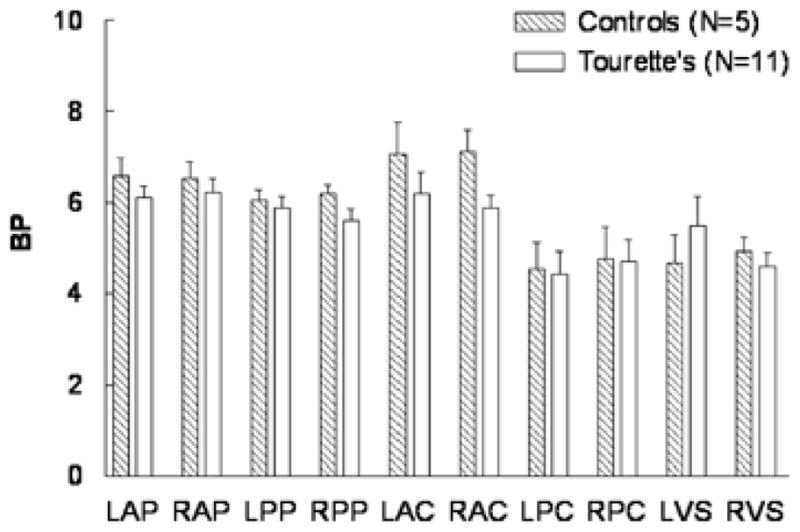
Figure 3. DAT Binding Potential in Subjects with Tourette Syndrome and Healthy Controls
No significant differences were seen in measurements of dopamine transporter (DAT) binding potential between subjects with Tourette syndrome (TS), as compared with normal controls, in any brain region (p>0.05).
Figure 4
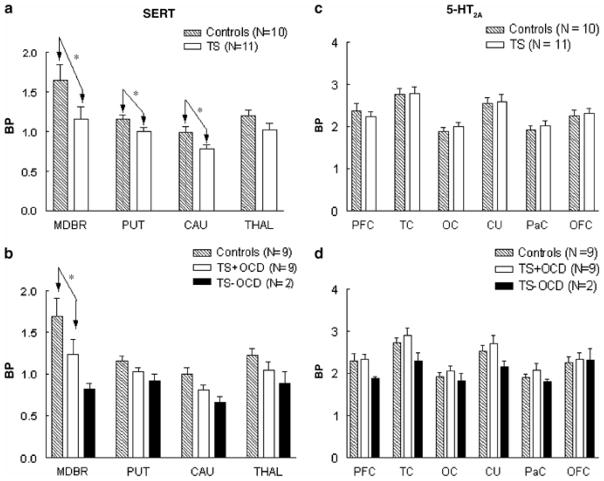
Figure 4. SERT and 5HT2AR Binding Potentials (BPs) in TS+OCD and TS−OCD Subjects, and Normal Controls
Panel A: Significant reductions (p < 0.05) were seen in serotonin transporter (SERT) BP in the midbrain, caudate, and putamen of subjects with Tourette syndrome (TS), when compared with normal controls. Panel C: No significant differences were seen in serotonin receptor (5-HT2AR) BP between TS and normal controls (p > 0.05). Panel B: When grouped by OCD status, the TS+OCD groups displayed significant decreases in SERT BP in midbrain, as compared with normal controls (p < 0.05). Panel D: When grouped by OCD status, TS+OCD subjects showed slightly higher 5-HT2A binding, but these results were not significant (p>0.1).
Figure 5
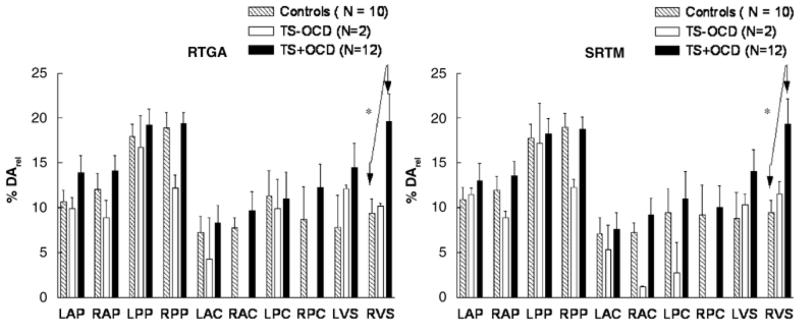
Figure 5. AMP-Induced DArel in TS+OCD and TS−OCD Subjects and Normal Controls, by the SRTM and RTGA Methods
Amphetamine (AMP)-induced dopamine release (DArel) was measured by the simplified reference tissue method (SRTM) (Lammerstma and Hume, 1996), and the reference tissue graphical analysis (RTGA) (Logan et al, 1996) in subjects with Tourette syndrome (TS), with and without obsessive-compulsive disorder (OCD), and normal controls. A significant increase in DArel was seen in TS+OCD, as compared with normal controls (p<0.05). Both analysis methods confirm the concept that AMP-induced DArel in the left ventral striatum is greater in TS+OCD > TS−OCD > normal controls.
Figure 6
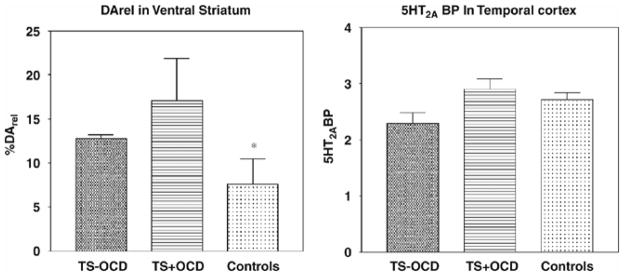
Figure 6
Elevation of AMP-Induced DArel and 5-HT2ARbinding potential (BP) in TS+OCD and TS−OCD Subjects, and Normal Controls A subset of subjects with Tourette syndrome and OCD (TS+OCD), who completed all dopamine and serotonin PET scans, were compared with the TS−OCD subjects and normal controls from the same study. In the 3 TS+OCD subjects, there was a significant elevation of DArel, as compared with normal controls (p=0.05) (*), and a significant elevation of 5-HT2AR BP, as compared with the TS−OCD subjects (p=0.05) (*).
Figure 7
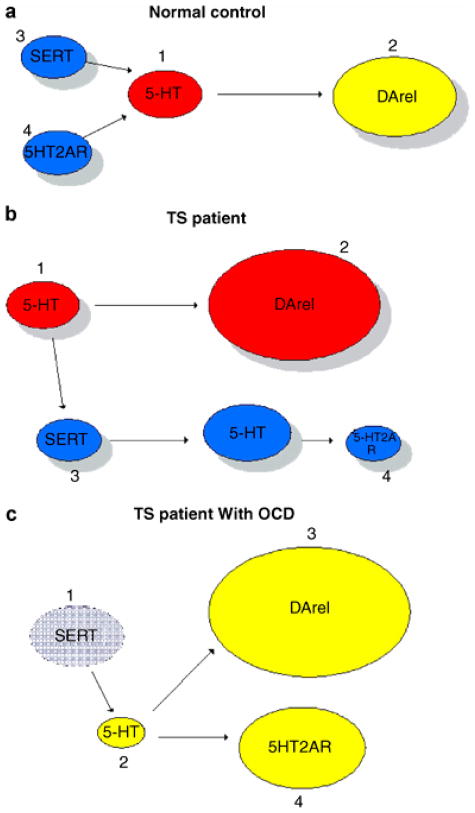
Figure 7. DA and 5-HT Dynamics in TS+OCD and TS−OCD
7A: Normal Control) In a healthy brain, 5-HT (1) levels can downregulate DArel (2). In turn, 5-HT can be regulated by SERT (3). The brain can regulate 5HT levels by changing SERT(3) and modulate the impact of 5-HT by altering 5HT2AR (4) levels. These compensatory mechanisms are altered in TS and TS with OCD, as shown below. B) TS patient (No OCD) In a patient with TS, we propose that the primary deficit is diminished 5HT levels (1) resulting in an upregulation of DArel (2). In response to diminished 5HT, SERT levels (2) decrease to compensate, allowing more 5HT to remain in the synapse, the higher intrasynaptic 5-HT in turn leads to a decrease in 5HT2AR numbers (4). C) TS Patient with OCD In a patient with both TS and OCD, SERT (1) fails to compensate, and as a result, there are substantially lower levels of 5HT(2). As a result, there is an even greater hyper-responsive DArel (3). Additionally, because of the lowered 5HT, there is a compensatory increase in 5HT2AR number. (4)

References

    1. American Psychiatric Association. Diagnostic and statistical manual of mental disorders. 4. American Psychiatric Association; Washington, DC: 2004. text revision (DSM-IV-TM™)
    1. Baumann MH, Danos P, Krell D, Diekmann S, Leschinger A, Stauch R, et al. Reduced volume of limbic system-affiliated basal ganglia in mood disorders: preliminary data from a postmortem study. Journal of Neuropsychiatry & Clinical Neuroscience. 1999;11:71–78. - PubMed
    1. Brasic JR, Musachio JL, Zhou Y, Cascella N, Nestadt G, Osman M. Neuropsychiatric assessment of [123I]iodo-3-(2 azetidinylmethoxy)pyridine. Movement Disorders. 2001a;16(Suppl 1):S54. [abstract]
    1. Brasic JR, Wong D, Eroglu A. PET scanning in autism spectrum disorders. eMedicine Journal. 2006b;7(2)
    1. Bruun RD, Budman CL. Risperidone as a treatment for Tourette’s syndrome. Journal of Clinical Psychiatry. 1996;57:29–31. - PubMed

Publication types

MeSH terms