


Factors affecting physicians' responses to patients' requests for antidepressants: focus group study
- PMID: 17987348
- PMCID: PMC2173928
- DOI: 10.1007/s11606-007-0441-8
Factors affecting physicians' responses to patients' requests for antidepressants: focus group study
Abstract
Background: The ways in which patients' requests for antidepressants affect physicians' prescribing behavior are poorly understood.
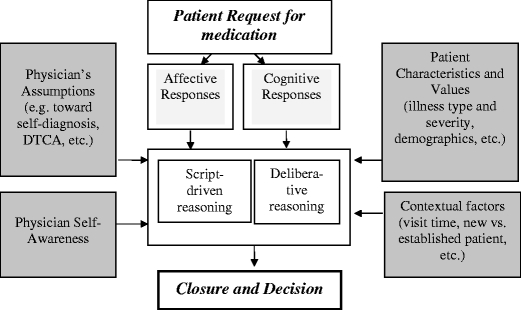
Objective: To describe physicians' affective and cognitive responses to standardized patients' (SPs) requests for antidepressants, as well as the attitudinal and contextual factors influencing prescribing behavior.
Design: Focus group interviews and brief demographic questionnaires.
Participants: Twenty-two primary care physicians in 6 focus groups; all had participated in a prior RCT of the influence of patients' requests on physicians' prescribing.
Measurements: Iterative review of interview transcripts, involving qualitative coding and thematic analysis.
Results: Physicians participating in the focus groups were frequently unaware of and denied the degree to which their thinking was biased by patient requests, but were able to recognize such biases after facilitated reflection. Common affective responses included annoyance and empathy. Common cognitive reactions resulted in further diagnostic inquiry or in acquiescing to the patient's demands to save time or build the patient-clinician relationship. Patients' requests for medication prompted the participants to err on the side of overtreating versus careful review of clinical indications. Lack of time and participants' attitudes--toward the role of the patient and the pharmaceutical ads--also influenced their responses, prompting them to interpret patient requests as diagnostic clues or opportunities for efficiency.
Conclusions: This study provides a taxonomy of affective and cognitive responses to patients' requests for medications and the underlying attitudes and contextual factors influencing them. Improved capacity for moment-to-moment self-awareness during clinical reasoning processes may increase the appropriateness of prescribing.
Figures
References
-
- {'text': '', 'ref_index': 1, 'ids': [{'type': 'DOI', 'value': '10.1001/jama.293.16.2030', 'is_inner': False, 'url': 'https://doi.org/10.1001/jama.293.16.2030'}, {'type': 'PubMed', 'value': '15855439', 'is_inner': True, 'url': 'https://pubmed.ncbi.nlm.nih.gov/15855439/'}]}
- Hollon M. Direct to consumer advertising: a haphazard approach to health promotion. JAMA. 2005;293:2030–3. - PubMed
-
- {'text': '', 'ref_index': 1, 'ids': [{'type': 'DOI', 'value': '10.1001/jama.281.4.380', 'is_inner': False, 'url': 'https://doi.org/10.1001/jama.281.4.380'}, {'type': 'PubMed', 'value': '9929095', 'is_inner': True, 'url': 'https://pubmed.ncbi.nlm.nih.gov/9929095/'}]}
- Holmer AF. Direct-to-consumer prescription drug advertising builds bridges between patient and physicians. JAMA. 1999;281:380–2. - PubMed
-
- {'text': '', 'ref_index': 1, 'ids': [{'type': 'PubMed', 'value': '9420585', 'is_inner': True, 'url': 'https://pubmed.ncbi.nlm.nih.gov/9420585/'}]}
- Lipsky MS, Taylor CA. The opinions and experiences of family physicians regarding direct-to-consumer advertising. J Fam Pract. 1997;45:495–9. - PubMed
-
- {'text': '', 'ref_index': 1, 'ids': [{'type': 'PubMed', 'value': '11813459', 'is_inner': True, 'url': 'https://pubmed.ncbi.nlm.nih.gov/11813459/'}]}
- Young D. Studies show drug ads influence prescription decisions, drug costs. Am J Health Syst Pharm. 2002;59:14, 16. - PubMed
-
- {'text': '', 'ref_index': 1, 'ids': [{'type': 'DOI', 'value': '10.1371/journal.pmed.0030145', 'is_inner': False, 'url': 'https://doi.org/10.1371/journal.pmed.0030145'}, {'type': 'PMC', 'value': 'PMC1420390', 'is_inner': False, 'url': 'https://pmc.ncbi.nlm.nih.gov/articles/PMC1420390/'}, {'type': 'PubMed', 'value': '16563041', 'is_inner': True, 'url': 'https://pubmed.ncbi.nlm.nih.gov/16563041/'}]}
- Almasi EA, Stafford RS, Kravitz RL, Mansfield PR. What are the public health effects of direct-to-consumer drug advertising? PLoS Med. 2006;3:e145. - PMC - PubMed
Publication types
MeSH terms
Substances
Grants and funding
LinkOut - more resources
Full Text Sources
Medical
