


Target selection for visually guided reaching in macaque
- PMID: 17989239
- PMCID: PMC2365509
- DOI: 10.1152/jn.01106.2007
Target selection for visually guided reaching in macaque
Abstract
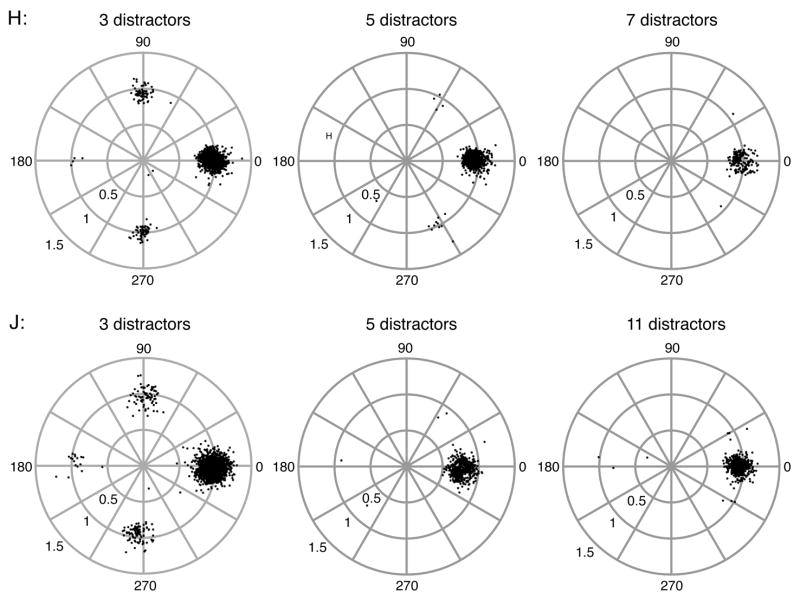
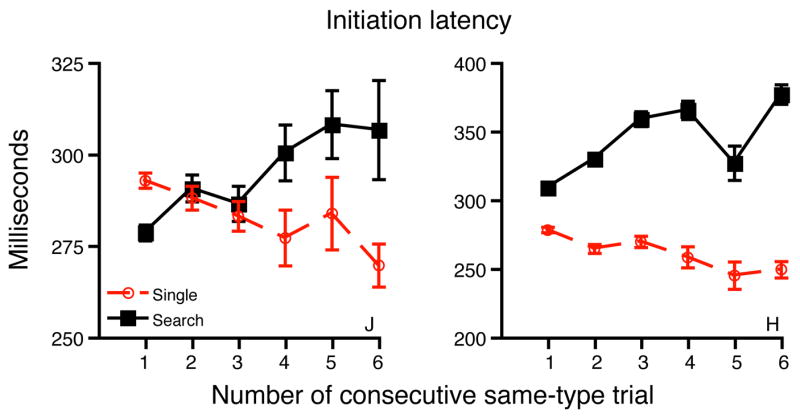
We examined target selection for visually guided reaching in monkeys using a visual search task in which an odd-colored target was presented with distractors. The colors of the target and distractors were randomly switched in each trial between red and green, and the number of distractors was varied. Previous studies of saccades and attention have shown that target selection in this task is easier when a greater number of homogenous distractors is present. We found that monkeys made fewer reaches to distractors and that reaches to the target were completed more quickly when a greater number of homogenous distractors was present. When the target was presented in a sparse array of distractors, reaches had longer movement durations and greater trajectory curvature. Reaching errors were directed more often to a distractor adjacent to the target, suggesting a spatially coarse-to-fine progression during target selection. Reaches were also influenced by the properties of trials in the recent past. When the colors of the target and distractors remained the same from trial to trial rather than switching, reaches were completed more quickly and accurately, indicating that color priming across trials facilitates target selection. Moreover, when difficult search trials were randomly intermixed with easier trials without distractors, reach latencies were influenced by the difficulty of previous trials, indicating that motor initiation strategies are gradually adjusted based on accumulated experience. Overall, these results are consistent with reaching results in humans, indicating that the monkey provides a sound model for understanding the neural underpinnings of reach target selection.
Figures




References
-
- Andersen RA, Essick GK, Siegel RM. Encoding of spatial location by posterior parietal neurons. Science. 1985;230:456–458. - PubMed
-
- Arai K, McPeek RM, Keller EL. Properties of saccadic responses in monkey when multiple competing visual stimuli are present. J Neurophysiol. 2004;91:890–900. - PubMed
-
- Ballard D, Hayhoe M, Pook P, Rao R. Deictic codes for the embodiment of cognition. Behav Brain Sci. 1997;20:723–767. - PubMed
-
- Bichot NP, Schall JD. Effects of similarity and history on neural mechanisms of visual selection. Nat Neurosci. 1999;2:549–554. - PubMed
Publication types
MeSH terms
Grants and funding
LinkOut - more resources
Full Text Sources
Miscellaneous
