


Increased expression of Toll-like receptor (TLR) 2 and TLR4 in the colonic mucosa of children with inflammatory bowel disease
- PMID: 17991289
- PMCID: PMC2276924
- DOI: 10.1111/j.1365-2249.2007.03531.x
Increased expression of Toll-like receptor (TLR) 2 and TLR4 in the colonic mucosa of children with inflammatory bowel disease
Abstract
Inflammatory bowel disease (IBD) may result from exaggerated stimulation of the mucosal immune system by luminal bacterial flora. Bacterial products are recognized by pattern recognition receptors such as Toll-like receptors (TLRs), which are key regulators of the innate immune system. Therefore, the expression of TLR2, TLR3 and TLR4 in colonic biopsy samples taken from children with active IBD were studied and compared to controls. Colonic biopsy samples were collected from macroscopically inflamed and non-inflamed regions of the mucosa of 12 children with freshly diagnosed IBD (fdIBD) and 23 children with relapsed IBD (rIBD). Specimens were also obtained from eight controls. TLR2, TLR3 and TLR4 mRNA expression and protein levels were determined by real-time reverse transcription polymerase chain reaction (RT-PCR) and Western blot. We found higher TLR2 and TLR4 mRNA and protein levels in the inflamed colonic mucosa of children with fdIBD and rIBD compared to controls. In the non-inflamed colonic mucosa of children with fdIBD and rIBD, TLR2 and TLR4 mRNA and protein levels were similar to controls. TLR2 and TLR4 mRNA and protein levels also did not differ between children with fdIBD or rIBD in either inflamed or non-inflamed colonic mucosa. TLR3 mRNA expression and protein levels were similar in all groups studied. Our results of increased levels of TLR2 and TLR4 in the inflamed colonic mucosa of children with IBD confirm the hypothesis that innate immunity has an important role in the pathogenesis of this disease.
Figures
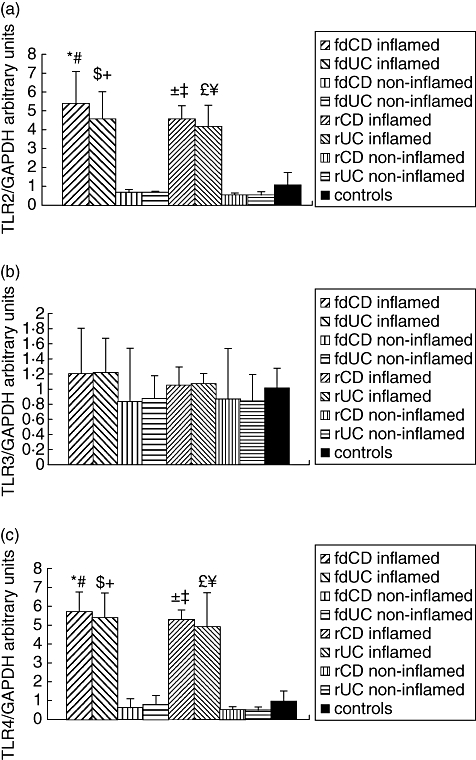
 ) Freshly diagnosed Crohn.s disease (fdCD) inflamed versus fdCD non-inflamed (P < 0·001), () fdCD inflamed versus controls (P < 0·01), (
 ) freshly diagnosed ulcerative colitis (fdUC) inflamed versus fdUC non-inflamed (P < 0·05), () fdUC inflamed versus controls (P < 0·05), (
 ) rCD inflamed versus rCD non-inflamed (P < 0·0001), (
 ) rCD inflamed versus controls (P < 0·01), (
 ) rUC inflamed versus rUC non-inflamed (P < 0·001), (
 ) rUC inflamed versus controls (P < 0·01).
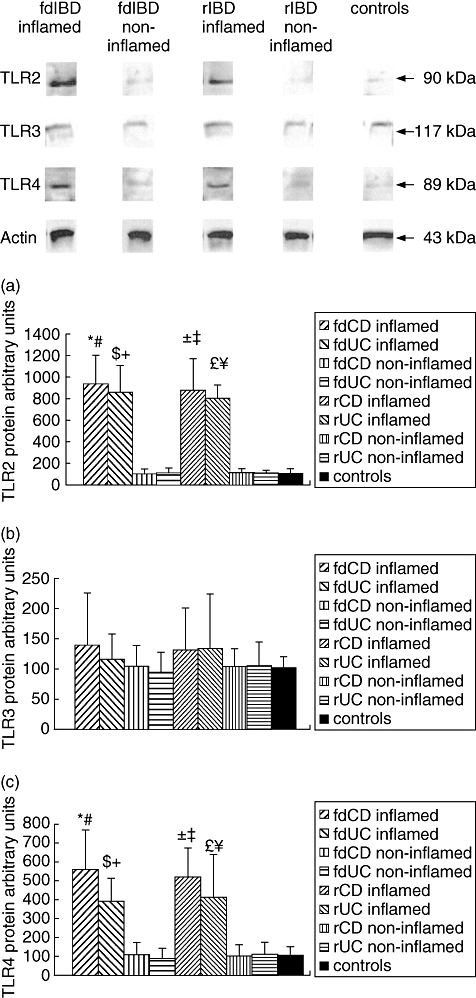 ) Freshly diagnosed Crohn.s disease (fdCD) inflamed versus fdCD non-inflamed (P < 0·01), () fdCD inflamed versus controls (P < 0·001), (
 ) freshly diagnosed ulcerative colitis (fdUC) inflamed versus fdUC non-inflamed (P < 0·05), () fdUC inflamed versus controls (P < 0·01), () rCD inflamed versus rCD non-inflamed (P < 0·0001), () rCD inflamed versus. controls (P < 0·001), () UC inflamed versus rUC non-inflamed (P < 0·001), () rUC inflamed versus controls (P < 0·001).
References
-
- Rogler G. Update in inflammatory bowel disease pathogenesis. Curr Opin Gastroenterol. 2004;20:311–17. - PubMed
-
- Schultsz C, Van Den Berg FM, Ten Kate FW, et al. The intestinal mucus layer from patients with inflammatory bowel disease harbors high numbers of bacteria compared with controls. Gastroenterology. 1999;117:1089–97. - PubMed
-
- Mayer L, Eisenhardt D, Salomon P, et al. Expression of class II molecules on intestinal epithelial cells in humans. Differences between normal and inflammatory bowel disease. Gastroenterology. 1991;100:3–12. - PubMed
Publication types
MeSH terms
Substances
LinkOut - more resources
Full Text Sources
