Randomized Controlled Trial
. 2008 Jan 15;586(2):495-514.
doi: 10.1113/jphysiol.2007.142059. Epub 2007 Nov 8.

Inhibitory circuits and the nature of their interactions in the human motor cortex a pharmacological TMS study

Affiliations
Randomized Controlled Trial

Inhibitory circuits and the nature of their interactions in the human motor cortex a pharmacological TMS study

J Florian et al. J Physiol. .

Abstract

Inhibitory circuits are crucial in modulating corticospinal output in the primary motor cortex (M1). Relatively little is known about how these inhibitory circuits interact. Here we measured three forms of inhibition in M1 by paired-pulse transcranial magnetic stimulation: short-interval intracortical inhibition (SICI), long-interval intracortical inhibition (LICI) and short-interval interhemispheric inhibition (SIHI). We specifically tested their interactions under pharmacological challenge with a single oral dose of diazepam, a positive allosteric modulator of the gamma-aminobutyric acid type A receptor (GABA A R), or baclofen, a specific agonist at the GABA type B receptor (GABA B R). Motor evoked potentials were recorded bilaterally from the first dorsal interosseous muscle in eight right-handed healthy volunteers. Diazepam enhanced SICI, and baclofen produced a trend towards enhanced LICI, corroborating the view that SICI reflects inhibition mediated by the GABA A R, and LICI very likely reflects inhibition mediated by the GABA B R. The pharmacology of SIHI was inconclusive and warrants further investigation. Findings strongly suggest that SICI, LICI and SIHI recruit three distinct inhibitory circuits in the human M1. The interactions between SIHI and SICI, LICI and SIHI, and LICI and SICI were all negative, that is SIHI suppressed SICI, and LICI suppressed both SIHI and SICI. Diazepam partially restored SICI in the presence of LICI, while all other interactions remained unaffected by diazepam or baclofen. It will be argued that the negative interactions between SIHI and SICI, LICI and SIHI, and LICI and SICI are most likely due to presynaptic GABA B R-mediated autoinhibition.


Figures
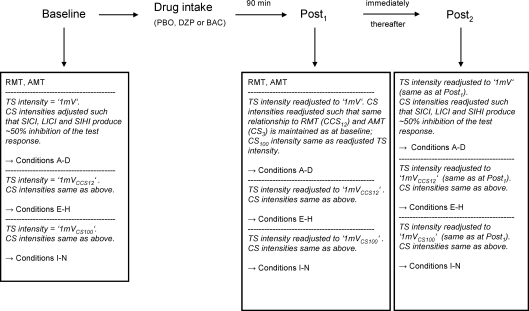
Figure 1
Figure 1. Time line of experiments
After baseline measurements subjects were given a single oral dose of either PBO, DZP or BAC. Note that for measurements of drug effects on SICI, LICI and SIHI alone at the Post1 measurement, CS intensities were readjusted differently as compared to at the Post2 measurement for evaluation of drug effects on the interactions SIHI–SICI, LICI–SIHI and LICI–SICI. For details also see Methods.
Figure 2
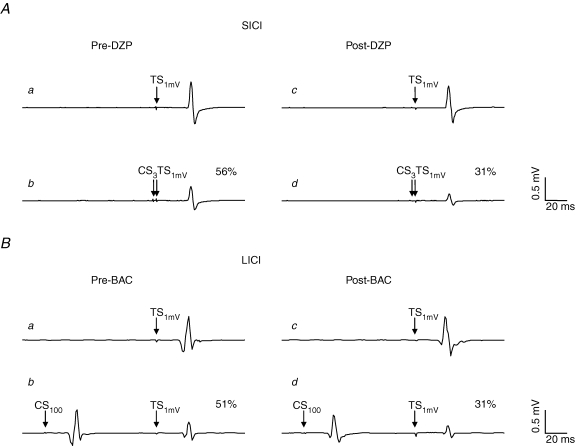
Figure 2. Effects of DZP on SICI and BAC on LICI in representative subjects
Each trace represents the average of eight trials. All traces are recordings from the right FDI muscle. A, effect of DZP on SICI. a, response pre-DZP to TS with intensity ‘1mV’ (TS1mV) alone (condition A in Table 1). b, response pre-DZP to the CS3–TS1mV pulse pair (condition B in Table 1): the MEP amplitude is suppressed to 56% of its unconditioned value (SICI). c and d, DZP increased SICI significantly, resulting in an MEP amplitude in the conditioned situation (d) of only 31% of the unconditioned situation (c). B, effect of BAC on LICI. a, response pre-BAC to TS1mV alone. b, response pre-BAC to the CS100–TS1mV pulse pair (condition D in Table 1): the MEP amplitude is suppressed to 51% of its unconditioned value (LICI). c and d, BAC increased LICI significantly, resulting in an MEP amplitude in the conditioned situation (d) of only 31% of the unconditioned situation (c). Note that MEP amplitudes to TS1mV alone post-drug intake (c) were matched to those pre-drug intake (a) in A and B.
Figure 3
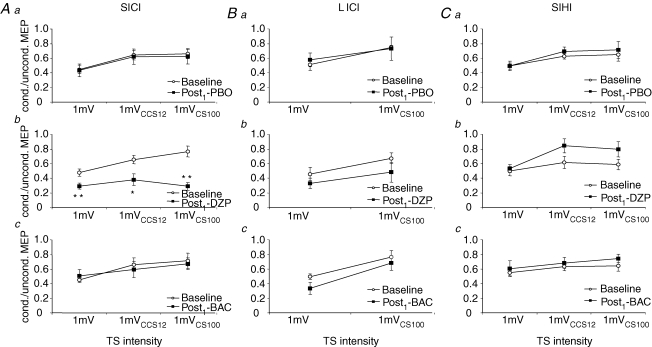
Figure 3. Effects of DZP and BAC on SICI, LICI and SIHI
Data are from eight subjects. Aa–c, effects of PBO (Aa), DZP (Ab) and BAC (Ac) on SICI. SICI was quantified by the ratio of the conditioned to the unconditioned MEP amplitude, i.e. conditions B/A for TS1mV, F/E for TS1mVCCS12 and J/I for TS1mVCS100. DZP increased SICI significantly at all TS intensities (Student's paired two-tailed t tests; *P < 0.05; **P < 0.01). Note that SICI was significantly less at the TS intensities ‘1mVCCS12’ and ‘1mVCS100’ than at the TS intensity ‘1mV’ pre- (P < 0.001 each) but not post-DZP intake (P > 0.1 for SICI at TS intensity ‘1mV’versus at TS intensity ‘1mVCCS12’; P > 0.9 for SICI at TS intensity ‘1mV’versus at TS intensity ‘1mVCS100’). Ba–c, effects of PBO (Ba), DZP (Bb) and BAC (Bc) on LICI. LICI was quantified as the ratio of MEP amplitudes in conditions D/A for TS1mV and L/I for TS1mVCS100. BAC produced a trend towards enhanced LICI at the TS intensity ‘1mV’ (Student's paired two-tailed t test; P = 0.09), but had no effect at the higher TS intensity ‘1mVCS100’. Ca–c, effects of PBO (Ca), DZP (Cb) and BAC (Cc) on SIHI. SIHI was quantified as the ratio of MEP amplitudes in conditions C/A for TS1mV, G/E for TS1mVCCS12 and K/I for TS1mVCS100. DZP produced a trend towards less SIHI at the higher TS intensities ‘1mVCCS12’ and ‘1mVCS100’ (Student's paired two-tailed t tests; P = 0.07 and P = 0.18, respectively), but had no effect at the TS intensity ‘1mV’. Note that all data are derived from the Post1 measurement. Error bars, s.e.m.
Figure 4
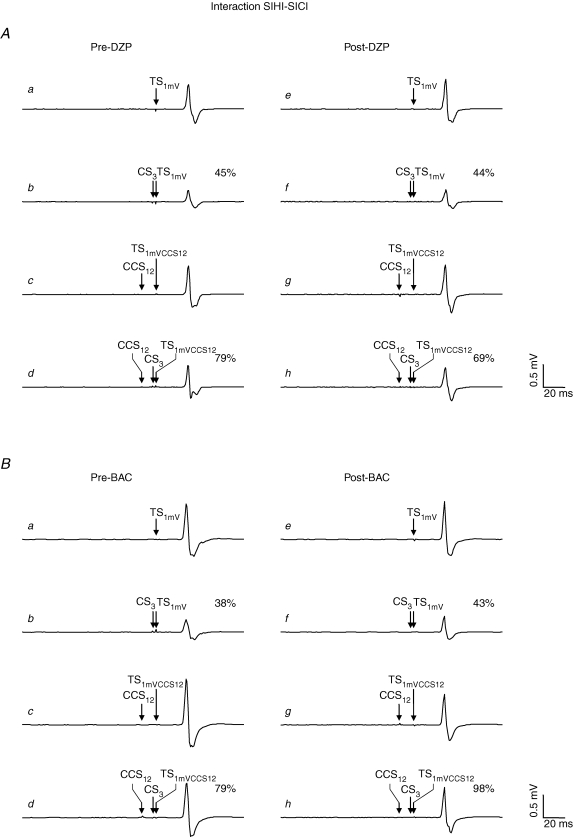
Figure 4. Effects of DZP and BAC on the interaction SIHI–SICI in representative subjects
Each trace represents the average of eight trials. All traces are recordings from the right FDI muscle. A, effect of DZP on the interaction SIHI–SICI. a, response pre-DZP to TS1mV alone (condition A in Table 1). b, response pre-DZP to the CS3–TS1mV pulse pair (condition B in Table 1) with suppression of the test response to 45% (SICI). c, response pre-DZP to the TS in the presence of CCS12 (condition G in Table 1): the increased test stimulus intensity ‘1mVCCS12’ compensated for the CCS12-induced SIHI of the test response, resulting in a test MEP amplitude of the CCS12–TS1mVCCS12 pulse pair of comparable size as in the unconditioned situation (a). d, triple pulse stimulation pre-DZP (condition H in Table 1): SICI in the presence of SIHI. The response to the CCS12–CS3–TS1mVCCS12 pulse triple is 79% of the CCS12–TS1mVCCS12 pulse pair (c), indicating less SICI in the presence of SIHI as compared to SICI alone matched for test MEP amplitude. eh, DZP did not change this negative interaction between SIHI and SICI. B, effect of BAC on the interaction SIHI–SICI. BAC did not change the interaction SIHI–SICI. Note that MEP amplitudes to TS1mV alone and CCS12–TS1mVCCS12 as well as the amount of SICI alone post-drug intake were matched to those pre-drug intake in A and B.
Figure 5
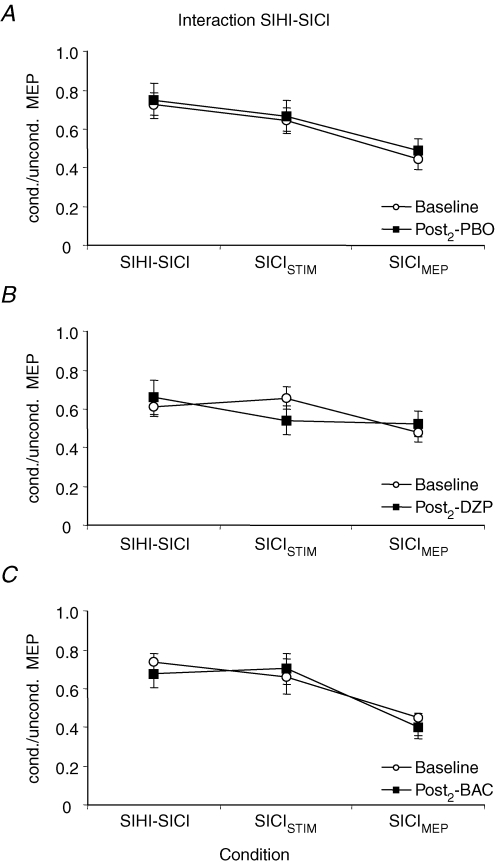
Figure 5. Effects of DZP and BAC on the interaction SIHI–SICI
Data are from eight subjects. AC, SICI in the absence of SIHI was quantified as the ratio of MEP amplitudes in conditions F/E (‘SICISTIM’) and B/A (‘SICIMEP’). SICI in the presence of SIHI was quantified as the ratio of MEP amplitudes in conditions H/G (‘SIHI–SICI’). SICI was significantly less in the presence of SIHI than in the absence of SIHI matched for test MEP amplitude (SICIMEP) in all three sessions (Student's paired two-tailed t test; P < 0.0001). SICI in the absence of SIHI was significantly less in the TS intensity-matched condition (SICISTIM) as compared to the test MEP amplitude-matched condition (SICIMEP) (Student's paired two-tailed t test; P < 0.0001). PBO, DZP and BAC had no effect on the interaction between SIHI and SICI. Note that all data are derived from the Post2 measurement where SICI and SIHI alone were readjusted to baseline after drug intake (see Methods and Fig. 1). Error bars, s.e.m.
Figure 6
Figure 6. Effects of DZP and BAC on the interaction LICI–SIHI in representative subjects
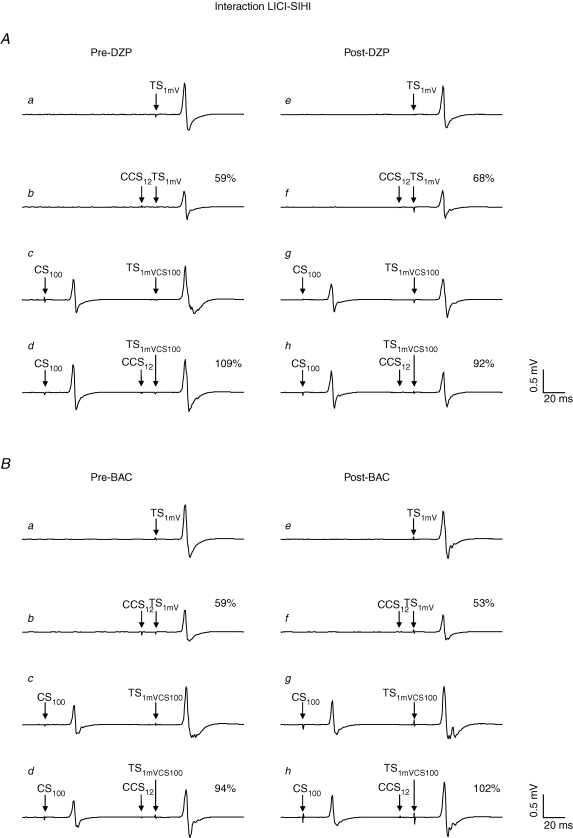
Each trace represents the average of eight trials. All traces are recordings from the right FDI muscle. A, effect of DZP on the interaction LICI–SIHI. a, response pre-DZP to TS1mV alone (condition A in Table 1). b, response pre-DZP to the CCS12–TS1mV pulse pair (condition C in Table 1) with suppression of the test response to 59% (SIHI). c, response pre-DZP to the TS in the presence of CS100 (condition L in Table 1): the increased test stimulus intensity ‘1mVCS100’ compensated for the CS100-induced LICI of the test response, resulting in a test MEP amplitude of the CS100–TS1mVCS100 pulse pair of comparable size as in the unconditioned situation (a). d, triple pulse stimulation pre-DZP (condition N in Table 1): SIHI in the presence of LICI. The response to the CS100–CCS12-TS1mVCS100 pulse triple is 109% of the CS100–TS1mVCS100 pulse pair (c), showing no longer SIHI but even some facilitation of the test response in the presence of LICI. eh, DZP did not change this negative interaction between LICI and SIHI. B, effect of BAC on the interaction LICI–SIHI. BAC did not change the interaction LICI–SIHI. Note that MEP amplitudes to TS1mV alone and CS100–TS1mVCS100 as well as the amount of SIHI alone post-drug intake were matched to those pre-drug intake in A and B.
Figure 7
Figure 7. Effects of DZP and BAC on the interaction LICI–SIHI
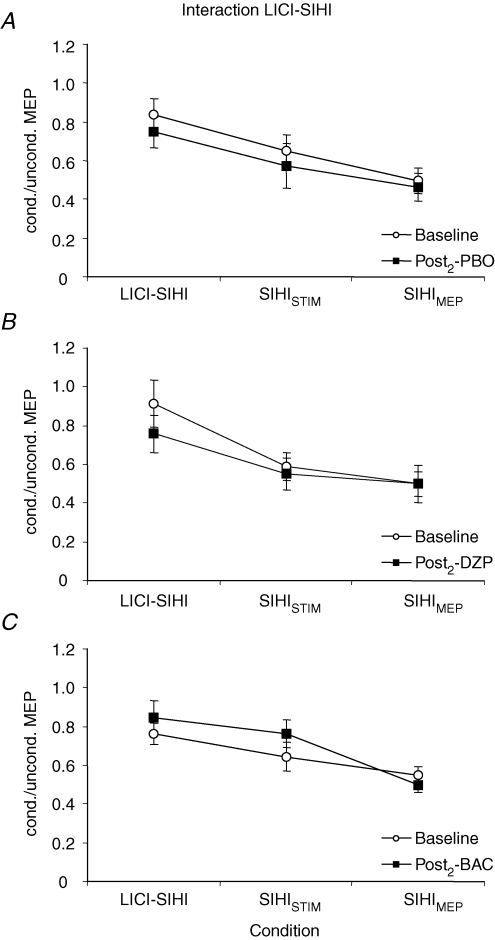
Data are from eight subjects. AC, SIHI in the absence of LICI was quantified as the ratio of MEP amplitudes in conditions K/I (‘SIHISTIM’) and C/A (‘SIHIMEP’). SIHI in the presence of LICI was quantified as the ratio of MEP amplitudes in conditions N/L (‘LICI–SIHI’). SIHI was significantly less in the presence of LICI than in the absence of LICI matched for TS intensity (SIHISTIM) and test MEP amplitude (SIHIMEP) in all three sessions (Student's paired two-tailed t tests; P < 0.0001). SIHI in the absence of LICI was significantly less in the TS intensity-matched condition (SIHISTIM) as compared to the test MEP amplitude-matched condition (SIHIMEP) (Student's paired two-tailed t test; P < 0.0001). PBO, DZP and BAC had no effect on the interaction between LICI and SIHI. Note that all data are derived from the Post2 measurement where SIHI and LICI alone were readjusted to baseline after drug intake (see Methods and Fig. 1). Error bars, s.e.m.
Figure 8
Figure 8. Effects of DZP and BAC on the interaction LICI–SICI in representative subjects
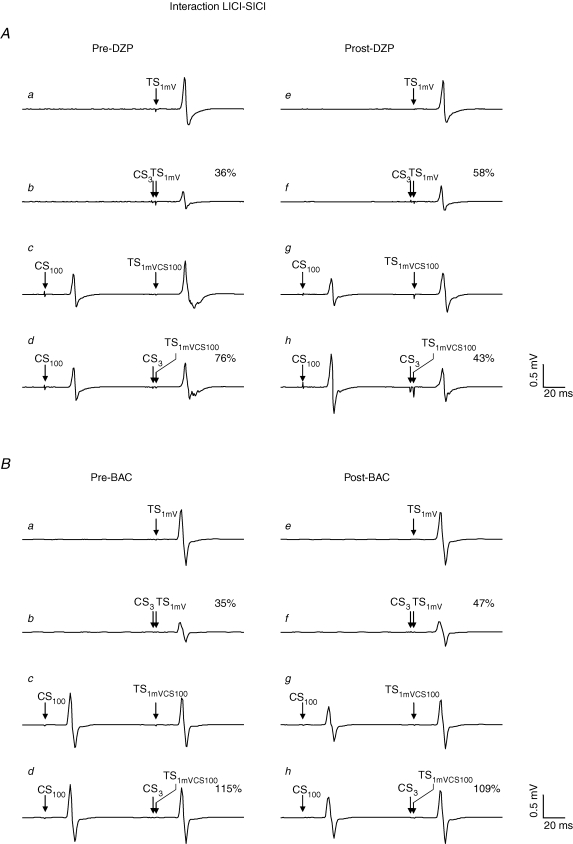
Each trace represents the average of eight trials. All traces are recordings from the right FDI muscle. A, effect of DZP on the interaction LICI–SICI. a, response pre-DZP to TS1mV alone (condition A in Table 1). b, response pre-DZP to the CS3–TS1mV pulse pair (condition B in Table 1) with suppression of the test response to 36% (SICI). c, response pre-DZP to the TS in the presence of CS100 (condition L in Table 1): the increased test stimulus intensity ‘1mVCS100’ compensated for the CS100 induced LICI of the test response, resulting in a test MEP amplitude of the CS100–TS1mVCS100 pulse pair of comparable size as in the unconditioned situation (a). d, triple pulse stimulation pre-DZP (condition M in Table 1): SICI in the presence of LICI. The response to the CS100–CS3-TS1mVCS100 pulse triple is 76% of the CS100–TS1mVCS100 pulse pair (c), indicating less SICI in the presence of LICI as compared to SICI alone matched for test MEP amplitude. eh, DZP reversed the negative interaction between LICI and SICI in this subject, resulting in more-pronounced SICI in the presence of LICI as compared to SICI in the absence of LICI matched for test MEP amplitude after administration of DZP. B, effect of BAC on the interaction LICI–SICI. On the contrary, BAC did not change the interaction LICI–SICI. Note that MEP amplitudes to TS1mV alone and CS100–TS1mVCS100 as well as the amount of SICI alone post-drug intake were matched to those pre-drug intake in A and B.
Figure 9
Figure 9. Effects of DZP and BAC on the interaction LICI–SICI
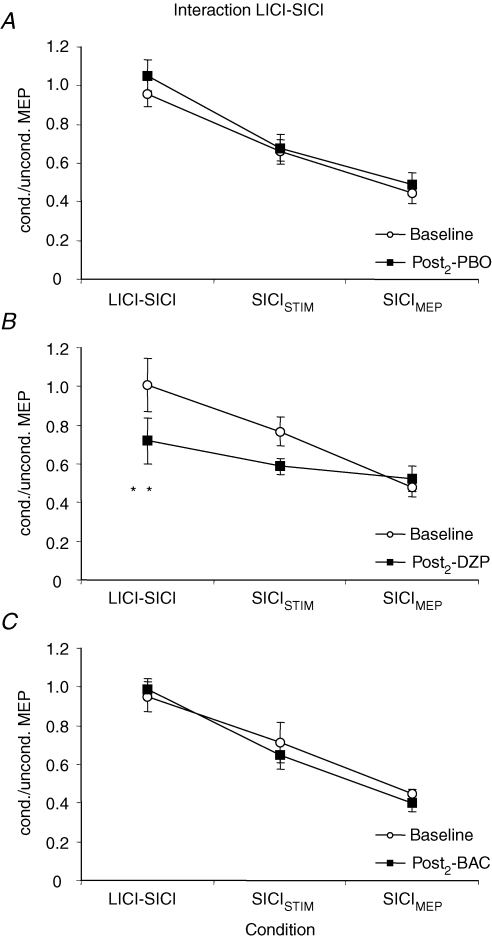
Data are from eight subjects. AC, SICI in the absence of LICI was quantified as the ratio of MEP amplitudes in conditions J/I (‘SICISTIM’) and B/A (‘SICIMEP’). SICI in the presence of LICI was quantified as the ratio of MEP amplitudes in conditions M/L (‘LICI–SICI’). SICI was significantly suppressed (in fact, it was almost completely blocked) in the presence of LICI when compared to SICI alone matched for TS intensity (‘SICISTIM’) and test MEP amplitude (‘SICIMEP’) (Student's paired two-tailed t tests; P < 0.001). SICI in the absence of LICI was significantly less in the TS intensity-matched condition (SICISTIM) as compared to the test MEP amplitude-matched condition (SICIMEP) (Student's paired two-tailed t test; P < 0.01). Whereas DZP significantly reinstated SICI in the presence of LICI (**P < 0.01; Student's paired two-tailed t test), PBO and BAC did not have any effect on the interaction between LICI and SICI. Note that all data are derived from the Post2 measurement where SICI and LICI alone were readjusted to baseline after drug intake (see Methods and Fig. 1). Error bars, s.e.m.

References

    1. Bettler B, Kaupmann K, Bowery N. GABAB receptors: drugs meet clones. Curr Opin Neurobiol. 1998;8:345–350. - PubMed
    1. Chen R. Interactions between inhibitory and excitatory circuits in the human motor cortex. Exp Brain Res. 2004;154:1–10. - PubMed
    1. Chen R, Yung D, Li JY. Organization of ipsilateral excitatory and inhibitory pathways in the human motor cortex. J Neurophysiol. 2003;89:1256–1264. - PubMed
    1. Chu J, Gunraj C, Chen R. Possible differences between the time courses of presynaptic and postsynaptic GABA(B) mediated inhibition in the human motor cortex. Exp Brain Res. 2007. in the press. - PubMed
    1. Daskalakis ZJ, Christensen BK, Fitzgerald PB, Roshan L, Chen R. The mechanisms of interhemispheric inhibition in the human motor cortex. J Physiol. 2002;543:317–326. - PMC - PubMed

Publication types

MeSH terms

LinkOut - more resources