


Early dexamethasone treatment for septic shock patients: a prospective randomized clinical trial
- PMID: 17992396
- PMCID: PMC11020550
- DOI: 10.1590/s1516-31802007000400009
Early dexamethasone treatment for septic shock patients: a prospective randomized clinical trial
Abstract
Context and objective: Sepsis and septic shock are very common conditions among critically ill patients that lead to multiple organ dysfunction syndrome (MODS) and death. Our purpose was to investigate the efficacy of early administration of dexamethasone for patients with septic shock, with the aim of halting the progression towards MODS and death.
Design and setting: Prospective, randomized, double-blind, single-center study, developed in a surgical intensive care unit at Hospital das Clínicas, Faculdade de Medicina da Universidade de São Paulo.
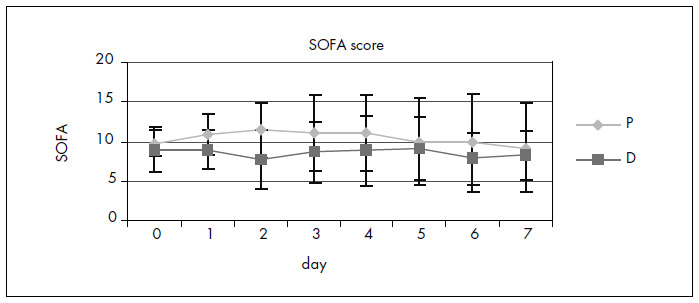
Methods: The study involved 29 patients with septic shock. All eligible patients were prospectively randomized to receive either a dose of 0.2 mg/kg of dexamethasone (group D) or placebo (group P), given three times at intervals of 36 hours. The patients were monitored over a seven-day period by means of the sequential organ failure assessment score.
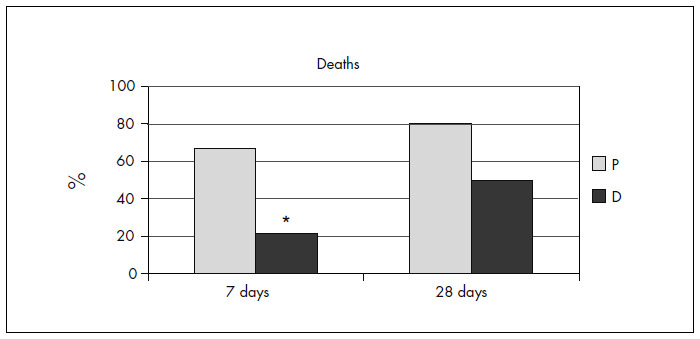
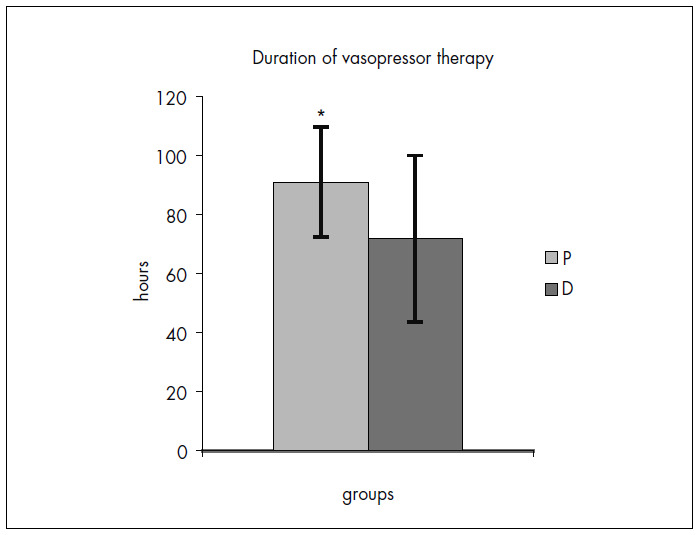
Results: Patients treated with dexamethasone did not require vasopressor therapy for as much time over the seven-day period as did the placebo group (p = 0.043). Seven-day mortality was 67% in group P (10 out of 15) and 21% in group D (3 out of 14) (relative risk = 0.31, 95% confidence interval 0.11 to 0.88). Dexamethasone enhanced the effects of vasopressor drugs.
Conclusions: Early treatment with dexamethasone reduced the seven-day mortality among septic shock patients and showed a trend towards reduction of 28-day mortality.
CONTEXTO E OBJETIVO:: Sepse e choque séptico são doenças muito comuns em pacientes gravemente enfermos, evoluindo muitas vezes com síndrome de disfunção de múltiplos órgãos (SDMO) e morte. A proposta do trabalho foi investigar a eficácia da administração precoce de dexametasona a estes pacientes, tentando evitar a progressão do choque séptico para SDMO e morte.
TIPO DE ESTUDO E LOCAL:: Estudo prospectivo, aleatório, duplamente encoberto, monocêntrico, realizado na Unidade de Terapia Intensiva pós-operatória do Hospital das Clínicas da Faculdade de Medicina da Universidade de São Paulo.
MÉTODOS:: Foram estudados 29 pacientes com choque séptico. Os participantes foram aleatoriamente divididos em dois grupos que receberam 0,2 mg/kg de dexametasona (grupo D) ou placebo (grupo P), repetidas a cada 36 horas. Os pacientes foram acompanhados durante sete dias de internação na Unidade de Terapia Intensiva através do escore SOFA (Sequential Organ Failure Assessment).
RESULTADOS:: Os pacientes que receberam dexametasona necessitaram de menos tempo de tratamento com vasopressores durante o período de sete dias (p = 0,043). A mortalidade em sete dias no grupo P foi de 67% (10 em 15) e no grupo D foi de 21% (3 em 14) (risco relativo = 0.31, intervalo de confiança 95% 0.11-0.88).
CONCLUSÃO:: O tratamento precoce com dexametasona dos pacientes com choque séptico reduziu a mortalidade em sete dias de acompanhamento e mostrou tendência de redução da mortalidade em 28 dias.
Conflict of interest statement
Figures
References
-
- Hotchkiss RS, Karl IE. The pathophysiology and treatment of sepsis. N Engl J Med. 2003;348(2):138–150. - PubMed
-
- Scheinman RI, Cogswell PC, Lofquist AK, Baldwin AS., Jr Role of transcriptional activation of I kappa B alpha in mediation of immunosuppression by glucocorticoids. Science. 1995;270(5234):283–286. - PubMed
-
- Briegel J, Forst H, Haller M, et al. Stress doses of hydrocortisone reverse hyperdynamic septic shock: a prospective, randomized, double-blind, single-center study. Crit Care Med. 1999;27(4):723–732. - PubMed
-
- Meduri GU, Headley AS, Golden E, et al. Effect of prolonged methylprednisolone therapy in unresolving acute respiratory distress syndrome: a randomized controlled trial. JAMA. 1998;280(2):159–165. - PubMed
Publication types
MeSH terms
Substances
LinkOut - more resources
Full Text Sources
Other Literature Sources
