. 2008 Jan;190(2):536-45.
doi: 10.1128/JB.01481-07. Epub 2007 Nov 9.

Characterization of the CopR regulon of Lactococcus lactis IL1403

Affiliations

Characterization of the CopR regulon of Lactococcus lactis IL1403

David Magnani et al. J Bacteriol. 2008 Jan.

Abstract

To identify components of the copper homeostatic mechanism of Lactococcus lactis, we employed two-dimensional gel electrophoresis to detect changes in the proteome in response to copper. Three proteins upregulated by copper were identified: glyoxylase I (YaiA), a nitroreductase (YtjD), and lactate oxidase (LctO). The promoter regions of these genes feature cop boxes of consensus TACAnnTGTA, which are the binding site of CopY-type copper-responsive repressors. A genome-wide search for cop boxes revealed 28 such sequence motifs. They were tested by electrophoretic mobility shift assays for the interaction with purified CopR, the CopY-type repressor of L. lactis. Seven of the cop boxes interacted with CopR in a copper-sensitive manner. They were present in the promoter region of five genes, lctO, ytjD, copB, ydiD, and yahC; and two polycistronic operons, yahCD-yaiAB and copRZA. Induction of these genes by copper was confirmed by real-time quantitative PCR. The copRZA operon encodes the CopR repressor of the regulon; a copper chaperone, CopZ; and a putative copper ATPase, CopA. When expressed in Escherichia coli, the copRZA operon conferred copper resistance, suggesting that it functions in copper export from the cytoplasm. Other member genes of the CopR regulon may similarly be involved in copper metabolism.


Figures
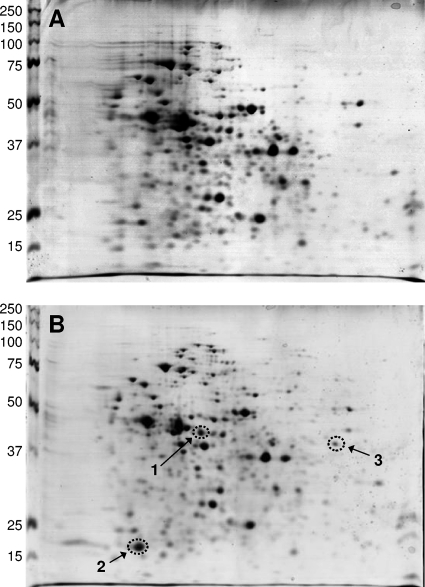
FIG. 1.
FIG. 1.
Examples of 2D gels of the cytosolic proteins of L. lactis IL1403 not induced (A) or induced with 200 μM copper for 45 min (B). Isoelectric focusing was in the horizontal direction with a pH gradient (from left to right) of 4 to 7, followed by sodium dodecyl sulfate gel electrophoresis on 12% polyacrylamide gels in the vertical direction. The scales on the left indicate the sizes of molecular mass markers in kDa. The gels were stained with colloidal Coomassie blue. Spot 1, glyoxylase I (YaiA); spot 2, nitroreductase (YtjD); spot 3, l-lactate oxidase (LctO).
FIG. 2.
FIG. 2.
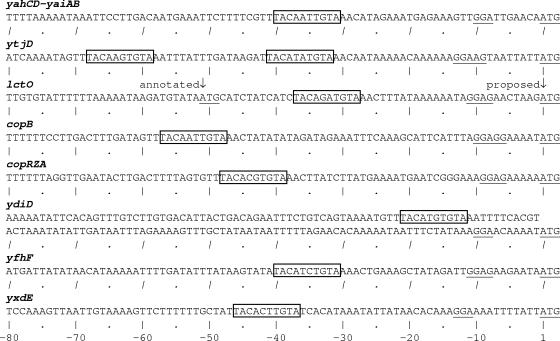
cop boxes in L. lactis promoters. The cop boxes of consensus TACAnnTGTA present in the promoter regions of L. lactis genes are boxed, and the presumed ribosome binding sites and ATG start codons are underlined. yahCD-yaiAB, promoter of the operon encoding, among others, glyoxylase I (accession no. AE006246); ytjD, nitroreductase promoter (accession no. AE006421); lctO, l-lactate oxidase promoter (accession no. AE006357); copB, promoter of a putative copper ATPase (accession no. NC_009004); copRZA, promoter of the copRZA operon encoding a repressor, a copper chaperone, and a copper ATPase (accession no. AE006316); ydiD, promoter of a hypothetical azoreductase (accession no. AE006275); yfhF, predicted membrane protein of unknown function (accession no. AE006291); and yxdE, predicted short-chain alcohol dehydrogenase (accession no. AE006454).
FIG. 3.
FIG. 3.
EMSA of the interaction of CopR with different cop boxes. (A to C) Thirty-base-pair double-stranded oligonucleotides containing the cop box motif flanked by 10 bp on either side were incubated with purified CopR of L. lactis. Samples were electrophoresed on nondenaturing, 15% polyacrylamide gels and stained with ethidium bromide. The arrows indicate the migration positions of free DNA, and the double arrows indicate those of the DNA-CopR complexes. Each lane contains 18 pmol of DNA and 175 pmol of CopR. The − and + signs indicate the absence and presence, respectively, of 5 μM copper.
FIG. 4.
FIG. 4.
Real-time quantitative PCR analysis of mRNA expression from genes with cop box promoters. RNA was isolated from cells which were not induced (open bars) or from cells induced with 200 μM of copper for 45 min (filled bars). Gene names are given on the abscissa.
FIG. 5.
FIG. 5.
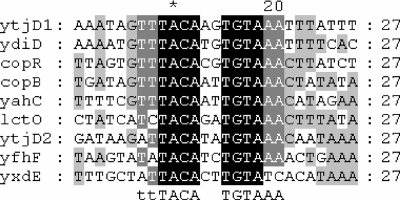
ClustalW alignment of cop boxes present in the promoter regions of L. lactis genes. Sequences are ordered by decreasing pairwise similarity and labeled with the first downstream gene. The most conserved residues are depicted in inverse colors. The extended cop box consensus sequence is indicated below the alignment.
FIG. 6.
FIG. 6.
Copper homeostatic genes of L. lactis. (A) Schematic representation of the copRZA operon and the copB gene. PcopR and PcopB indicate the promoter regions containing the cop boxes, and the arrows indicate the conjectured start of transcription. The genes are not drawn to scale. (B and C) Alignment of the N termini of CopA and CopB, respectively, of L. lactis (Ll) with the corresponding enzymes of E. hirae (Eh). Identical or similar amino acid residues are indicated in reverse colors; dissimilar residues are emphasized in gray.
FIG. 7.
FIG. 7.
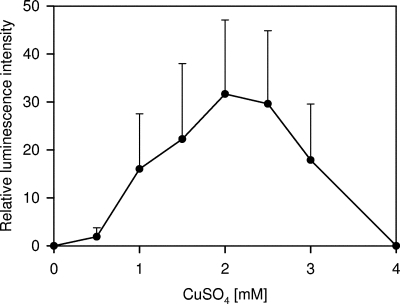
Biosensor assay of CopR regulation by copper. E. coli DH5α containing the plasmid pCRZL with the lux genes under the control of the copRZA promoter and the CopR repressor was induced with different CuSO4 concentrations, and luminescence was measured. The error bars indicate standard deviations.
FIG. 8.
FIG. 8.
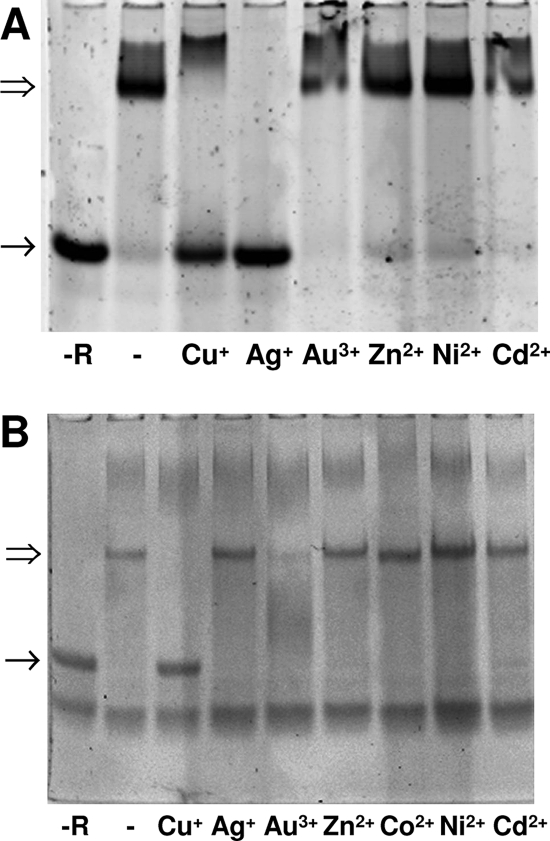
Metal specificity of CopR-promoter interactions. The release of CopR from the copRZA and the copB cop boxes was assessed by EMSA. Oligonucleotides (2.5 pmol) were incubated with a 20-fold molar excess of purified CopR in presence of 50 μM of the metal ions indicated in the figure and resolved on polyacrylamide gels as described in Materials and Methods. (A) cop box of the copRZA operon. (B) cop box of the copB gene. −R, control without CopR.
FIG. 9.
FIG. 9.
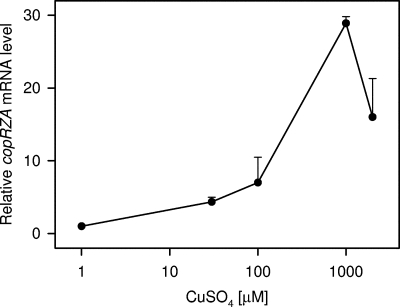
Real-time quantitative PCR measurement of copRZA mRNA expression in response to copper. Cultures of wild-type L. lactis in complex media were induced in mid-log phase with the indicated concentrations of CuSO4 for 45 min, RNA was extracted and reverse transcribed, and cop mRNA levels were determined by real-time quantitative PCR with primers dm9 and dm10, directed against the copA gene. The error bars indicate standard deviations.
FIG. 10.
FIG. 10.
Copper resistance in E. coli conferred by the L. lactis copRZA operon. (A) Growth response of E. coli W3110ΔcopA containing the control vector pSU18 (open circles) or the vector pSURZA containing the L. lactis copRZA operon (solid circles). The indicated copper concentrations were added to the media, and the OD was measured after 8 h of growth. (B) Replica plating of strains on a plate without added copper (left) or with 2 mM CuSO4 (right). Section 1, E. coli W3110 wild type; section 2, E. coli W3110ΔcopA with pSURZA containing the copRZA operon; section 3, E. coli W3110ΔcopA containing the pSU18 control vector.

References

    1. Arnesano, F., L. Banci, I. Bertini, S. Ciofi-Baffoni, E. Molteni, D. L. Huffman, and T. V. O'Halloran. 2002. Metallochaperones and metal-transporting ATPases: a comparative analysis of sequences and structures. Genome Res. 12255-271. - PubMed
    1. Ausubel, R. M., R. Brent, R. E. Kingston, D. D. Moore, J. A. Smith, and K. Struhl. 1995. Current protocols in molecular biology. John Wiley & Sons, Inc., New York, NY.
    1. Barré, O., F. Mourlane, and M. Solioz. 2007. Copper induction of lactate oxidase of Lactococcus lactis: a novel metal stress response. J. Bacteriol. 1895947-5954. - PMC - PubMed
    1. Bolotin, A., P. Wincker, S. Mauger, O. Jaillon, K. Malarme, J. Weissenbach, S. D. Ehrlich, and A. Sorokin. 2001. The complete genome sequence of the lactic acid bacterium Lactococcus lactis ssp. lactis IL1403. Genome Res. 11731-753. - PMC - PubMed
    1. Cobine, P., W. A. Wickramasinghe, M. D. Harrison, T. Weber, M. Solioz, and C. T. Dameron. 1999. The Enterococcus hirae copper chaperone CopZ delivers copper(I) to the CopY repressor. FEBS Lett. 44527-30. - PubMed

Publication types

MeSH terms

LinkOut - more resources