


Contextualized self-representations in adulthood
- PMID: 17995465
- PMCID: PMC2432182
- DOI: 10.1111/j.1467-6494.2007.00475.x
Contextualized self-representations in adulthood
Abstract
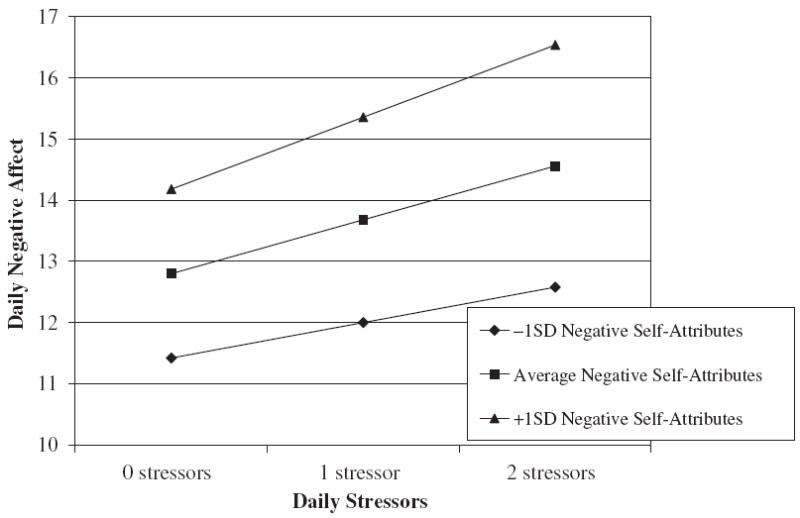
Theorizing has focused on individuals' self-representations as a psychological resource for coping with life stress and developmental challenges in adulthood. Many of the prominent theories have conceptualized self-representations with regard to specific social contexts (e.g., role-specific self-representations) and have examined specific structural organizations of the self-concept with regard to psychological adjustment. This article describes research on the associations between self-concept structures and psychological well-being in adulthood. Specific emphasis is given to the feature of self-concept differentiation (SCD). Most research suggests that a high level of SCD tends to indicate self-fragmentation and tends to be associated with poorer adjustment and psychological well-being. Findings from a daily diary study with adults of all ages are reported showing that different levels of SCD were in a consistent and meaningful way related to the daily endorsement of positive and negative self-attributes. Daily self-representations, in turn, were significantly related to individuals' level of daily negative affect and to intra-individual variation in negative affect. These findings suggest that SCD may exert its effect on adjustment and psychological well-being through specific ways of processing self-related information.
Figures


References
-
- Almeida DM, Wethington E, Kessler RC. The Daily Inventory of Stressful Experiences (DISE): An interview-based approach for measuring daily stressors. Assessment. 2002;9:41–55. - PubMed
-
- Baird BM, Le K, Lucas RE. On the nature of intraindividual personality variability: Reliability, validity, and associations with well-being. Journal of Personality and Social Psychology. 2006;90:512–527. - PubMed
-
- Baumeister RR. The self. In: Gilbert DT, Fiske ST, Lindzey G, editors. The handbook of social psychology. 4. Vol. 1. New York: McGraw-Hill; 1998. pp. 680–740.
-
- Bigler M, Neimeyer GJ, Brown E. The divided self revisited: Effects of self-concept clarity and self-concept differentiation on psychological adjustment. Journal of Social and Clinical Psychology. 2001;20:396–415.
-
- Block J. Ego-identity, role variability, and adjustment. Journal of Consulting and Clinical Psychology. 1961;25:392–397. - PubMed
Publication types
MeSH terms
Grants and funding
LinkOut - more resources
Full Text Sources
