


doi: 10.1021/nl072471q.
Epub 2007 Nov 13.
Oligonucleotide loading determines cellular uptake of DNA-modified gold nanoparticles
Affiliations
- PMID: 17997588
- PMCID: PMC8585332
- DOI: 10.1021/nl072471q
Item in Clipboard
Oligonucleotide loading determines cellular uptake of DNA-modified gold nanoparticles
Nano Lett.
2007 Dec.
Abstract
The cellular internalization of oligonucleotide-modified nanoparticles is investigated. Uptake is dependent on the density of the oligonucleotide loading on the surface of the particles, where higher densities lead to greater uptake. Densely functionalized nanoparticles adsorb a large number of proteins on the nanoparticle surface. Nanoparticle uptake is greatest where a large number of proteins are associated with the particle.
Figures
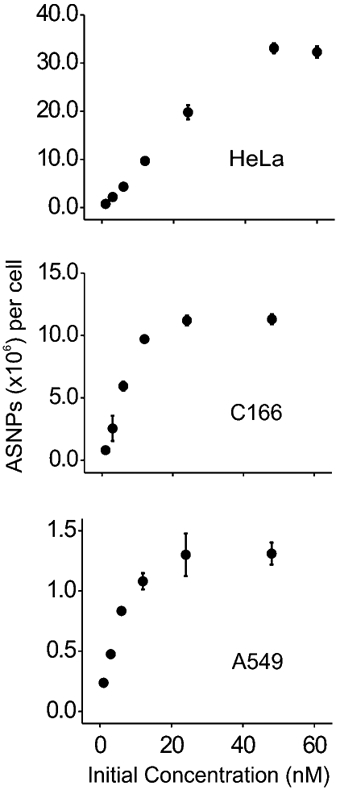
Cellular uptake of ASNPs. Analysis of ASNPs in three different cell types (HeLa, C166, A549) shows that the number of ASNPs per cell is dependent on initial particle concentration and cell type.
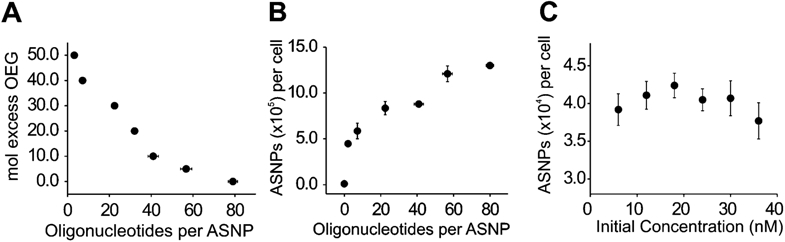
(A) Characterization of oligonucleotide loading on OEG:DNA particles. (B) Uptake as a function of the number of oligonucleotides per ASNP in A549 cells. The number of ASNPs per cell increases as the number of oligonucleotides increases (particle concentration in the media was 10 nM). (C) Au NPs functionalized with OEG show comparatively little uptake (A549 cells) even at high concentration additions.
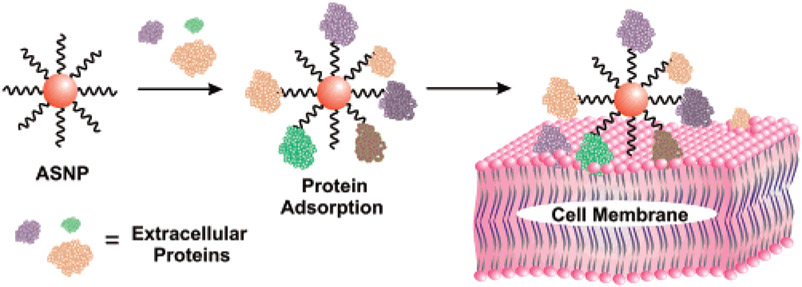
Proposed Scheme for ASNP Cellular Uptakea aUpon addition to the media, ASNPs bind extracellular proteins and allow the ASNP to interface with the cellular membrane. The number of proteins per particle correlates with particle uptake.
References
-
- Nam JM; Thaxton CS; Mirkin CA Science 2003, 301 (5641), 1884–1886. - PubMed
-
- Elghanian R; Storhoff JJ; Mucic RC; Letsinger RL; Mirkin CA Science 1997, 277 (5329), 1078–1081. - PubMed
-
- Mirkin CA; Letsinger RL; Mucic RC; Storhoff JJ Nature 1996, 382 (6592), 607–609. - PubMed
-
- Alivisatos AP; Johnsson KP; Peng XG; Wilson TE; Loweth CJ; Bruchez MP; Schultz PG Nature 1996, 382 (6592), 609–611. - PubMed
-
- Rosi NL; Giljohann DA; Thaxton CS; Lytton-Jean AKR; Han MS; Mirkin CA Science 2006, 312 (5776), 1027–1030. - PubMed
Publication types
MeSH terms
Substances
Grants and funding
LinkOut - more resources
Full Text Sources
Other Literature Sources
