


Longitudinal changes in BMD and bone geometry in a population-based study
- PMID: 17997708
- PMCID: PMC2645701
- DOI: 10.1359/jbmr.071103
Longitudinal changes in BMD and bone geometry in a population-based study
Abstract
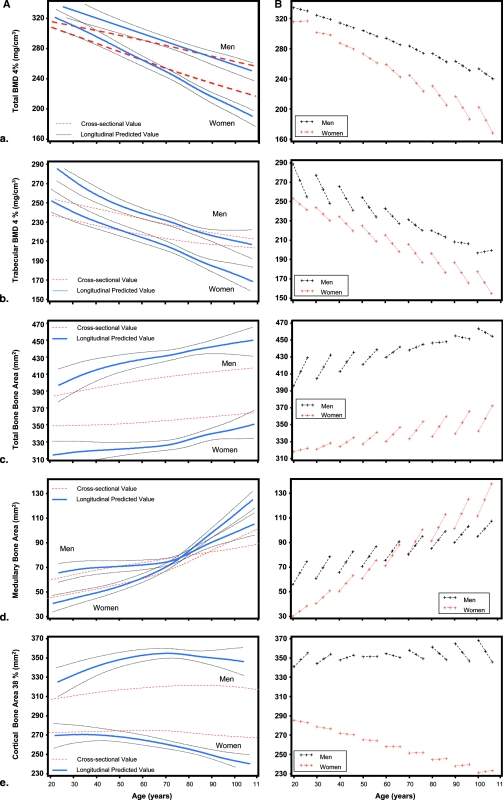
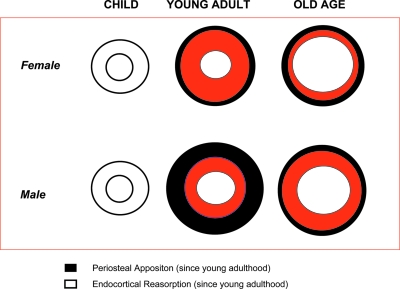
We prospectively examined vBMD and structural bone parameters assessed by QCT among participants of the InCHIANTI study over a 6-yr follow-up. Periosteal apposition occurred both in men and women. Endocortical resorption causes bone loss in older women despite periosteal apposition.
Introduction: To address the hypothesis that age-related changes in BMD and bone geometry may be different in men and women, we prospectively examined volumetric BMD (vBMD) and structural bone parameters assessed by QCT among participants of the InCHIANTI study over a 6-yr follow-up.
Materials and methods: Three hundred forty-five men and 464 women 21-102 yr of age from the InCHIANTI study, a population-based study in Tuscany, Italy, were included. Tibial QCT bone parameters were measured at enrollment (1998-2000) and at 3- (2001-2003) and 6-yr (2004-2006) follow-ups.
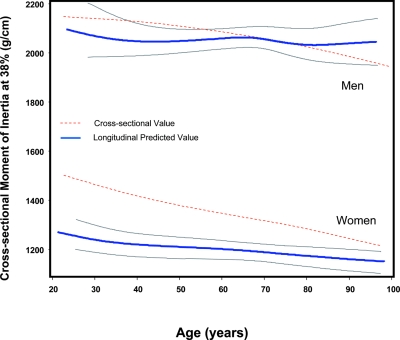
Results: Periosteal apposition occurred both in men and women. The annual rate of bone periosteal apposition was higher in younger than in older men, whereas in women, the rate of apposition was homogenous across age groups. The age-related medullary expansion, expression of endocortical resorption, was significantly higher in women compared with men. In women, but not in men, accelerated endocortical resorption not sufficiently balanced by periosteal apposition caused accelerated loss in cortical bone mass. The cross-sectional moment of inertia decreased progressively over the life span in both sexes.
Conclusions: Endocortical resorption causes bone loss in older women despite periosteal apposition. Obtaining a balance between endocortical resorption and periosteal apposition should be the target for interventions aimed to decrease bone loss and prevent osteoporosis in older women.
Figures
References
-
- Seeman E. The periosteum-a surface for all seasons. Osteoporos Int. 2007;18:123–128. - PubMed
-
- Seeman E, Delmas PD. Bone quality—the material and structural basis of bone strength and fragility. N Engl J Med. 2006;354:2250–2261. - PubMed
-
- NIH Consensus Statement Online. Osteoporosis prevention, diagnosis, and therapy. 2000. Available online at http://consensus.nih.gov/2000/2000Osteoporosis111html.htm. - PubMed
-
- Riggs BL, Melton LJ, III, Robb RA, Camp JJ, Atkinson EJ, Peterson JM, Rouleau PA, McCollough CH, Bouxsein ML, Khosla S. Population-based study of age and sex differences in bone volumetric density, size, geometry, and structure at different skeletal sites. J Bone Miner Res. 2004;19:1945–1954. - PubMed
-
- Ahlborg HG, Johnell O, Turner CH, Rannevik G, Karlsson MK. Bone loss and bone size after menopause. N Engl J Med. 2003;349:327–334. - PubMed
Publication types
MeSH terms
Grants and funding
LinkOut - more resources
Full Text Sources
Medical
