


Evolutionary associations between nectar properties and specificity in bird pollination systems
- PMID: 17999944
- PMCID: PMC2412932
- DOI: 10.1098/rsbl.2007.0496
Evolutionary associations between nectar properties and specificity in bird pollination systems
Abstract
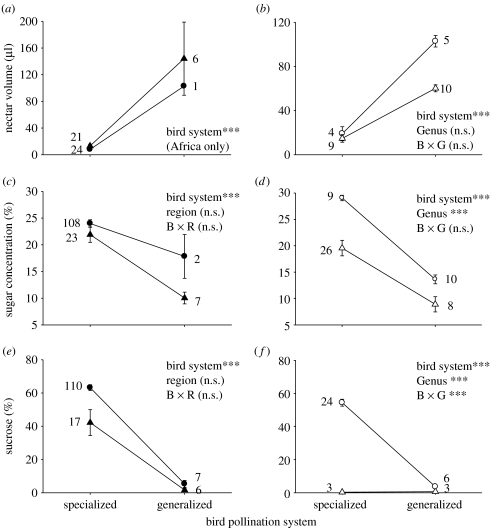
A long-standing paradigm in biology has been that hummingbirds and passerine birds select for different nectar properties in the plants they pollinate. Here we show that this dichotomy is false and a more useful distinction is that between specialized and generalized bird pollination systems. Flowers adapted for sunbirds, which are specialized passerine nectarivores, have nectar similar to that of hummingbird flowers in terms of volume (approx. 10-30 microl), concentration (approx. 15-25% w/w) and sucrose content (approx. 40-60% of total sugar). In contrast, flowers adapted to generalized bird pollinators are characterized by large volumes (approx. 40-100 microl) of extremely dilute (approx. 8-12%) nectar with minimal sucrose (approx. 0-5%). These differences in nectar traits are highly significant even when statistical analyses are based on phylogenetically separate pairwise comparisons between taxa. We present several hypotheses for the association between nectar properties and specificity in bird pollination systems.
Figures
References
-
- Baker H.G, Baker I. Chemical constituents of nectar in relation to pollination mechanisms and phylogeny. In: Nitecki M.H, editor. Biochemical aspects of evolutionary biology. University of Chicago Press; Chicago, IL: 1982a. pp. 131–171.
-
- Baker I, Baker H.G. Some chemical constituents of floral nectars of Erythrina in relation to pollinators and systematics. Allertonia. 1982b;3:25–37.
-
- Baker H.G, Baker I, Hodges S.A. Sugar composition of nectar and fruits consumed by birds and bats in the tropics and subtropics. Biotropica. 1998;30:559–586. doi:10.1111/j.1744-7429.1998.tb00097.x - DOI
-
- Brown J.H, Kodric-Brown A. Convergence, competition, and mimicry in a temperate community of hummingbird-pollinated flowers. Ecology. 1979;60:1022–1035. doi:10.2307/1936870 - DOI
-
- Bruneau A. Evolution and homology of bird pollination syndromes in Erythrina (Leguminosae) Am. J. Bot. 1997;84:54–71. doi:10.2307/2445883 - DOI
Publication types
MeSH terms
LinkOut - more resources
Full Text Sources
