The mechanism of action of beta-D-2'-deoxy-2'-fluoro-2'-C-methylcytidine involves a second metabolic pathway leading to beta-D-2'-deoxy-2'-fluoro-2'-C-methyluridine 5'-triphosphate, a potent inhibitor of the hepatitis C virus RNA-dependent RNA polymerase
- PMID: 17999967
- PMCID: PMC2224766
- DOI: 10.1128/AAC.01184-07
The mechanism of action of beta-D-2'-deoxy-2'-fluoro-2'-C-methylcytidine involves a second metabolic pathway leading to beta-D-2'-deoxy-2'-fluoro-2'-C-methyluridine 5'-triphosphate, a potent inhibitor of the hepatitis C virus RNA-dependent RNA polymerase
Abstract
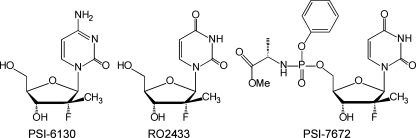
beta-D-2'-Deoxy-2'-fluoro-2'-C-methylcytidine (PSI-6130) is a potent inhibitor of hepatitis C virus (HCV) RNA replication in an HCV replicon assay. The 5'-triphosphate of PSI-6130 is a competitive inhibitor of the HCV RNA-dependent RNA polymerase (RdRp) and acts as a nonobligate chain terminator. Recently, it has been shown that the metabolism of PSI-6130 also results in the formation of the 5'-triphosphate of the uridine congener, beta-D-2'-deoxy-2'-fluoro-2'-C-methyluridine (PSI-6206; RO2433). Here we show that the formation of the 5'-triphosphate of RO2433 (RO2433-TP) requires the deamination of PSI-6130 monophosphate and that RO2433 monophosphate is subsequently phosphorylated to the corresponding di- and triphosphates by cellular UMP-CMP kinase and nucleoside diphosphate kinase, respectively. RO2433-TP is a potent inhibitor of the HCV RdRp; however, both enzymatic and cell-based assays show that PSI-6130 triphosphate is a more potent inhibitor of the HCV RdRp than RO2433-TP.
Figures


References
-
- Alaoui-Lsmaili, M. H., M. Hamel, L. L'Heureux, O. Nicolas, D. Bilimoria, P. Labonte, S. Mounir, and R. F. Rando. 2000. The hepatitis C virus NS5B RNA-dependent RNA polymerase activity and susceptibility to inhibitors is modulated by metal cations. J. Hum. Virol. 3:306-316. - PubMed
-
- Alter, M. J., D. Kruszon-Moran, O. V. Nainan, G. M. McQuillan, F. Gao, L. A. Moyer, R. A. Kaslow, and H. S. Margolis. 1999. The prevalence of hepatitis C virus infection in the United States, 1988 through 1994. N. Engl. J. Med. 341:556-562. - PubMed
-
- Blight, K. J., A. A. Kolykhalov, and C. M. Rice. 2000. Efficient initiation of HCV RNA replication in cell culture. Science 290:1972-1974. - PubMed
-
- Carroll, S. S., J. E. Tomassini, M. Bosserman, K. Getty, M. W. Stahlhut, A. B. Eldrup, B. Bhat, D. Hall, A. L. Simcoe, R. LaFemina, C. A. Rutkowski, B. Wolanski, Z. Yang, G. Migliaccio, R. De Francesco, L. C. Kuo, M. MacCoss, and D. B. Olsen. 2003. Inhibition of hepatitis C virus RNA replication by 2′-modified nucleoside analogs. J. Biol. Chem. 278:11979-11984. - PubMed
-
- Clark, J. L., J. C. Mason, L. Hollecker, L. J. Stuyver, P. M. Tharnish, T. R. McBrayer, M. J. Otto, P. A. Furman, R. F. Schinazi, and K. A. Watanabe. 2006. Synthesis and antiviral activity of 2′-deoxy-2′-fluoro-2′-C-methyl purine nucleosides as inhibitors of hepatitis C virus RNA replication. Bioorg. Med. Chem. Lett. 16:1712-1715. - PubMed
MeSH terms
Substances
LinkOut - more resources
Full Text Sources
Other Literature Sources
Chemical Information
Research Materials