. 2007 Nov 20;104(47):18825-9.
doi: 10.1073/pnas.0708506104. Epub 2007 Nov 13.

NPY1, a BTB-NPH3-like protein, plays a critical role in auxin-regulated organogenesis in Arabidopsis

Affiliations

NPY1, a BTB-NPH3-like protein, plays a critical role in auxin-regulated organogenesis in Arabidopsis

Youfa Cheng et al. Proc Natl Acad Sci U S A. .

Abstract

Auxin is an essential regulator for plant development. To elucidate the mechanisms by which auxin regulates plant development, we isolated an Arabidopsis mutant naked pins in yuc mutants 1 (npy1) that develops pin-like inflorescences and fails to initiate any flowers in yuc1 yuc4, a background that is defective in auxin biosynthesis. The phenotypes of npy1 yuc1 yuc4 triple mutants closely resemble those of Arabidopsis mutants pin-formed1 (pin1), pinoid (pid), and monopteros (mp), which are defective in either auxin transport or auxin signaling. NPY1 belongs to a large family of proteins and is homologous to NON-PHOTOTROPIC HYPOCOTYL 3 (NPH3), a BTB/POZ protein that regulates phototropic responses along with the protein kinase PHOT1 (Phototropin 1). We demonstrate that NPY1 works with the protein kinase PID, which is homologous to PHOT1, to regulate auxin-mediated plant development. The npy1 pid double mutants fail to form any cotyledons, a phenotype that is also observed in yuc1 yuc4 pid triple mutants. Interestingly, both auxin-regulated organogenesis and phototropic responses require an auxin response factor (ARF). Disruption of ARF7/NPH4 leads to nonphototropic hypocotyls and arf5/mp forms pin-like inflorescences. Whereas the PHOT1/NPH3 pathway is regulated by light, our data suggest that the PID/NPY1 pathway may be regulated by auxin synthesized by the YUC flavin monooxygenases. Our findings put YUCs, PID, and NPY1 into a genetic framework for further dissecting the mechanisms of auxin action in plant development.


Conflict of interest statement

The authors declare no conflict of interest.

Figures
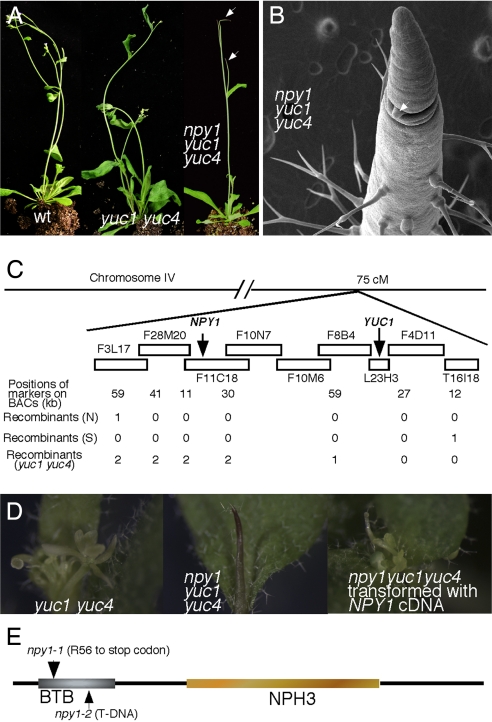
Fig. 1.
Fig. 1.
Identification and molecular cloning of npy1. (A) Mutations in NPY1 in yuc1 yuc4 background caused the formation of pin-like inflorescences. From left to right: WT, yuc1 yuc4, and npy1 yuc1 yuc4. Arrows point toward the pin-like inflorescences. (B) An electron micrograph of npy1 yuc1 yuc4. Note that no flowers were initiated from the inflorescence. Lateral meristems can be initiated from the main inflorescence in npy1 yuc1 yuc4 (arrow). (C) Molecular cloning of NPY1. (D) Complementation of npy1 with the At4g31820 cDNA. From left to right: yuc1 yuc4, npy1 yuc1 yuc4, and npy1 yuc1 yuc4 transformed with At4g31820 cDNA. Note that yuc1 yuc4 developed abnormal flowers, whereas npy1 yuc1 yuc4 never produced any flowers. Introduction of At4g31820 cDNA to npy1 yuc1 yuc4 led to yuc1 yuc4 phenotypes. (E) Domain structure of NPY1.
Fig. 2.
Fig. 2.
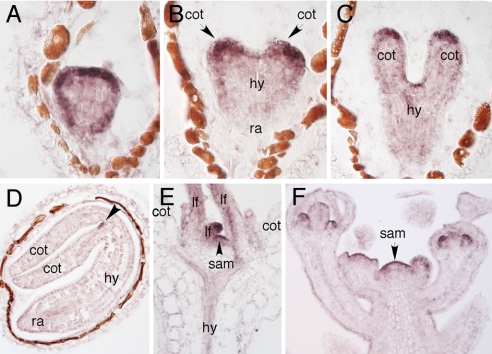
Analysis of the expression patterns of NPY1 by RNA in situ hybridization. NPY1 expression in a globular-stage embryo (A), an early heart-stage embryo (B), a late heart-stage embryo (C), a mature embryo (D), a light-grown seedling (E), and an inflorescence apex (F). Cot, cotyledon; hy, hypocotyl; ra, root meristem; sam, shoot apical meristem; lf, leaf.
Fig. 3.
Fig. 3.
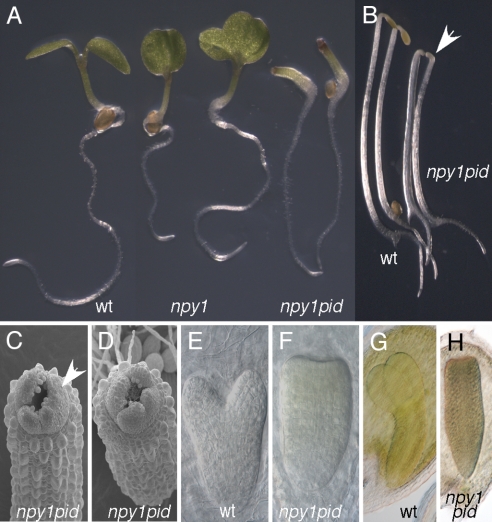
Genetic interactions between npy1 and pid. (A) Complete loss of cotyledons in npy1 pid double mutants. From left to right: WT, 2 seedlings of npy1, and npy1 pid. (B) Dark-grown npy1 pid seedlings. Note that npy1 pid did not have cotyledons, but it still retained the apical hook (arrow). The two seedlings at Left are WT, and the two at Right are npy1 pid. (C and D) Electron micrographs of npy1 pid seedlings grown in light. Note that the true leaves were initiated in npy1 pid, but normal phyllotaxis is disrupted. (E) A heart-stage WT embryo. (F) A heart-stage npy1 pid embryo. (G) A torpedo-stage WT embryo. (H) A torpedo-stage npy1 pid embryo.
Fig. 4.
Fig. 4.
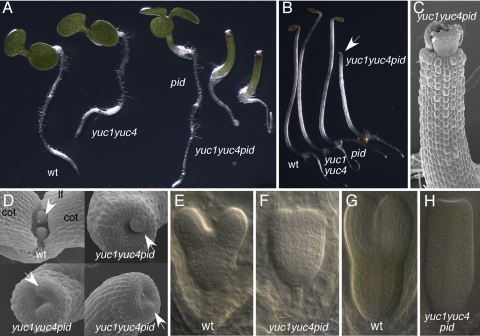
Genetic interactions between pid and yuc1 yuc4 double mutants. (A) Disruption of cotyledon development in yuc1 yuc4 pid triple mutants. From left to right: WT, yuc1 yuc4, pid, two seedlings of yuc1 yuc4pid. (B) Effects of yuc1 yuc4 pid on seedling growth in the dark. From left to right: WT, yuc1 yuc4, pid, and yuc1 yuc4 pid triple mutants. (C) An electron micrograph of yuc1 yuc4 pid grown in light for 5 days. Note the lack of cotyledons in the seedling. (D) Electron micrographs of 3-day-old dark-grown seedlings. The Top Left is WT, and the other seedlings are yuc1 yuc4pid. Note that the apical region is concave shape in yuc1 yuc4 pid and that leaf primordia are initiated. In WT, two true leaf primordia are in opposite position and are similar in size. (E) A WT heart-stage embryo. (F) A yuc1 yuc4 pid heart-stage embryo. (G) A torpedo-stage WT embryo. (H) A torpedo-stage yuc1 yuc4 pid embryo. Cot, cotyledon; lf, leaf.
Fig. 5.
Fig. 5.
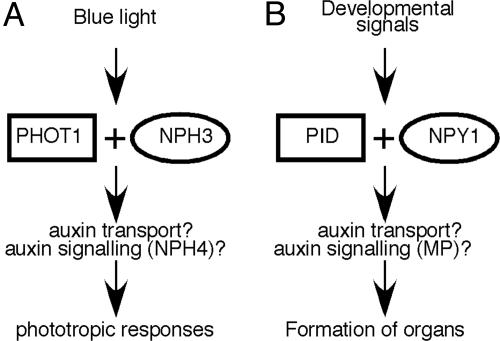
Model for NPY1 in auxin-regulated plant development. (A) PHOT1 and NPH3 in blue-light-mediated phototropism. (B) Regulation of plant development by NPY1 and PID. PHOT1 is homologous to the protein kinase PID, whereas NPH3 is a homolog of NPY1. Note that both PHOT1/NPH3 and PID/NPY1 pathways require the involvement of an auxin response factor. Inactivation of ARF7/NPH4 leads to nonphototropic hypocotyls, whereas disruption of ARF5/MP leads to the formation of pin-like inflorescence.

References

    1. Leyser O. Annu Rev Plant Biol. 2002;53:377–398. - PubMed
    1. Hobbie L, Estelle M. Plant Cell Environ. 1994;17:525–540. - PubMed
    1. Tan X, Calderon-Villalobos LI, Sharon M, Zheng C, Robinson CV, Estelle M, Zheng N. Nature. 2007;446:640–645. - PubMed
    1. Kepinski S, Leyser O. Nature. 2005;435:446–451. - PubMed
    1. Dharmasiri N, Dharmasiri S, Estelle M. Nature. 2005;435:441–445. - PubMed

Publication types

MeSH terms