Short-term exercise improves beta-cell function and insulin resistance in older people with impaired glucose tolerance
- PMID: 18000089
- PMCID: PMC2243226
- DOI: 10.1210/jc.2007-1734
Short-term exercise improves beta-cell function and insulin resistance in older people with impaired glucose tolerance
Abstract
Background: There is a high prevalence of diabetes and impaired glucose tolerance (IGT) in the older population. Normal aging is associated with insulin resistance and impaired insulin secretion, with greater defects in people with IGT. Short-term exercise has been found to increase insulin sensitivity, but little is known about acute exercise effects on beta-cell function in older people with IGT.
Methods: We assessed the effects of 7 consecutive days of supervised aerobic exercise (1 h/d at 60-70% heart rate reserve) in 12 sedentary older people with IGT. Screening included oral glucose tolerance test, stress/maximal O(2) uptake test, and dual-energy x-ray absorptiometry scan. Participants had a frequently sampled iv glucose tolerance test at baseline and 15-20 h after the seventh exercise session. Insulin sensitivity (S(I)), glucose disappearance constant (Kg, a measure of iv glucose tolerance), acute insulin response to glucose (AIRg), and disposition index (AIRg x S(I)), a measure of beta-cell function in relation to insulin resistance, were calculated.
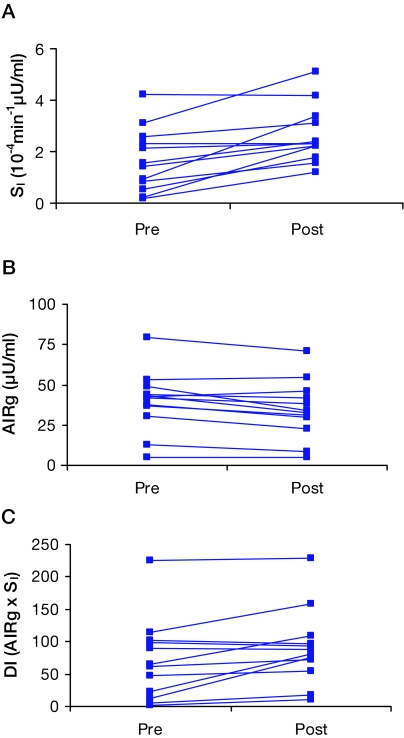
Results: Exercise was well tolerated. Body weight, fasting glucose, fasting insulin, and iv glucose tolerance were unchanged with exercise. S(I) increased by 59%, AIRg decreased by 12%, and disposition index increased by 31%. There was no significant change in fasting lipid, catecholamine, leptin, or adiponectin levels.
Conclusions: Short-term exercise not only improved insulin resistance but also significantly enhanced beta-cell function in older people with IGT. These effects of short-term exercise on beta-cell function cannot be explained by changes in body weight or circulating levels of lipids, leptin, adiponectin, or catecholamines.
Figures
References
-
- Chang AM, Halter JB 2003 Aging and insulin secretion. Am J Physiol Endocrinol Metab 284:E7–E12 - PubMed
-
- Harris MI, Flegal KM, Cowie CC, Eberhardt MS, Goldstein DE, Little RR, Wiedmeyer HM, Byrd-Holt DD 1998 Prevalence of diabetes, impaired fasting glucose, and impaired glucose tolerance in U.S. adults. The Third National Health and Nutrition Examination Survey, 1988–1994. Diabetes Care 21:518–524 - PubMed
-
- Resnick HE, Harris MI, Brock DB, Harris TB 2000 American Diabetes Association diabetes diagnostic criteria, advancing age, and cardiovascular disease risk profiles: results from the Third National Health and Nutrition Examination Survey. Diabetes Care 23:176–180 - PubMed
-
- Basu R, Breda E, Oberg AL, Powell CC, Dalla Man C, Basu A, Vittone JL, Klee GG, Arora P, Jensen MD, Toffolo G, Cobelli C, Rizza RA 2003 Mechanisms of the age-associated deterioration in glucose tolerance: contribution of alterations in insulin secretion, action, and clearance. Diabetes 52:1738–1748 - PubMed
Publication types
MeSH terms
Substances
Grants and funding
LinkOut - more resources
Full Text Sources
Medical
Miscellaneous