


Postpartum traditions and nutrition practices among urban Lao women and their infants in Vientiane, Lao PDR
- PMID: 18000519
- PMCID: PMC3435433
- DOI: 10.1038/sj.ejcn.1602928
Postpartum traditions and nutrition practices among urban Lao women and their infants in Vientiane, Lao PDR
Erratum in
- Eur J Clin Nutr. 2009 Mar;63(3):450. Martinez-Ussel, B [corrected to Martinez-Aussel, B]
Abstract
Background/objective: To assess the traditional postpartum practices, mother and child nutritional status and associated factors.
Subjects/methods: A cross-sectional study in 41 randomly selected villages on the outskirts of Vientiane capital city, Lao PDR (Laos). 300 pairs of infants (< 6 months of age) and their mothers were enrolled. Information was collected about pregnancy, delivery and traditional practices through a standardized questionnaire. Dietary intake and food frequency were estimated using the 24 h recall method, calibrated bowls and FAO food composition tables. Mothers' and infants' anthropometry was assessed and multivariate analysis performed.
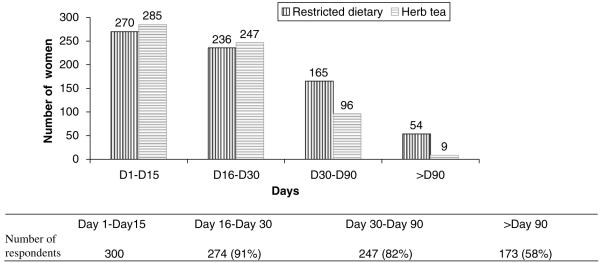
Results: Contrasting with a high antenatal care attendance (91%) and delivery under health professional supervision (72%), a high prevalence of traditional practices was found, including exposure to hot beds of embers (97%), use of traditional herb tea as the only beverage (95%) and restricted diets (90%). Twenty-five mothers (8.3%) were underweight. Mothers had insufficient intake of calories (55.6%), lipids (67.4%), iron (92.0%), vitamins A (99.3%) and C (45%), thiamin (96.6%) and calcium (96.6%). Chewed glutinous rice was given to infants as an early (mean 34.6, 95% CI:29.3-39.8 days) complementary food by 53.7% of mothers, and was associated with stunting in 10% children (OR=1.35, 95% CI:1.04-1.75).
Conclusion: The high prevalence of traditional postpartum restricted diets and practices, and inadequate maternal nutritional intake in urban Laos, suggest that antenatal care may be an important opportunity to improve postpartum diets.
Figures
References
-
- Drewett R, Amatayakul K, Wongsawasdii L, Mangklabruks A, Ruckpaopunt S, Ruangyuttikarn C, et al. Nursing frequency and the energy intake from breast milk and supplementary food in a rural Thai population: a longitudinal study. Eur J Clin Nutr. 1993;47:880–891. - PubMed
-
- FAO Food Composition Table for Use in East Asia. FAO Food Policy and Nutrition Division and US Department of health education and welfare: Rome. 1972 Part II Section A 1–334. available at: http://www.FAO.org/docrep/003/X6878E/X6878E00.htm#TOC.
-
- FAO/WHO Carbohydrates in human nutrition. (FAO Food and Nutrition Paper–66). Report of a Joint FAO/WHO Expert Consultation. 1998 available at: http://www.fao.org/docrep/W8079E/W8079E00.htm. - PubMed
-
- FAO and IUCN The Role and Nutritional Value of Aquatic Resources in the Livelihoods of Rural People A Participatory Assessment in Attapeu Province, Lao PDR. 2003 available at: www.FAO.org/docrep/004/ad454e/ad454e00.htm.
-
- Gerhold C. Food habits of the valley people of Laos. J Am Diet Assoc. 1967;50:493–497. - PubMed
Publication types
MeSH terms
Grants and funding
LinkOut - more resources
Full Text Sources
Medical
