


Neuropilin-1 modulates p53/caspases axis to promote endothelial cell survival
- PMID: 18000534
- PMCID: PMC2048754
- DOI: 10.1371/journal.pone.0001161
Neuropilin-1 modulates p53/caspases axis to promote endothelial cell survival
Abstract
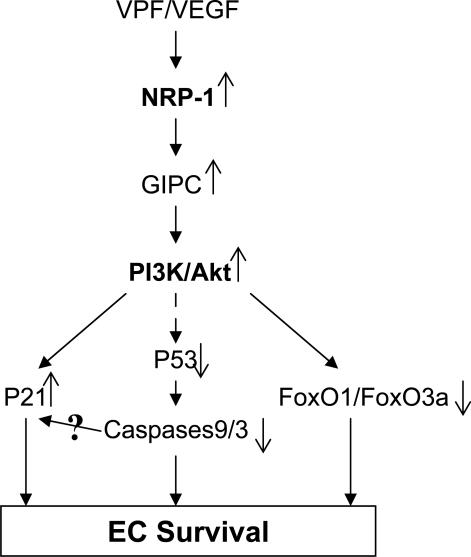
Vascular permeability factor/vascular endothelial growth factor (VPF/VEGF), one of the crucial pro-angiogenic factors, functions as a potent inhibitor of endothelial cell (EC) apoptosis. Previous progress has been made towards delineating the VPF/VEGF survival signaling downstream of the activation of VEGFR-2. Here, we seek to define the function of NRP-1 in VPF/VEGF-induced survival signaling in EC and to elucidate the concomitant molecular signaling events that are pivotal for our understanding of the signaling of VPF/VEGF. Utilizing two different in vitro cell culture systems and an in vivo zebrafish model, we demonstrate that NRP-1 mediates VPF/VEGF-induced EC survival independent of VEGFR-2. Furthermore, we show here a novel mechanism for NRP-1-specific control of the anti-apoptotic pathway in EC through involvement of the NRP-1-interacting protein (NIP/GIPC) in the activation of PI-3K/Akt and subsequent inactivation of p53 pathways and FoxOs, as well as activation of p21. This study, by elucidating the mechanisms that govern VPF/VEGF-induced EC survival signaling via NRP-1, contributes to a better understanding of molecular mechanisms of cardiovascular development and disease and widens the possibilities for better therapeutic targets.
Conflict of interest statement
Figures
References
-
- Gobe G, Browning J, Howard T, Hogg N, Winterford C, et al. Apoptosis occurs in endothelial cells during hypertension-induced microvascular rarefaction. J Struct Biol. 1997;118(1):63–72. - PubMed
-
- Dimmeler S, Hermann C, Zeiher AM. Apoptosis of endothelial cells. Contribution to the pathophysiology of atherosclerosis? Eur Cytokine Netw. 1998;9(4):697–698. - PubMed
-
- Tricot O, Mallat Z, Heymes C, Belmin J, Leseche G, et al. Relation between endothelial cell apoptosis and blood flow direction in human atherosclerotic plaques. Circulation. 2000;101(21):2450–2453. - PubMed
-
- Taraseviciene-Stewart L, Kasahara Y, Alger L, Hirth P, Mc Mahon G, et al. Inhibition of the VEGF receptor 2 combined with chronic hypoxia causes cell death-dependent pulmonary endothelial cell proliferation and severe pulmonary hypertension. Faseb J. 2001;15(2):427–438. - PubMed
-
- Cailhier JF, Laplante P, Hebert MJ. Endothelial apoptosis and chronic transplant vasculopathy: recent results, novel mechanisms. Am J Transplant. 2006;6(2):247–253. - PubMed
Publication types
MeSH terms
Substances
Grants and funding
LinkOut - more resources
Full Text Sources
Other Literature Sources
Molecular Biology Databases
Research Materials
Miscellaneous
