. 2008 Jan;36(Database issue):D245-9.
doi: 10.1093/nar/gkm977. Epub 2007 Nov 14.

The 20 years of PROSITE

Affiliations

The 20 years of PROSITE

Nicolas Hulo et al. Nucleic Acids Res. 2008 Jan.

Abstract

PROSITE consists of documentation entries describing protein domains, families and functional sites, as well as associated patterns and profiles to identify them. It is complemented by ProRule, a collection of rules based on profiles and patterns, which increases the discriminatory power of profiles and patterns by providing additional information about functionally and/or structurally critical amino acids. In this article, we describe the implementation of a new method to assign a status to pattern matches, the new PROSITE web page and a new approach to improve the specificity and sensitivity of PROSITE methods. The latest version of PROSITE (release 20.19 of 11 September 2007) contains 1319 patterns, 745 profiles and 764 ProRules. Over the past 2 years, about 200 domains have been added, and now 53% of UniProtKB/Swiss-Prot entries (release 54.2 of 11 September 2007) have a PROSITE match. PROSITE is available on the web at: http://www.expasy.org/prosite/.


Figures
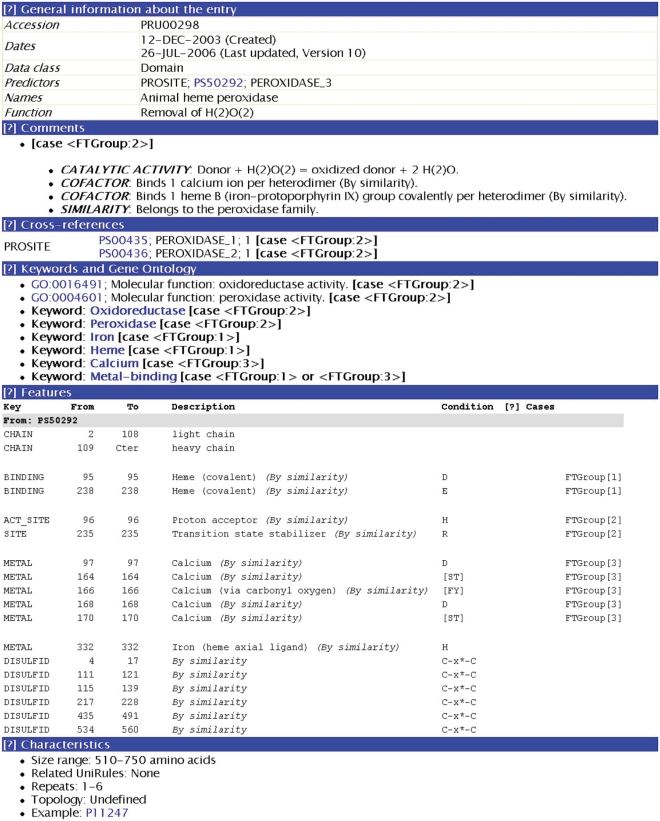
Figure 1.
Figure 1.
An example of a ProRule in ‘niceview’ format from the PROSITE web page showing the different types of annotation that can be generated by ProRule. The rule PRU00298 is used to annotate proteins matched by the animal peroxidase profile (PS50292) on the ScanProsite web page. It can annotate comment lines, KW, GO terms and various FT lines. In this rule, all types of annotation are conditionals. For example, the comment line ‘catalytic activity’ is generated only if the condition FTGroup(2) is fulfilled (a H in the sequence must align with position 96 of the profile and a R with position 235). The numbers in the ‘From’ and ‘To’ column in the features tables correspond to specific columns in the profile (for more details on the ProRule format see: ftp://ftp.expasy.org/databases/prosite/unirule.pdf).
Figure 2.
Figure 2.
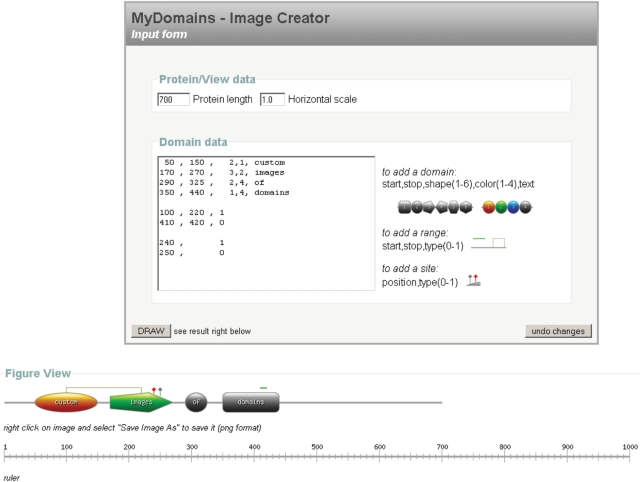
The web form and the output of the PROSITE ‘MyDomains’ image creator tool. A very simple syntax allows the user to define the shape, colour, size and name of one or several domains. Specific residues and ranges can also be marked.

References

    1. Bairoch A. PROSITE: a dictionary of sites and patterns in proteins. Nucleic Acids Res. 1991;19:2241–2245. - PMC - PubMed
    1. Bairoch A, Bucher P. PROSITE: recent developments. Nucleic Acids Res. 1994;22:3583–3589. - PMC - PubMed
    1. Gribskov M, Luthy, R. Eisenberg D. Profile analysis. Meth. Enzymol. 1990;183:146–159. - PubMed
    1. Bucher P, Karplus K, Moeri N, Hofmann K. A flexible motif search technique based on generalized profiles. Comput. Chem. 1996;20:3–23. - PubMed
    1. http://www.isrec.isb-sib.ch/ftp-server/pftools/pft2.3/

Publication types