


Attenuation of counterregulatory responses to recurrent hypoglycemia by active thalamic inhibition: a mechanism for hypoglycemia-associated autonomic failure
- PMID: 18003752
- PMCID: PMC2435187
- DOI: 10.2337/db07-1329
Attenuation of counterregulatory responses to recurrent hypoglycemia by active thalamic inhibition: a mechanism for hypoglycemia-associated autonomic failure
Abstract
Objective: Hypoglycemia, the limiting factor in the glycemic management of diabetes, is the result of the interplay of therapeutic insulin excess and compromised glycemic defenses. The key feature of the latter is an attenuated sympathoadrenal response to hypoglycemia that typically follows an episode of recent antecedent iatrogenic hypoglycemia, a phenomenon termed hypoglycemia-associated autonomic failure (HAAF) in diabetes. We investigated the role of cerebral mechanisms in HAAF by measuring regional brain activation during recurrent hypoglycemia with attenuated counterregulatory responses and comparing it with initial hypoglycemia in healthy individuals.
Research design and methods: We used [(15)O]water and positron emission tomography to measure regional cerebral blood flow as a marker of brain synaptic activity during hyperinsulinemic hypoglycemic clamps (55 mg/dl [3.0 mmol/l]) in the naïve condition (day 1) and after approximately 24 h of interval interprandial hypoglycemia (day 2) in nine healthy adults.
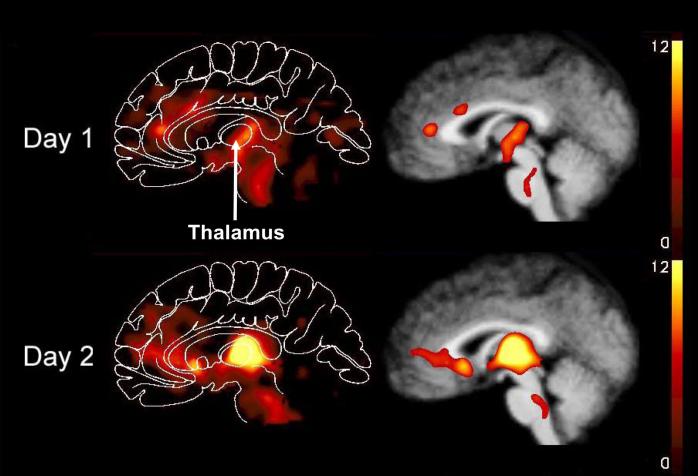
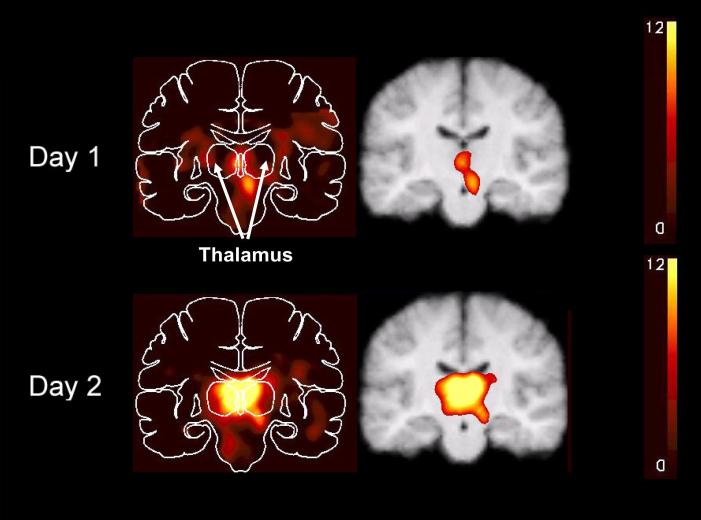
Results: Interval hypoglycemia produced attenuated sympathoadrenal, symptomatic, and other counterregulatory responses to hypoglycemia on day 2, a model of HAAF. Synaptic activity in the dorsal midline thalamus during hypoglycemia was significantly greater on day 2 than day 1 (P = 0.004).
Conclusions: Greater synaptic activity associated with attenuated counterregulatory responses indicates that the dorsal midline thalamus plays an active inhibitory role in reducing sympathoadrenal and symptomatic responses to hypoglycemia when previous hypoglycemia has occurred, the key feature of HAAF in diabetes.
Figures
References
-
- Cryer PE. Diverse causes of hypoglycemia-associated autonomic failure in diabetes. N Engl J Med. 2004;350:2272–2279. - PubMed
-
- Segel SA, Paramore DS, Cryer PE. Hypoglycemia-associated autonomic failure in advanced type 2 diabetes. Diabetes. 2002;51:724–733. - PubMed
-
- DeRosa MA, Cryer PE. Hypoglycemia and the sympathoadrenal system: Neurogenic symptoms are largely the result of sympathetic neural, rather than adrenomedullary, activation. Am J Physiol Endocrinol Metab. 2004;287:E32–E41. - PubMed
-
- Gold AE, MacLeod KM, Frier BM. Frequency of severe hypoglycemia in patients with type 1 diabetes with impaired awareness of hypoglycemia. Diabetes Care. 1994;17:697–703. - PubMed
Publication types
MeSH terms
Substances
Grants and funding
LinkOut - more resources
Full Text Sources
Medical
