


Detectable serum flagellin and lipopolysaccharide and upregulated anti-flagellin and lipopolysaccharide immunoglobulins in human short bowel syndrome
- PMID: 18003793
- PMCID: PMC3064750
- DOI: 10.1152/ajpregu.00650.2007
Detectable serum flagellin and lipopolysaccharide and upregulated anti-flagellin and lipopolysaccharide immunoglobulins in human short bowel syndrome
Abstract
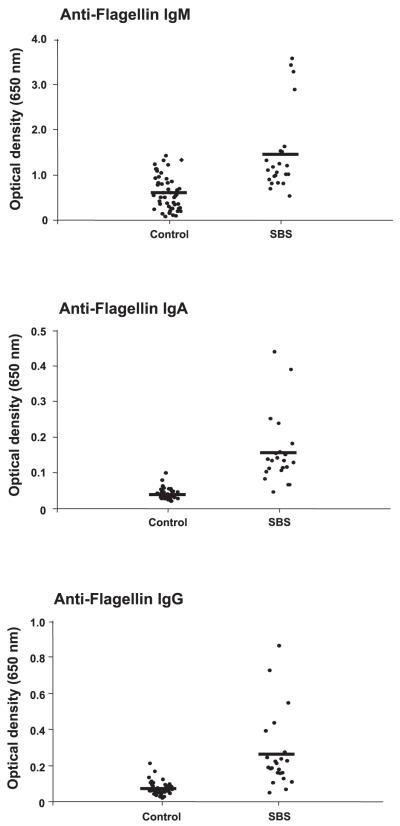
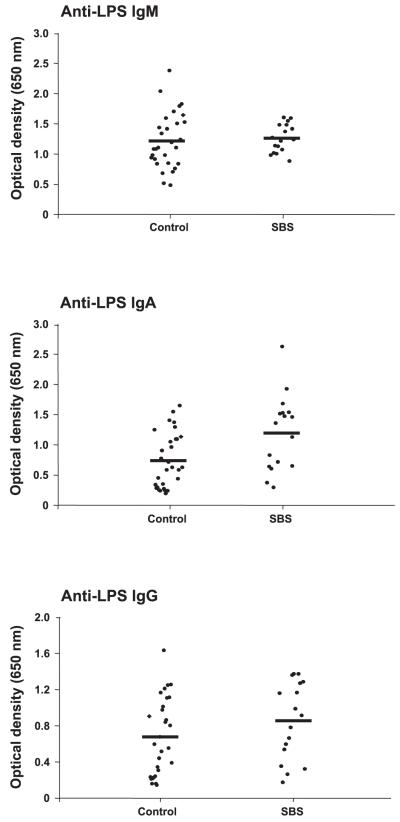
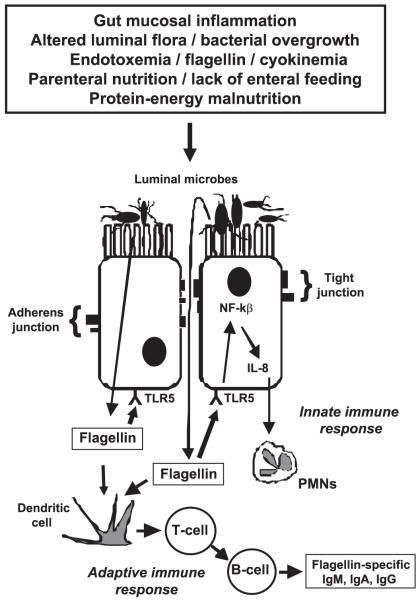
Gut barrier dysfunction may occur in short bowel syndrome (SBS). We hypothesized that systemic exposure to flagellin and lipopolysaccharide (LPS) in SBS might regulate specific immune responses. We analyzed serial serum samples obtained from parenteral nutrition (PN)-dependent patients with SBS versus non-SBS control serum. Serum from 23 adult SBS patients was obtained at baseline and 4, 8, 12, 16, 20, and 24 wk in a trial of modified diet with or without growth hormone. Control serum was obtained from 48 healthy adults and 37 adults requiring PN during critical illness. Serum flagellin was detected by an ELISA recognizing an array of gram-negative flagellins, and LPS was detected by limulus assay. Serum flagellin- and LPS-specific immunoglobulin levels (IgM, IgA, and IgG) were determined by ELISA. Serum flagellin and LPS were undetectable in control subjects. In contrast, serum flagellin, LPS, or both were detected in 14 SBS patients (61%) during one or more time points [flagellin alone, 5/23 (22%); LPS alone, 6/23 (26%); or flagellin + LPS, 3/23 (13%)]. Flagellin-specific serum IgM, IgA, and IgG levels were markedly increased in SBS patients compared with both control populations and remained elevated during the 6-mo study period. LPS-specific IgA was significantly higher in SBS patients compared with healthy controls; LPS-specific IgM, IgA, and IgG levels each decreased over time in association with PN weaning. We conclude that adults with PN-dependent SBS are systemically exposed to flagellin and LPS, presumably from the gut lumen. This likely regulates innate and adaptive immune responses to these specific bacterial products.
Figures
References
-
- Briet F, Flourie B, Achour L, Maurel M, Rambaud JC, Messing B. Bacterial adaptation in patients with short bowel, and colon in continuity. Gastroenterology. 1995;109:1446–1453. - PubMed
-
- Bruewer M, Luegering A, Kucharzik T, Parkos CA, Madara JL, Hopkins AM, Nusrat A. Proinflammatory cytokines disrupt epithelial barrier function by apoptosis-independent mechanisms. J Immunol. 2003;171:6164–6172. - PubMed
-
- Buchman AL, Moukarzel A, Goodson B, Herzog F, Pollack P, Reyen L, Alvarez M, Ament ME, Gornbein J. Catheter-related infections associated with home parenteral nutrition and predictive factors for the need for catheter removal in their treatment. JPEN J Parenter Enteral Nutr. 1994;18:297–230. - PubMed
-
- D’Antiga L, Dhawan A, Davenport M, Mieli-Vergani G, Bjarnason I. Intestinal absorption and permeability in paediatric short-bowel syndrome: a pilot study. J Pediatr Gastroenterol Nutr. 1999;29:588–593. - PubMed
Publication types
MeSH terms
Substances
Grants and funding
- R01 DK 061417/DK/NIDDK NIH HHS/United States
- K24 DK096574/DK/NIDDK NIH HHS/United States
- R01 DK061417/DK/NIDDK NIH HHS/United States
- R01 DK 55850/DK/NIDDK NIH HHS/United States
- M01 RR000039/RR/NCRR NIH HHS/United States
- M01 RR 00039/RR/NCRR NIH HHS/United States
- R01 DK055850/DK/NIDDK NIH HHS/United States
- R24 DK 064399/DK/NIDDK NIH HHS/United States
- K08 DK002802/DK/NIDDK NIH HHS/United States
- K24 RR023356/RR/NCRR NIH HHS/United States
- UL1 RR025008/RR/NCRR NIH HHS/United States
- UL1 TR000454/TR/NCATS NIH HHS/United States
- R24 DK064399/DK/NIDDK NIH HHS/United States
- R01 DK 002802/DK/NIDDK NIH HHS/United States
- R03 DK067123/DK/NIDDK NIH HHS/United States
LinkOut - more resources
Full Text Sources
Other Literature Sources
Miscellaneous
