Control of membrane fusion mechanism by lipid composition: predictions from ensemble molecular dynamics
- PMID: 18020701
- PMCID: PMC2077900
- DOI: 10.1371/journal.pcbi.0030220
Control of membrane fusion mechanism by lipid composition: predictions from ensemble molecular dynamics
Abstract
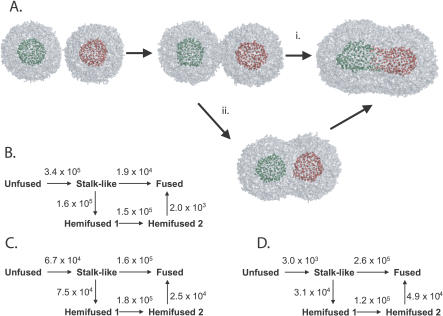
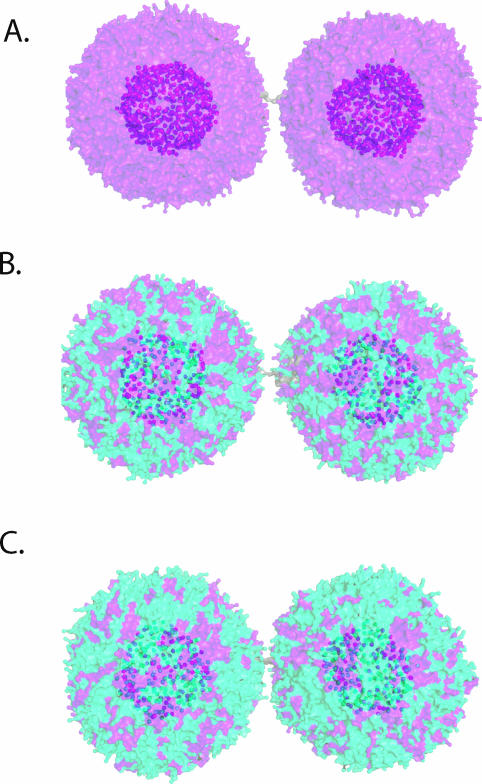
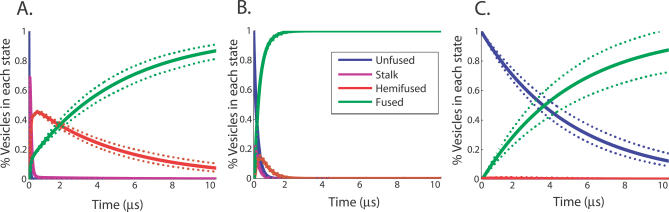
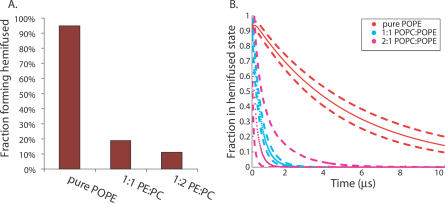
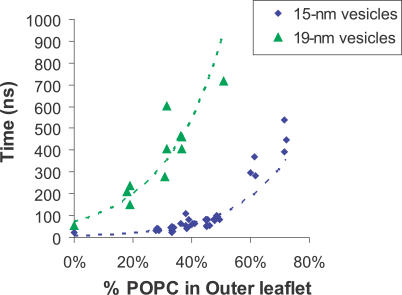
Membrane fusion is critical to biological processes such as viral infection, endocrine hormone secretion, and neurotransmission, yet the precise mechanistic details of the fusion process remain unknown. Current experimental and computational model systems approximate the complex physiological membrane environment for fusion using one or a few protein and lipid species. Here, we report results of a computational model system for fusion in which the ratio of lipid components was systematically varied, using thousands of simulations of up to a microsecond in length to predict the effects of lipid composition on both fusion kinetics and mechanism. In our simulations, increased phosphatidylcholine content in vesicles causes increased activation energies for formation of the initial stalk-like intermediate for fusion and of hemifusion intermediates, in accordance with previous continuum-mechanics theoretical treatments. We also use our large simulation dataset to quantitatively compare the mechanism by which vesicles fuse at different lipid compositions, showing a significant difference in fusion kinetics and mechanism at different compositions simulated. As physiological membranes have different compositions in the inner and outer leaflets, we examine the effect of such asymmetry, as well as the effect of membrane curvature on fusion. These predicted effects of lipid composition on fusion mechanism both underscore the way in which experimental model system construction may affect the observed mechanism of fusion and illustrate a potential mechanism for cellular regulation of the fusion process by altering membrane composition.
Conflict of interest statement
Figures

References
-
- Brown MS, Goldstein JL. A receptor-mediated pathway for cholesterol homeostasis. Science. 1986;232:34–47. - PubMed
-
- Goldstein JL, DeBose-Boyd RA, Brown MS. Protein sensors for membrane sterols. Cell. 2006;124:35–46. - PubMed
-
- Schneiter R, Brugger B, Sandhoff R, Zellnig G, Leber A, et al. Electrospray ionization tandem mass spectrometry (ESI-MS/MS) analysis of the lipid molecular species composition of yeast subcellular membranes reveals acyl chain-based sorting/remodeling of distinct molecular species en route to the plasma membrane. J Cell Biol. 1999;146:741–754. - PMC - PubMed
-
- Sprong H, van der Sluijs P, van Meer G. How proteins move lipids and lipids move proteins. Nat Rev Mol Cell Biol. 2001;2:504–513. - PubMed
-
- Chernomordik LV, Kozlov MM. Protein-lipid interplay in fusion and fission of biological membranes. Annu Rev Biochem. 2003;72:175–207. - PubMed
Publication types
MeSH terms
Substances
LinkOut - more resources
Full Text Sources
Other Literature Sources