


Genetics and smoking cessation improving outcomes in smokers at risk
- PMID: 18021915
- PMCID: PMC2170888
- DOI: 10.1016/j.amepre.2007.09.006
Genetics and smoking cessation improving outcomes in smokers at risk
Abstract
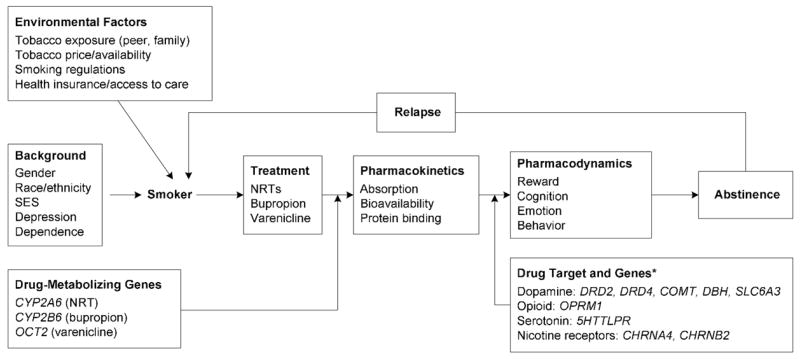
This article reviews evidence supporting the potential utility of a pharmacogenetic approach to the treatment of nicotine dependence. There is substantial evidence that nicotine dependence and smoking persistence are heritable, and are determined by a complex interplay of polygenic and environmental influences. The most robust evidence for specific genetic influences on nicotine dependence is found in studies of genetic variation in nicotine-metabolizing enzymes. Data also support the role of genes in the dopamine and opioid pathways as predictors of dependence and smoking relapse; however, the evidence for genetic associations is not always consistent. Emerging data from pharmacogenetic trials of nicotine-dependence treatment are promising, suggesting that genetic profiles of smokers someday may be used by providers to choose the type, dose, and duration of treatment for individual smokers. However, additional trials including larger and more diverse populations are needed before such data can be translated to practice to reduce smoking prevalence and tobacco-related disease.
Figures
References
-
- Fiore MC, Bailey W, Cohen S. Clinical Practice Guideline. Rockville MD: U.S. Department of Health and Human Services (USDHHS). Public Health Service; 2000. Treating tobacco use and dependence.
-
- Fiore M, Smith S, Jorenby D, Baker T. The effectiveness of the nicotine patch for smoking cessation: a meta-analysis. JAMA. 1994;271:1940–47. - PubMed
-
- Transdermal Nicotine Study Group. Transdermal nicotine for smoking cessation: Six-month results from two multicenter controlled trials. JAMA. 1991;266:3133–38. - PubMed
-
- Gold PB, Rubey RN, Harvey RT. Naturalistic, self-assignment comparative trial of bupropion SR, a nicotine patch, or both for smoking cessation treatment in primary care. Am J Addict. 2002;11:315–31. - PubMed
-
- Jorenby DE, Leischow SJ, Nides MA, et al. A controlled trial of sustained-release bupropion, a nicotine patch, or both for smoking cessation. N Engl J Med. 1999;340:685–91. - PubMed
Publication types
MeSH terms
Substances
Grants and funding
LinkOut - more resources
Full Text Sources
Other Literature Sources
Medical
