Comparative Study
. 2008 Jan;47(1):236-46.
doi: 10.1002/hep.21912.

Minocycline and N-methyl-4-isoleucine cyclosporin (NIM811) mitigate storage/reperfusion injury after rat liver transplantation through suppression of the mitochondrial permeability transition

Affiliations
Comparative Study

Minocycline and N-methyl-4-isoleucine cyclosporin (NIM811) mitigate storage/reperfusion injury after rat liver transplantation through suppression of the mitochondrial permeability transition

Tom P Theruvath et al. Hepatology. 2008 Jan.

Abstract

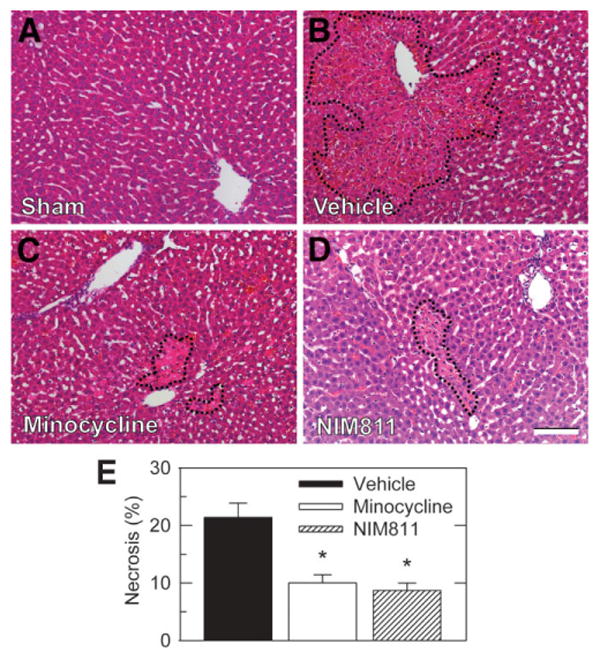
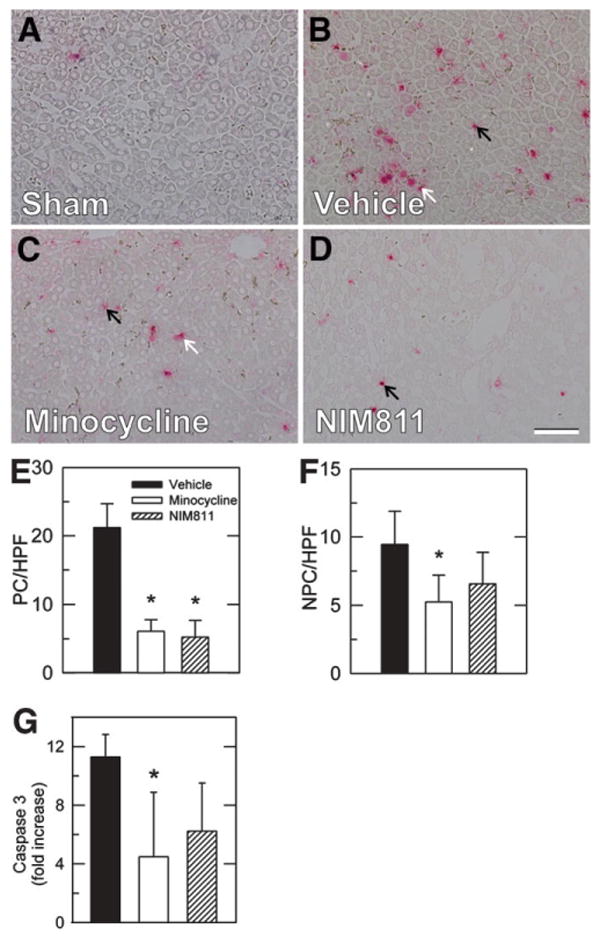
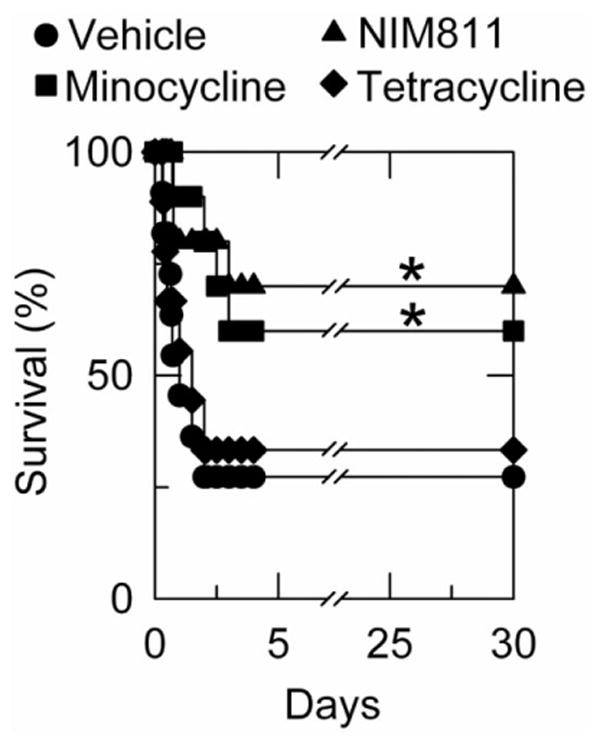
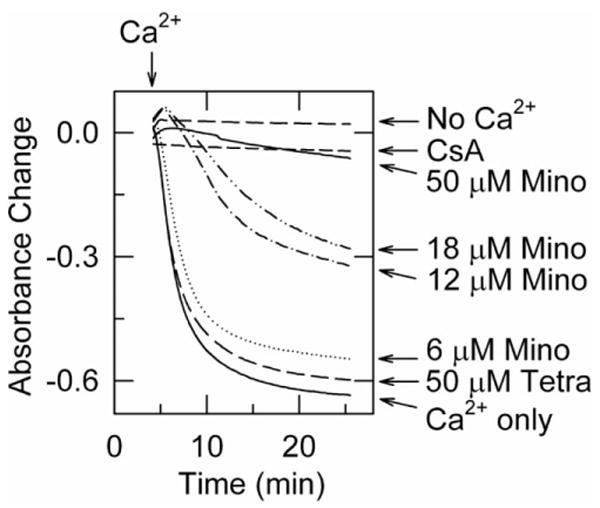
Graft failure after liver transplantation may involve mitochondrial dysfunction. We examined whether prevention of mitochondrial injury would improve graft function. Orthotopic rat liver transplantation was performed after 18 hours' cold storage in University of Wisconsin solution and treatment with vehicle, minocycline, tetracycline, or N-methyl-4-isoleucine cyclosporin (NIM811) of explants and recipients. Serum alanine aminotransferase (ALT), necrosis, and apoptosis were assessed 6 hours after implantation. Mitochondrial polarization and cell viability were assessed by intravital microscopy. Respiration and the mitochondrial permeability transition (MPT) were assessed in isolated rat liver mitochondria. After transplantation with vehicle or tetracycline, ALT increased to 5242 U/L and 4373 U/L, respectively. Minocycline and NIM811 treatment decreased ALT to 2374 U/L and 2159 U/L, respectively (P < 0.01). Necrosis and terminal deoxynucleotidyl transferase-mediated nick-end labeling (TUNEL) also decreased from 21.4% and 21 cells/field, respectively, after vehicle to 10.1% and 6 cells/field after minocycline and to 8.7% and 5.2 cells/field after NIM811 (P < 0.05). Additionally, minocycline decreased caspase-3 activity in graft homogenates (P < 0.05). Long-term graft survival was 27% and 33%, respectively, after vehicle and tetracycline treatment, which increased to 60% and 70% after minocycline and NIM811 (P < 0.05). In isolated mitochondria, minocycline and NIM811 but not tetracycline blocked the MPT. Minocycline blocked the MPT by decreasing mitochondrial Ca(2+) uptake, whereas NIM811 blocks by interaction with cyclophilin D. Intravital microscopy showed that minocycline and NIM811 preserved mitochondrial polarization and cell viability after transplantation (P < 0.05).

Conclusion: Minocycline and NIM811 attenuated graft injury after rat liver transplantation and improved graft survival. Minocycline and/or NIM811 might be useful clinically in hepatic surgery and transplantation.


Conflict of interest statement

Potential conflict of interest: Nothing to report.

Figures
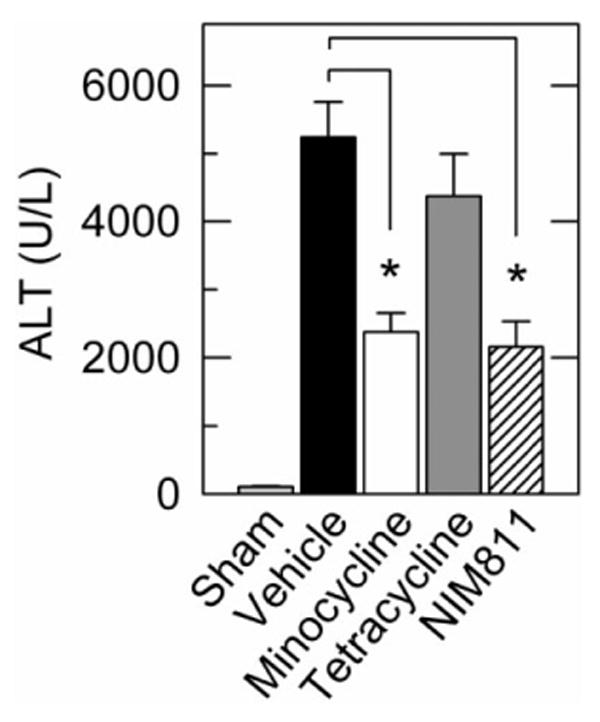
Fig. 1
Fig. 1
Minocycline and NIM811 decrease ALT release after rat liver transplantation. Serum ALT was assessed 6 hours after sham operation or rat liver transplantation. Explants and recipients were treated with vehicle (lactated Ringer's solution), minocycline (18 μM to explants, 10 mg/kg to recipients), tetracycline (18 μM to explants, 10 mg/kg to recipients), or NIM811 (5 μM to explants, 10 mg/kg to recipients). Group sizes were: sham, 4; vehicle, 21; minocycline, 10; tetracycline, 10; NIM811, 8. *P< 0.05.
Fig. 2
Fig. 2
Minocycline and NIM811 decrease necrosis after liver transplantation. Rat livers were transplanted, as described in Fig. 1. At 6 hours postoperatively, necrosis was assessed by hematoxylin-eosin histology in sham-operated (A), vehicle-treated (B), minocycline-treated (C), and NIM811-treated (D) grafts. Dashed lines identify necrotic areas. (E) Necrosis as percent area in liver sections averaged from 5 livers per group. Necrosis in sham was absent and not plotted. Bar is 100 μm. *P < 0.05 versus vehicle.
Fig. 3
Fig. 3
Minocycline and NIM811 decrease apoptosis after rat liver transplantation. Rat livers were transplanted, as described in Fig. 1. At 6 hours postoperatively, TUNEL was assessed in sections of sham-operated (A), vehicle-treated (B), minocycline-treated (C), and NIM811-treated (D) grafts. (E and F) TUNEL in parenchymal (PC) and nonparenchymal (NPC) cells. TUNEL for sham was virtually zero and not plotted. (G) Caspase 3 activity in liver homogenates at 6 hours after transplantation as fold increase over sham operation. Bar is 50 μm. *P < 0.05 versus vehicle.
Fig. 4
Fig. 4
Minocycline and NIM811 improve survival after liver transplantation. Thirty-day survival was assessed in rats subjected to liver transplantation after treatments with vehicle, minocycline, NIM811, or tetracycline, as described in Fig. 1. Size of individual groups was 9 to 11. *P < 0.05 compared with vehicle and tetracycline.
Fig. 5
Fig. 5
Minocycline inhibits calcium-induced swelling of isolated mitochondria. Swelling of rat liver mitochondria was monitored by absorbance, as described in Materials and Methods. CaCl2 (250 μM) was added at arrow except for tracing marked No Ca2+. Two minutes before CaCl2 addition, mitochondria were treated with minocycline (Mino), tetracycline (Tetra), or 1 μM CsA.
Fig. 6
Fig. 6
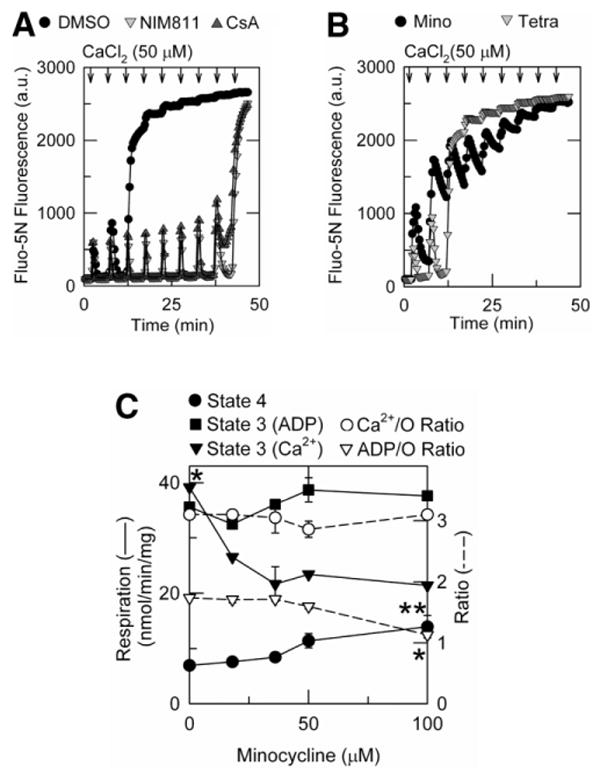
Minocycline inhibits calcium uptake without altering oxidative phosphorylation or energetic efficiency of calcium accumulation. Free Ca2+ was measured from Fluo-5N fluorescence, and oxygen consumption was measured polarographically, as described in Materials and Methods. (A) Mitochondria were preincubated with dimethylsulfoxide, 5 μM NIM811, or 1 μM CsA. After 2 minutes, 50 μM CaCl2 was added every 5 minutes (arrows). (B) Mitochondria were preincubated for 2 minutes with 18 μM minocycline or 18 μM tetracycline, and CaCl2 was added as in (A). (C) State 4 and state 3 respiration were measured before and after addition of 218 μM ADP or 250 μM CaCl2, as described in Materials and Methods. ADP/O and Ca2+/O ratios were calculated from total oxygen consumed during state 3 respiration from 3 or more measurements. *P < 0.05, **P < 0.05 versus no minocycline.
Fig. 7
Fig. 7
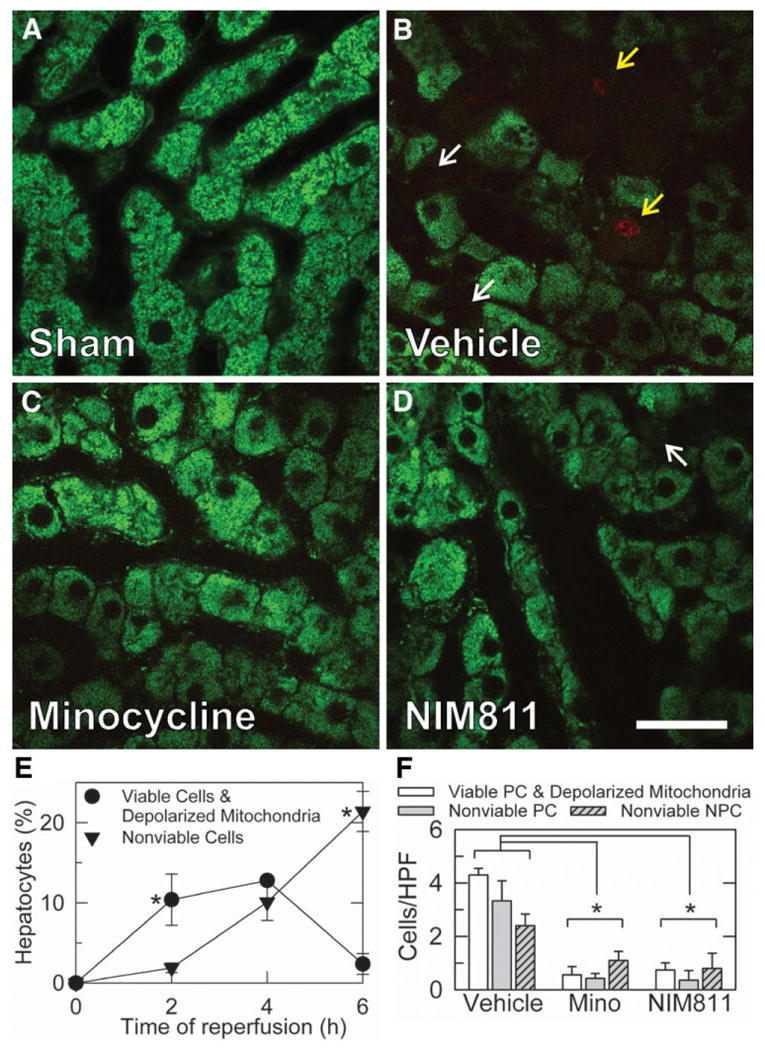
Minocycline and NIM811 decrease mitochondrial depolarization and cell death after rat liver transplantation. Donor livers and graft recipients were treated with vehicle, minocycline, or NIM811, as described in Fig. 1. At 4 hours postoperatively, liver grafts were visualized by intravital multiphoton microscopy of rhodamine 123 and PI fluorescence. Shown are representative overlay images of green rhodamine 123 and red PI fluorescence collected from livers after sham operation (A) and liver grafts after vehicle (B), minocycline (C), and NIM811 (D) treatment. Punctate staining of rhodamine 123 denoted polarization of individual mitochondria, whereas dim diffuse cellular staining indicated mitochondrial depolarization (white arrows). PI nuclear staining signified loss of cell viability (yellow arrows). (E) Quantification of the time course of mitochondrial depolarization and cell death after liver transplantation as a percentage of hepatocytes using intravital spinning disk confocal microscopy performed after sham operation (0 hours) and at 2-6 hours postoperatively. Individual group sizes were 3-4 rats per time-point. *P < 0.05 versus other group. (F) Quantification of numbers per HPF of viable parenchymal cells (PC) with depolarized mitochondria, nonviable PC, and nonviable nonparenchymal cells (NPC) at 4 hours after transplantation from intravital multiphoton microscopy. Size of individual groups was 5. Bar is 30 μm. *P < 0.05.

Comment in

References

    1. Caldwell-Kenkel JC, Currin RT, Tanaka Y, Thurman RG, Lemasters JJ. Kupffer cell activation and endothelial cell damage after storage of rat livers: effects of reperfusion. Hepatology. 1991;13:83–95. - PubMed
    1. Takei Y, Marzi I, Gao WS, Gores GJ, Lemasters JJ, Thurman RG. Leukocyte adhesion and cell-death following orthotopic liver-transplantation in the rat. Transplantation. 1991;51:959–965. - PubMed
    1. Jaeschke H, Lemasters JJ. Apoptosis versus oncotic necrosis in hepatic ischemia/reperfusion injury. Gastroenterology. 2003;125:1246–1257. - PubMed
    1. Rudiger HA, Graf R, Clavien PA. Liver ischemia: apoptosis as a central mechanism of injury. J Invest Surg. 2003;16:149–159. - PubMed
    1. Kim JS, He L, Lemasters JJ. Mitochondrial permeability transition: a common pathway to necrosis and apoptosis. Biochem Biophys Res Commun. 2003;304:463–470. - PubMed

Publication types

MeSH terms