


Longitudinal associations between television viewing and body mass index among white and black girls
- PMID: 18023782
- PMCID: PMC2128759
- DOI: 10.1016/j.jadohealth.2007.04.018
Longitudinal associations between television viewing and body mass index among white and black girls
Abstract
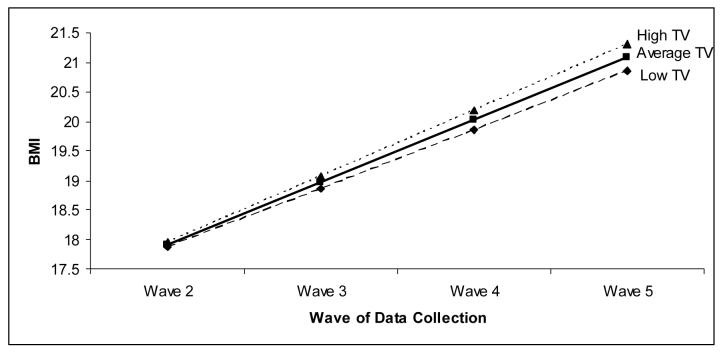
Purpose: Childhood overweight is one of the most important public health problems facing America today, and time spent watching television has been proposed as a causal factor. This study examines the effects of television (TV) viewing on the trajectory of body mass index (BMI) over the course of adolescence.
Methods: We analyzed data on TV viewing and BMI from the National Heart, Lung, and Blood Institute Growth and Health Study, a panel study of 2,379 white and black girls followed for up to 10 annual visits, beginning at age 9 or 10 years. Latent growth curve models were used to estimate the effects of daily TV viewing on the slope of BMI, one using TV viewing at age 10 to predict the trajectory of BMI from ages 11-14, and one using TV viewing at age 14 to predict BMI trajectory from ages 15-19. Models controlled for baseline BMI, physical activity, maturation stage, and socioeconomic status.
Results: For white girls, higher levels of baseline TV viewing were positively associated with a steeper trajectory of BMI for the 4 years following a baseline visit (ages 11-14 years, on average). TV viewing was not associated with the trajectory of BMI over the last five of the 10 visits. For black girls, TV viewing was not associated with either trajectory of BMI.
Conclusions: White girls who watched more TV at baseline showed a steeper increase in BMI over early adolescence compared to girls who watched less TV. TV viewing may be a factor contributing to overweight among young girls.
Figures
Comment in
-
The prominent influence of race on weight-related health among children and adolescents.J Adolesc Health. 2007 Dec;41(6):523-4. doi: 10.1016/j.jadohealth.2007.09.007. J Adolesc Health. 2007. PMID: 18023779 No abstract available.
References
-
- Flegal KM, Carroll MD, Ogden CL, et al. Prevalence and Trends in Obesity Among US Adults, 1999-2000. JAMA. 2002;288:1723–1727. - PubMed
-
- Ogden CL, Flegal KM, Carroll MD, et al. Prevalence and Trends in Overweight among US Children and Adolescents, 1999-2000. JAMA. 2002;288:1728–1732. - PubMed
-
- Hedley AA, Ogden CL, Johnson CL, et al. Prevalence of Overweight and Obesity among US Children, Adolescents, and Adults, 1999-2002. JAMA. 2004;291:2847–2850. - PubMed
-
- Ogden CL, Carroll MD, Curtin LR, et al. Prevalence of Overweight and Obesity in the United States, 1999-2004. JAMA. 2006;295:1549–1555. - PubMed
-
- Eisenmann JC, Bartee RT, Wang MQ. Physical Activity, TV Viewing, and Weight in U.S. Youth: 1999 Youth Risk Behavior Survey. Obes Res. 2002;10:379–385. - PubMed
Publication types
MeSH terms
Grants and funding
LinkOut - more resources
Full Text Sources
