


A new Late Miocene great ape from Kenya and its implications for the origins of African great apes and humans
- PMID: 18024593
- PMCID: PMC2148271
- DOI: 10.1073/pnas.0706190104
A new Late Miocene great ape from Kenya and its implications for the origins of African great apes and humans
Abstract
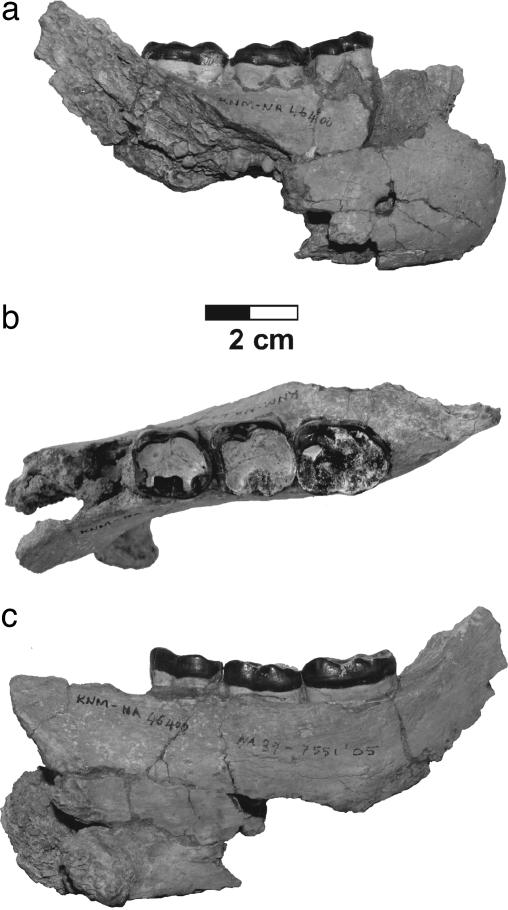
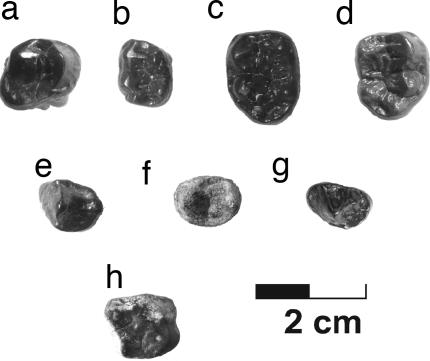
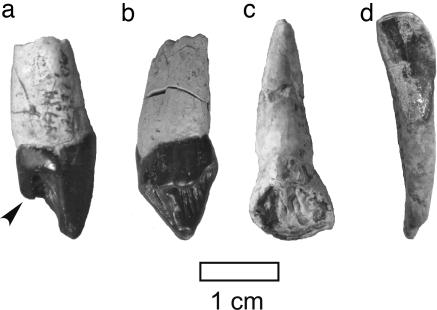
Extant African great apes and humans are thought to have diverged from each other in the Late Miocene. However, few hominoid fossils are known from Africa during this period. Here we describe a new genus of great ape (Nakalipithecus nakayamai gen. et sp. nov.) recently discovered from the early Late Miocene of Nakali, Kenya. The new genus resembles Ouranopithecus macedoniensis (9.6-8.7 Ma, Greece) in size and some features but retains less specialized characters, such as less inflated cusps and better-developed cingula on cheek teeth, and it was recovered from a slightly older age (9.9-9.8 Ma). Although the affinity of Ouranopithecus to the extant African apes and humans has often been inferred, the former is known only from southeastern Europe. The discovery of N. nakayamai in East Africa, therefore, provides new evidence on the origins of African great apes and humans. N. nakayamai could be close to the last common ancestor of the extant African apes and humans. In addition, the associated primate fauna from Nakali shows that hominoids and other non-cercopithecoid catarrhines retained higher diversity into the early Late Miocene in East Africa than previously recognized.
Conflict of interest statement
The authors declare no conflict of interest.
Figures
Comment in
-
New apes fill the gap.Proc Natl Acad Sci U S A. 2007 Dec 11;104(50):19661-2. doi: 10.1073/pnas.0710109105. Epub 2007 Dec 5. Proc Natl Acad Sci U S A. 2007. PMID: 18077396 Free PMC article. No abstract available.
References
-
- Goodman M, Porter CA, Czelusniak J, Page SL, Schneider H, Shoshani J, Gunnell G, Groves CP. Mol Phylogenet Evol. 1998;9:585–598. - PubMed
-
- Stauffer RL, Walker A, Ryder OA, Lyons-Weiler M, Blair Hedges S. J Hered. 2001;92:469–474. - PubMed
-
- Glazko GV, Nei M. Mol Biol Evol. 2003;20:424–434. - PubMed
-
- Steiper ME, Young NM. Mol Phylogenet Evol. 2006;2006:384–394. - PubMed
-
- Hill A, Ward S. Yearb Phys Anthropol. 1988;31:49–83.
Publication types
MeSH terms
LinkOut - more resources
Full Text Sources
Research Materials
Miscellaneous
