. 2007 Nov 27;104(48):18976-81.
doi: 10.1073/pnas.0705127104. Epub 2007 Nov 16.

Molecular crowding enhances native structure and stability of alpha/beta protein flavodoxin

Affiliations

Molecular crowding enhances native structure and stability of alpha/beta protein flavodoxin

Loren Stagg et al. Proc Natl Acad Sci U S A. .

Abstract

To investigate the consequences of macromolecular crowding on the behavior of a globular protein, we performed a combined experimental and computational study on the 148-residue single-domain alpha/beta protein, Desulfovibrio desulfuricans apoflavodoxin. In vitro thermal unfolding experiments, as well as assessment of native and denatured structures, were probed by using far-UV CD in the presence of various amounts of Ficoll 70, an inert spherical crowding agent. Ficoll 70 has a concentration-dependent effect on the thermal stability of apoflavodoxin (DeltaT(m) of 20 degrees C at 400 mg/ml; pH 7). As judged by CD, addition of Ficoll 70 causes an increase in the amount of secondary structure in the native-state ensemble (pH 7, 20 degrees C) but only minor effects on the denatured state. Theoretical calculations, based on an off-lattice model and hard-sphere particles, are in good agreement with the in vitro data. The simulations demonstrate that, in the presence of 25% volume occupancy of spheres, native flavodoxin is thermally stabilized, and the free energy landscape shifts to favor more compact structures in both native and denatured states. The difference contact map reveals that the native-state compaction originates in stronger interactions between the helices and the central beta-sheet, as well as by less fraying in the terminal helices. This study demonstrates that macromolecular crowding has structural effects on the folded ensemble of polypeptides.


Conflict of interest statement

The authors declare no conflict of interest.

Figures
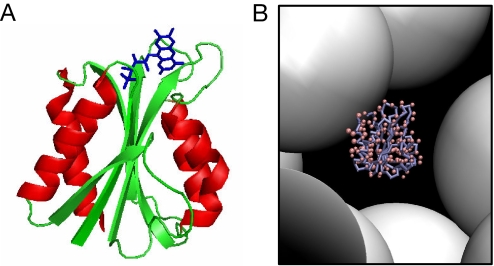
Fig. 1.
Fig. 1.
Protein system used in this study. (A) Model of D. vulgaris flavodoxin (2fx2). The sequence of D. desulfuricans flavodoxin, used in our in vitro experiments, is 46% identical to that of D. vulgaris. Green, β-sheets and loops; red, α-helices; blue, FMN cofactor (removed in our experiments). (B) Snapshot of apoflavodoxin and hard spheres of the size of Ficoll 70 (volume fraction = 25%) as used in the simulations.
Fig. 2.
Fig. 2.
In vitro thermal stability as a function of crowding agent. (A) Thermal unfolding curves for apoflavodoxin probed by far-UV CD in the presence of various amounts of Ficoll 70. (B) Tm vs. Ficoll 70 concentrations for apoflavodoxin in three different buffer conditions (squares, 10 mM Hepes; circles, 20 mM phosphate; diamonds, 40 mM phosphate plus 250 mM NaCl, all at pH 7).
Fig. 3.
Fig. 3.
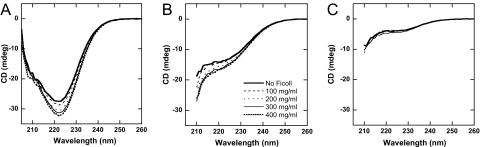
In vitro structural effects due to macromolecular crowding. Far-UV CD of (A) folded (pH 7, 20°C), (B) thermally unfolded (pH 7, 95°C), and (C) chemically unfolded (3 M GuHCl, pH 7, 20°C) flavodoxin in the presence of various amounts of Ficoll 70 (key for all in B).
Fig. 4.
Fig. 4.
In silico energy landscapes for apoflavodoxin with and without crowding. The 2D free-energy landscape as a function of Rg and Q at T = 360 K at volume fractions of crowder of zero (i.e., bulk) (A) and 25% (B). Rg is the radius of gyration in unit of σ (σ = 3.8 Å). Q is the fraction of native contacts. The color is scaled by kBT.
Fig. 5.
Fig. 5.
Mapping of in silico structural changes due to crowding against residue numbers. Difference contact map of the folded (A) and unfolded states (B) between 25% and 0% volume occupancy of crowders at T = 360 K. Secondary structure elements are indicated.
Fig. 6.
Fig. 6.
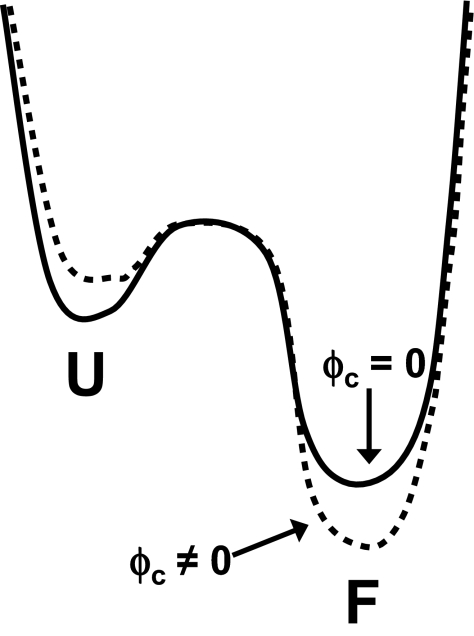
Crowding affects both folded and unfolded ensembles. Schematic free-energy profile for flavodoxin folding. The enhanced stability at φc ≠ 0 (dashed curve) is due to a combination of unfolded-state destabilization and stabilizing of the folded state.

References

    1. van den Berg B, Ellis RJ, Dobson CM. EMBO J. 1999;18:6927–6933. - PMC - PubMed
    1. Rivas G, Ferrone F, Herzfeld J. EMBO Rep. 2004;5:23–27. - PMC - PubMed
    1. Record MT, Jr, Courtenay ES, Cayley S, Guttman HJ. Trends Biochem Sci. 1998;23:190–194. - PubMed
    1. Ellis RJ, Minton AP. Nature. 2003;425:27–28. - PubMed
    1. Zimmerman SB, Minton AP. Annu Rev Biophys Biomol Struct. 1993;22:27–65. - PubMed

Publication types