. 2008 Jan;74(1):188-99.
doi: 10.1128/AEM.00327-07. Epub 2007 Nov 16.

Bacterial community composition in Central European running waters examined by temperature gradient gel electrophoresis and sequence analysis of 16S rRNA genes

Affiliations

Bacterial community composition in Central European running waters examined by temperature gradient gel electrophoresis and sequence analysis of 16S rRNA genes

Sara Beier et al. Appl Environ Microbiol. 2008 Jan.

Abstract

The bacterial community composition in small streams and a river in central Germany was examined by temperature gradient gel electrophoresis (TGGE) with PCR products of 16S rRNA gene fragments and sequence analysis. Complex TGGE band patterns suggested high levels of diversity of bacterial species in all habitats of these environments. Cluster analyses demonstrated distinct differences among the communities in stream and spring water, sandy sediments, biofilms on stones, degrading leaves, and soil. The differences between stream water and sediment were more significant than those between sites within the same habitat along the stretch from the stream source to the mouth. TGGE data from an entire stream course suggest that, in the upper reach of the stream, a special suspended bacterial community is already established and changes only slightly downstream. The bacterial communities in water and sediment in an acidic headwater with a pH below 5 were highly similar to each other but deviated distinctly from the communities at the other sites. As ascertained by nucleotide sequence analysis, stream water communities were dominated by Betaproteobacteria (one-third of the total bacteria), whereas sediment communities were composed mainly of Betaproteobacteria and members of the Fibrobacteres/Acidobacteria group (each accounting for about 25% of bacteria). Sequences obtained from bacteria from water samples indicated the presence of typical cosmopolitan freshwater organisms. TGGE bands shared between stream and soil samples, as well as sequences found in bacteria from stream samples that were related to those of soil bacteria, demonstrated the occurrence of some species in both stream and soil habitats. Changes in bacterial community composition were correlated with geographic distance along a stream, but in comparisons of different streams and rivers, community composition was correlated only with environmental conditions.


Figures
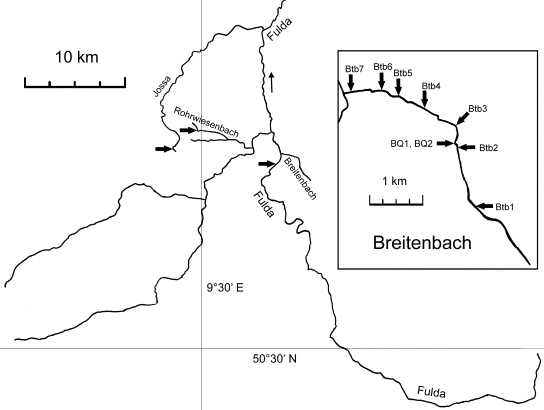
FIG. 1.
FIG. 1.
Map of the upper Fulda River catchment in central Germany showing the locations of the sampling sites (indicated by arrows).
FIG. 2.
FIG. 2.
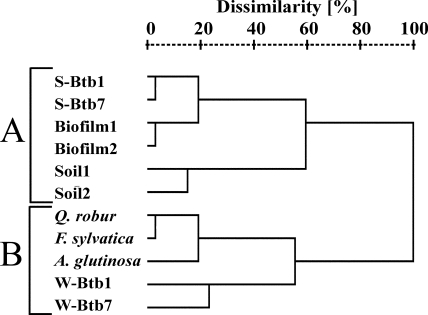
Comparison of the bacterial community compositions in different habitats of the Breitenbach by cluster analysis of TGGE profiles prepared with 16S rRNA gene fragments. The dissimilarity matrix for each sample was calculated using squared Euclidean distances, and clustering was performed by the Ward method. The highest dissimilarity value between samples was set at 100%.
FIG. 3.
FIG. 3.
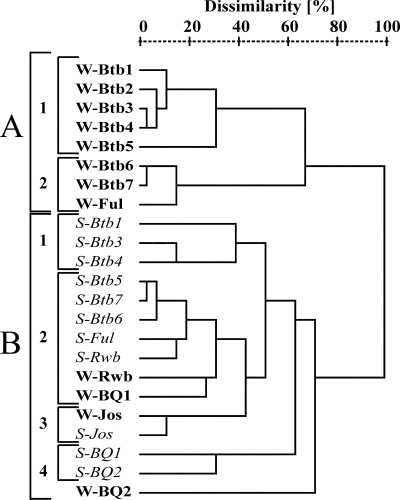
Comparison of the bacterial community compositions in water and sediment samples from the Breitenbach (sites Btb1 to Btb7), the Breitenbach spring (BQ1 and BQ2), the Rohrwiesenbach and Jossa streams, and the river Fulda. The dendrogram was prepared as described in the legend to Fig. 2.
FIG. 4.
FIG. 4.
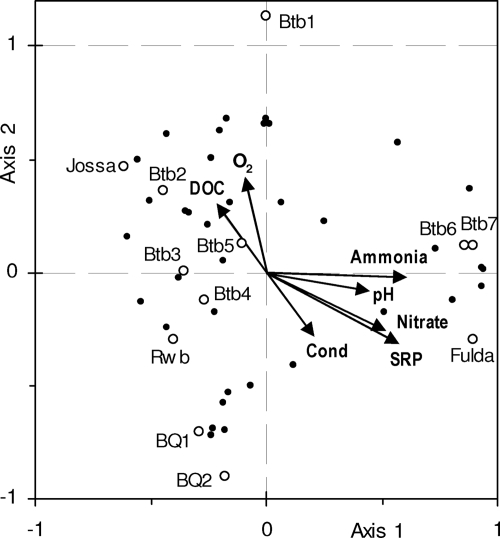
PCA biplot of the TGGE band patterns (active variables) and environmental data (passive variables) from water samples from all studied streams and rivers. Axes 1 and 2 explain 40% of the variance in bacterial community composition. Small points symbolize operational taxonomic units (TGGE bands of identical positions), and large open circles indicate the sampling sites. Environmental variables are as follows: DOC concentration, soluble reactive phosphorus (SRP) concentration, and conductivity (cond).
FIG. 5.
FIG. 5.
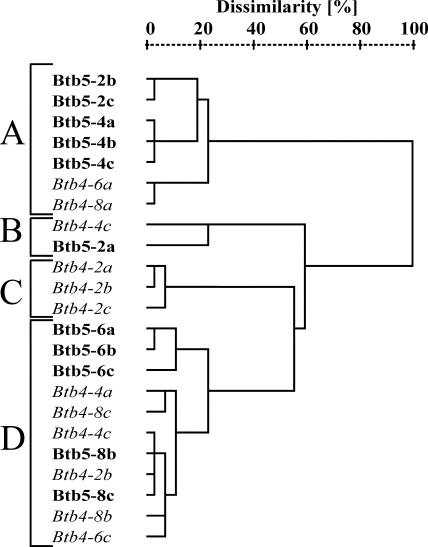
Comparison of the bacterial community compositions in depth profiles from two sediment cores from sampling sites Btb4 and Btb5 in the middle reach of the Breitenbach. The dendrogram was prepared as described in the legend to Fig. 2. Depths are indicated as follows: 2, 0 to 2 cm; 4, 2 to 4 cm; 6, 4 to 6 cm; and 8, 6 to 8 cm. Suffixes a to c denote subsamples.
FIG. 6.
FIG. 6.
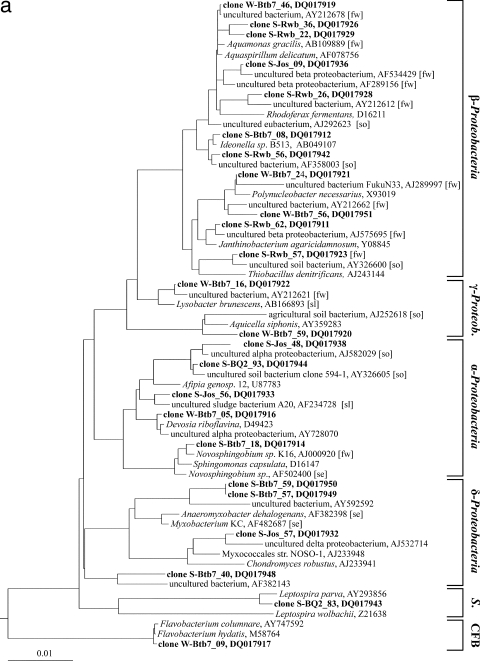
Phylogenetic trees based on partial 16S rRNA gene sequences obtained from bacteria from water and sediment samples (in boldface) and their nearest relatives from GenBank. Sequences are coded by sample designation, clone number, and GenBank accession number. If known, the habitat of the nearest relative is given in brackets (fw, freshwater; se, sediment, freshwater, or estuary; so, soil; and sl, activated sludge). The trees were generated by using the ARB software package with the maximum-likelihood algorithm. (a) Proteobacteria (γ-Proteob., Gammaproteobacteria), Spirochaetes (S.), and the Bacteroidetes/Chlorobi group (CFB). The scale bar represents 1 nucleotide substitution per 100 nucleotides. (b) The Fibrobacteres/Acidobacteria group, Verrucomicrobia (Verruco.), and Planctomycetes (Plancto.). The scale bar represents 1 nucleotide substitution per 20 nucleotides. (c) Actinobacteria and Chloroflexi (Chl.). The scale bar represents 1 nucleotide substitution per 20 nucleotides.
FIG. 6.
FIG. 6.
Phylogenetic trees based on partial 16S rRNA gene sequences obtained from bacteria from water and sediment samples (in boldface) and their nearest relatives from GenBank. Sequences are coded by sample designation, clone number, and GenBank accession number. If known, the habitat of the nearest relative is given in brackets (fw, freshwater; se, sediment, freshwater, or estuary; so, soil; and sl, activated sludge). The trees were generated by using the ARB software package with the maximum-likelihood algorithm. (a) Proteobacteria (γ-Proteob., Gammaproteobacteria), Spirochaetes (S.), and the Bacteroidetes/Chlorobi group (CFB). The scale bar represents 1 nucleotide substitution per 100 nucleotides. (b) The Fibrobacteres/Acidobacteria group, Verrucomicrobia (Verruco.), and Planctomycetes (Plancto.). The scale bar represents 1 nucleotide substitution per 20 nucleotides. (c) Actinobacteria and Chloroflexi (Chl.). The scale bar represents 1 nucleotide substitution per 20 nucleotides.
FIG. 7.
FIG. 7.
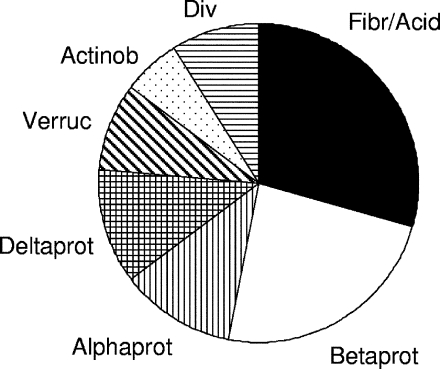
Taxonomic distribution of the clonal 16S rRNA gene sequences from bacteria from stream sediments in eastern Hesse (Germany). Fibr/Acid, Fibrobacteres/Acidobacteria group; Betaprot, Betaproteobacteria; Alphaprot, Alphaproteobacteria; Deltaprot, Deltaproteobacteria; Verruc, Verrucomicrobia; Actinob, Actinobacteria. The category Div contains Spirochaetes, Planctomycetes, and Chloroflexi.

References

    1. Allan, J. D. 1995. Stream ecology: structure and function of running waters. Chapman & Hall, London, United Kingdom.
    1. Amann, R. I., W. Ludwig, and K.-H. Schleifer. 1995. Phylogenetic identification and in situ detection of individual microbial cells without cultivation. Microbiol. Rev. 59:143-169. - PMC - PubMed
    1. Araya, R., K. Tani, T. Takagi, N. Yamaguchi, and M. Nasu. 2003. Bacterial activity and community composition in stream water and biofilm from an urban river determined by fluorescent in situ hybridization and DGGE analysis. FEMS Microbiol. Ecol. 43:111-119. - PubMed
    1. Baker, J. H., and I. S. Farr. 1977. Origins, characterizations and dynamics of suspended bacteria in two chalk streams. Arch. Hydrobiol. 80:308-326.
    1. Battin, T. J., A. Wille, B. Sattler, and R. Psenner. 2001. Phylogenetic and functional heterogeneity of sediment biofilms along environmental gradients in a glacial stream. Appl. Environ. Microbiol. 67:799-807. - PMC - PubMed

Associated data

LinkOut - more resources