. 2008 Jan;36(1):263-83.
doi: 10.1093/nar/gkm969. Epub 2007 Nov 19.

SUMO1 negatively regulates BRCA1-mediated transcription, via modulation of promoter occupancy

Affiliations

SUMO1 negatively regulates BRCA1-mediated transcription, via modulation of promoter occupancy

Mi Ae Park et al. Nucleic Acids Res. 2008 Jan.

Abstract

BRCA1, a tumor suppressor gene, is implicated in the repression and activation of transcription via interactions with a diverse range of proteins. The mechanisms regulating the action of BRCA1 are not fully understood. Here, we use the promoters of Gadd45alpha, p27(KIP1) and p21(WAF1/CIP1) to demonstrate that SUMO1 represses transactivation potential of BRCA1 by causing BRCA1 to be released from the promoters and augmenting histone deacetylation via recruitment of histone deacetylase (HDAC) activity. Consistently, silencing of SUMO1 led to recruitment of BRCA1 and release of HDAC1 at the BRCA1 target promoters, and subsequent transcriptional activation of the BRCA1 target genes. Furthermore, a sumoylation-incompetent mutant missing the sumoylation donor site suppressed BRCA1-induced activation of transcription, whereas E2 UBC9 or the dominant-negative mutant UBC9 had no effect, implying that repression of BRCA1-mediated activation of transcription by SUMO1 is independent of sumoylation. Repression of BRCA1-mediated activation of transcription by SUMO1 was reversed by DNA damage by inducing the release of SUMO1 from the Gadd45alpha promoter and the recruitment of BRCA1, along with increased histone acetylation, to enhance activation of transcription. Together, our data provide evidence that SUMO1 plays a role in the activation-repression switch of BRCA1-mediated transcription via modulation of promoter occupancy.


Figures

Figure 1.
Figure 1.
BRCA1 associates with SUMO1 in vitro and in vivo. (A) Schematic representation of BRCA1 constructs. The RING domain (RING), nuclear localization signal sequences (NLS), activation domain and two BRCT domains (BRCT) are indicated. Numbers above the BRCA1 constructs used in this study indicate the amino acid residues of the respective BRCA1 fragments. (B) Interaction of BRCA1 with SUMO1 in the yeast two-hybrid system. Yeast cells transformed with two-hybrid plasmids were grown under induced conditions for reporter gene activation. The streaks represent yeast cells cotransformed with either pLexA-BRCA1 (1–324, 260–553, 502–802 or 758–1064) and pB42AD-SUMO1. The ability of the transactivation domains of BRCA1 to interact with SUMO1 was measured following cotransformation of yeast cells with pB42AD-BRCA1 (1005–1313 or 1314–1864) and pLexA-SUMO1. (C) In vitro interaction of BRCA1 with SUMO1. The six GST-BRCA1 (1–324, 260–553, 502–802, 758–1064, 1005–1313 and 1314–1864, indicated as #1–#6, respectively) and GST proteins were immobilized on GST-Sepharose beads and incubated with His-SUMO1 proteins. His-SUMO1 proteins bound to immobilized GST-BRCA1 proteins were analyzed by immunoblotting with an anti-SUMO1 antibody (Upper). Twenty percent of the input SUMO1 proteins (input). SUMO1 did not bind to immobilized GST. An equivalent amount of GST-BRCA1 protein was used for immobilization (Lower). (D) In vivo interaction of BRCA1 with SUMO1. Extracts of 293T cells were immunoprecipitated with anti-BRCA1. Coimmunoprecipitated SUMO1 proteins were detected by immunoblots with anti-SUMO1 antibody.
Figure 2.
Figure 2.
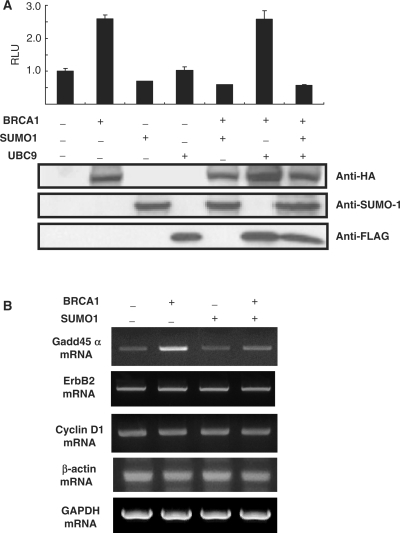
SUMO1 represses BRCA1-induced transcriptional activity from the Gadd45α promoter. (A) The induction of transcriptional activity by BRCA1 of the Gadd45α promoter, on the promoter-driven reporter gene, was monitored in the presence and absence of SUMO1 or UBC9, as indicated, in U2OS cells. The luciferase activity of the reporter gene alone was arbitrarily set to one. Results were obtained from six separate experiments, and standard deviations are shown (*P < 0.05). Immunoblots for exogenously expressed HA-BRCA1, SUMO1 and FLAG-Ubc9 proteins were performed with anti-HA, anti-SUMO1 and anti-FLAG antibodies, respectively, to ensure that all levels are equivalent. (B) Expression of Gadd45α transcripts in the presence and absence of BRCA1 and SUMO1 was analyzed by RT-PCR. The amount of GAPDH transcripts is shown as a quantitative control for Gadd45α transcripts.
Figure 3.
Figure 3.
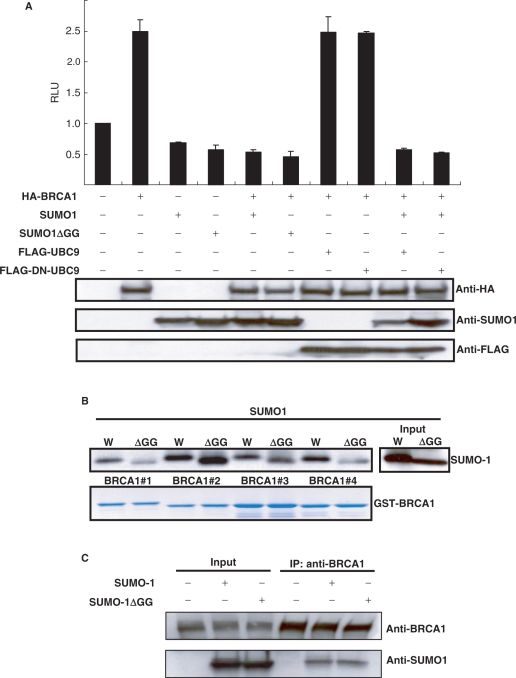
Sumoylation-independent repression of BRCA1-induced transcription of the Gadd45α promoter by SUMO1. (A) The activity of the Gadd45α promoter-driven reporter was analyzed in the presence of wild-type SUMO1 or its mutant derivative, SUMO1ΔGG, in U2OS cells cotransfected with BRCA1. The transcription from the Gadd45α promoter was also measured in the presence of the wild type (UBC9) or dominant-negative (DN-UBC9) UBC9. The results were analyzed as described in Figure 2. (B) In vitro association of BRCA1 with SUMO1ΔGG. The GST pull-down assay was performed as described in Figure 1, except that the SUMO1ΔGG protein was used. (C) In vivo association of BRCA1 with SUMO1ΔGG. Either wild-type SUMO1 or its mutant derivative SUMO1ΔGG, were transiently expressed in 293T cells. Equivalent amounts of total cellular protein were immunoprecipitated with anti-BRCA1 (IP: anti-BRCA1) antibody. Coimmunoprecipitated SUMO1 proteins were detected by an anti-SUMO1 immunoblot (Anti-SUMO1). The immunoprecipitated BRCA1 proteins were detected by an anti-BRCA1 antibody (Anti-BRCA1).
Figure 4.
Figure 4.
BRCA1 has SUMO interaction motifs. (A) The putative SUMO interaction motifs (SIMs) of BRCA1 along with that of other proteins (31–34) are aligned. (B) SIMs in BRCA1 mediates interaction of BRCA1 with SUMO1. The ability of putative SIMs of BRCA1 as described in (A) to interact with SUMO1 was measured by monitoring β-galactosidase activity, following cotransformation of yeast cells with pLexA-BRCA1 (1–324, 260–553, 502–802 and 758–1064; wild type or mutant fragments) and pB42AD-SUMO1. (Bottom) Equivalent protein expression of wild-type and mutant LexA-BRCA1 was examined by immunoblotting using anti-LexA antibodies. (C) Mutation of SIMs enhances BRCA1's transcriptional activity. The transcription from the Gadd45α promoter was measured in the presence of BRCA1 wild-type (W) or SIM mutants. The results were analyzed as described in Figure 2. (Inset) Immunoblotting for ensuring of equivalent protein expression of wild type and SIM mutant HA-BRCA1 was performed with anti-HA antibody. (D) SIMs are required for SUMO1-induced repression of BRCA1-mediated transcription. The repression of transcriptional activity of BRCA1 by SUMO1 was monitored in the presence of SUMO1. The repressive activity of SUMO1 on the wild type BRCA1-mediated Gadd45α transcription (W) was set to one. The relative repression of SIM mutant BRCA1-mediated transcription by SUMO1 to that of wild type BRCA1 was analyzed. Results were obtained from three separate experiments, and standard deviations are shown (*P < 0.05). Immunoblots for exogenously expressed HA-BRCA1 and SUMO1 proteins were performed with anti-HA and SUMO1 antibodies, respectively, to ensure that all levels are equivalent.
Figure 5.
Figure 5.
SUMO1-mediated repression of BRCA1-induced transcriptional activity occurs in a histone deacetylase-dependent manner. (A) TSA abolished the repressive activity of SUMO1. The activity of Gadd45α-luciferase reporter was measured in U2OS cells treated with or without TSA. The luciferase activity of the untreated cells transfected with reporter only was set to one. The results were analyzed as described in Figure 2. Equivalent protein expression of HA-BRCA1 and SUMO1 was examined by immunoblotting using antibodies to HA and SUMO1, respectively. (B) SUMO1 reduced the level of histone acetylation of the Gadd45α promoter. The acetylation status of histones at the Gadd45α promoter was monitored by chromatin immunoprecipitation (ChIP) with anti-acetyl H4 antibody. In 293T cells, ChIP assays were performed in the presence or absence of BRCA1 and SUMO1. In addition, changes in the acetylation status of histone were measured following treatment without or with TSA (TSA). The endogenous Gadd45α promoter DNA that coprecipitated with the anti-acetyl H4 antibody was detected by PCR (left) or replicate quantitative real time PCR (right). All PCRs and real-time PCRs were normalized to the input control. (Right) Quantity of immunoprecipitated DNA from the untransfected cells untreated with TSA was set to one. (C) SUMO1ΔGG induced a reduction in histone acetylation at the Gadd45α promoter. ChIP analysis of the endogenous Gadd45α promoter in 293T cells was performed in the presence of transfected wild-type SUMO1 or its mutant derivative SUMO1ΔGG. The results were analyzed as described in (B).
Figure 6.
Figure 6.
The Gadd45α promoter occupancy of BRCA1, SUMO1 and HDAC1. (A) SUMO1 induced recruitment of HDAC1 and release of BRCA1 at the Gadd45α promoter. ChIP analysis of Gadd45α promoter in 293T cells expressing BRCA1 and SUMO1 was performed using antisera specific to the indicated proteins. (B) Real-time PCRs were performed for quantitative ChIP analysis of Gadd45α promoter with anti-HDAC1 (IP: HDAC1) and anti-BRCA1(IP: BRCA1) antibodies, respectively. (C) ChIP analysis of the Gadd45α promoter in 293T cells in the presence of SUMO1ΔGG using antisera specific to BRCA1 (IP: BRCA1) and HDAC1 (IP: HDAC1). (Right) Quantitative ChIP analysis was performed using real-time PCR. (D) HDAC1 plays a role in SUMO1-induced repression of BRCA1-mediated transcription. Gadd45α-luciferase reporter gene activity was measured in U2OS cells transfected with plasmids as indicated, in the absence (white) or presence of siRNA against HDAC1 (black). The values represent the mean ± SEM from three experiments (*P < 0.05). The relative induction of the Gadd45α promoter by BRCA1 to that of the reporter alone was measured in the presence or absence of HDAC1 silencing. (Right) Relative repressive activity of SUMO1 was measured in the HDAC1 knockdown cells (black), as indicated and analyzed in Figure 4 (D). Knockdown of HDAC1 protein and equivalent expression of BRCA1 and SUMO1 proteins were examined by immunoblotting using anti-HDAC1, anti-HA and anti-SUMO1 antibodies, respectively. (E) Depletion of HDAC1 attenuated the SUMO1-induced reduction in histone acetylation at the Gadd45α promoter. Quantitative ChIP analysis of the endogenous Gadd45α promoter in 293T cells was performed using real-time PCRs in the HDAC1-depleted cells and performed as described in Figure 5.
Figure 6.
Figure 6.
The Gadd45α promoter occupancy of BRCA1, SUMO1 and HDAC1. (A) SUMO1 induced recruitment of HDAC1 and release of BRCA1 at the Gadd45α promoter. ChIP analysis of Gadd45α promoter in 293T cells expressing BRCA1 and SUMO1 was performed using antisera specific to the indicated proteins. (B) Real-time PCRs were performed for quantitative ChIP analysis of Gadd45α promoter with anti-HDAC1 (IP: HDAC1) and anti-BRCA1(IP: BRCA1) antibodies, respectively. (C) ChIP analysis of the Gadd45α promoter in 293T cells in the presence of SUMO1ΔGG using antisera specific to BRCA1 (IP: BRCA1) and HDAC1 (IP: HDAC1). (Right) Quantitative ChIP analysis was performed using real-time PCR. (D) HDAC1 plays a role in SUMO1-induced repression of BRCA1-mediated transcription. Gadd45α-luciferase reporter gene activity was measured in U2OS cells transfected with plasmids as indicated, in the absence (white) or presence of siRNA against HDAC1 (black). The values represent the mean ± SEM from three experiments (*P < 0.05). The relative induction of the Gadd45α promoter by BRCA1 to that of the reporter alone was measured in the presence or absence of HDAC1 silencing. (Right) Relative repressive activity of SUMO1 was measured in the HDAC1 knockdown cells (black), as indicated and analyzed in Figure 4 (D). Knockdown of HDAC1 protein and equivalent expression of BRCA1 and SUMO1 proteins were examined by immunoblotting using anti-HDAC1, anti-HA and anti-SUMO1 antibodies, respectively. (E) Depletion of HDAC1 attenuated the SUMO1-induced reduction in histone acetylation at the Gadd45α promoter. Quantitative ChIP analysis of the endogenous Gadd45α promoter in 293T cells was performed using real-time PCRs in the HDAC1-depleted cells and performed as described in Figure 5.
Figure 7.
Figure 7.
Analysis of transcription from the Gadd45α promoter following silencing of SUMO1 or BRCA1. (A) Gadd45α-luciferase reporter gene activity was measured in U2OS cells transfected with plasmids as indicated, in the absence (white) or presence of siRNA against SUMO1 (gray) or BRCA1 (black). The values represent the mean ± SEM from three experiments (*P < 0.05). The relative induction of the Gadd45α promoter by BRCA1 to that of the reporter alone was measured in the presence or absence of SUMO1 (gray) or BRCA1 (black) silencing. (B) Expression of Gadd45α mRNAs was measured using real-time RT-PCR in U2OS cells transfected with plasmids as indicated, in the absence (−) or presence (+) of siRNA against SUMO1 (siSUMO1) or BRCA1 (siBRCA1). (Inset) A representative agarose gel analysis of RT- PCR products. (C and D) BRCA1 and SUMO1 compete for the Gadd45α promoter. ChIP analyses of the endogenous Gadd45α promoter in 293T cells transfected with siRNAs against SUMO1 (C) or BRCA1 (D) were performed with each indicated antibody. The DNA precipitated in the immunocomplexes was PCR (left) or real-time PCR (right) amplified using primers specific to the Gadd45α promoter. Immunoblots demonstrate the reduction of the indicated target protein level.
Figure 8.
Figure 8.
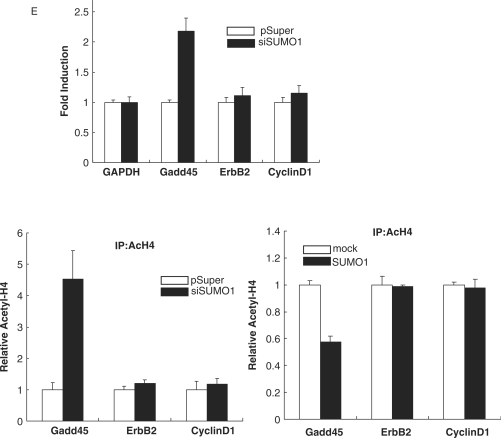
Silencing of SUMO1 enhances transcription of p27KIP1 and p21WAF1/CIP1 genes. (A) Transcription of p27KIP1 and p21WAF1/CIP1 genes was analyzed following silencing of SUMO1. Induction of p27KIP1 (p27 mRNA) and p21WAF1/CIP1 (p21 mRNA) expression by silencing of SUMO1 was analyzed by RT-PCR. A representative agarose gel (left) and real-time PCR (right) analyzing RT-PCR products for Gadd45α, p27KIP1 and p21WAF1/CIP1 using total RNA isolated from 293T cells transfected with pSUPER (−) or pSUPER-siSUMO1 (+) is shown with GAPDH as a quantitative control. (B) Effect of SUMO1 on the association of BRCA1 with target promoters of p27KIP1 and p21WAF1/CIP1 genes. Following silencing of SUMO1 (siSUMO1) or BRCA1 (siBRCA1), ChIP assays were carried out using anti-SUMO1 (IP: SUMO1), anti-BRCA1 (IP: BRCA1) or anti-HDAC1 (IP: HDAC1) antibodies. The pulled-down chromatin pools were then PCR or real-time PCR amplified with primers for promoters of p27KIP1 (p27 promoter) and p21WAF1/CIP1 (p21 promoter) genes. As a positive control, 0.01% of the total chromatin sample before immunoprecipitation (Input) was used for PCR amplification. (C) Effect of SUMO1 on the acetylation status of histones at the Gadd45α (Gadd45), p27KIP1 (p27) and p21WAF1/CIP1 (p21) promoters was monitored by chromatin immunoprecipitation (ChIP) with anti-acetyl H4 antibody (IP: AcH4). In 293T cells, ChIP assays were performed in the presence or absence of siRNAs against SUMO1 and ectopic expression of SUMO1. The endogenous Gadd45α promoter DNA that coprecipitated with the anti-acetyl H4 antibody was detected by PCR (top) or real-time PCR (bottom). All PCRs and real-time PCRs were normalized to the input control. The ChIP using real time PCR was performed and analyzed as described in Figure 5. (D) Effect of SUMO1ΔGG on the association of BRCA1 with target promoters of p27KIP1 (white) and p21WAF1/CIP1 (black) genes. ChIP analysis of the endogenous p27KIP1 and p21WAF1/CIP1 promoters in 293T cells was performed in the presence of transfected wild-type SUMO1 or its mutant derivative SUMO1ΔGG. The results were analyzed as described in (C). (E) No effect of SUMO1 on transcription and histone acetylation of GAPDH, ErbB2 and CyclinD1 promoters, which are not under the control of BRCA1. (Top) Transcription of GAPDH, ErbB2 and CyclinD1 genes was analyzed by real-time RT-PCR as described in (A). (Bottom) The acetylation status of histones at the GAPDH, ErbB2 and CyclinD1 promoters was analyzed as described in (C).
Figure 8.
Figure 8.
Silencing of SUMO1 enhances transcription of p27KIP1 and p21WAF1/CIP1 genes. (A) Transcription of p27KIP1 and p21WAF1/CIP1 genes was analyzed following silencing of SUMO1. Induction of p27KIP1 (p27 mRNA) and p21WAF1/CIP1 (p21 mRNA) expression by silencing of SUMO1 was analyzed by RT-PCR. A representative agarose gel (left) and real-time PCR (right) analyzing RT-PCR products for Gadd45α, p27KIP1 and p21WAF1/CIP1 using total RNA isolated from 293T cells transfected with pSUPER (−) or pSUPER-siSUMO1 (+) is shown with GAPDH as a quantitative control. (B) Effect of SUMO1 on the association of BRCA1 with target promoters of p27KIP1 and p21WAF1/CIP1 genes. Following silencing of SUMO1 (siSUMO1) or BRCA1 (siBRCA1), ChIP assays were carried out using anti-SUMO1 (IP: SUMO1), anti-BRCA1 (IP: BRCA1) or anti-HDAC1 (IP: HDAC1) antibodies. The pulled-down chromatin pools were then PCR or real-time PCR amplified with primers for promoters of p27KIP1 (p27 promoter) and p21WAF1/CIP1 (p21 promoter) genes. As a positive control, 0.01% of the total chromatin sample before immunoprecipitation (Input) was used for PCR amplification. (C) Effect of SUMO1 on the acetylation status of histones at the Gadd45α (Gadd45), p27KIP1 (p27) and p21WAF1/CIP1 (p21) promoters was monitored by chromatin immunoprecipitation (ChIP) with anti-acetyl H4 antibody (IP: AcH4). In 293T cells, ChIP assays were performed in the presence or absence of siRNAs against SUMO1 and ectopic expression of SUMO1. The endogenous Gadd45α promoter DNA that coprecipitated with the anti-acetyl H4 antibody was detected by PCR (top) or real-time PCR (bottom). All PCRs and real-time PCRs were normalized to the input control. The ChIP using real time PCR was performed and analyzed as described in Figure 5. (D) Effect of SUMO1ΔGG on the association of BRCA1 with target promoters of p27KIP1 (white) and p21WAF1/CIP1 (black) genes. ChIP analysis of the endogenous p27KIP1 and p21WAF1/CIP1 promoters in 293T cells was performed in the presence of transfected wild-type SUMO1 or its mutant derivative SUMO1ΔGG. The results were analyzed as described in (C). (E) No effect of SUMO1 on transcription and histone acetylation of GAPDH, ErbB2 and CyclinD1 promoters, which are not under the control of BRCA1. (Top) Transcription of GAPDH, ErbB2 and CyclinD1 genes was analyzed by real-time RT-PCR as described in (A). (Bottom) The acetylation status of histones at the GAPDH, ErbB2 and CyclinD1 promoters was analyzed as described in (C).
Figure 8.
Figure 8.
Silencing of SUMO1 enhances transcription of p27KIP1 and p21WAF1/CIP1 genes. (A) Transcription of p27KIP1 and p21WAF1/CIP1 genes was analyzed following silencing of SUMO1. Induction of p27KIP1 (p27 mRNA) and p21WAF1/CIP1 (p21 mRNA) expression by silencing of SUMO1 was analyzed by RT-PCR. A representative agarose gel (left) and real-time PCR (right) analyzing RT-PCR products for Gadd45α, p27KIP1 and p21WAF1/CIP1 using total RNA isolated from 293T cells transfected with pSUPER (−) or pSUPER-siSUMO1 (+) is shown with GAPDH as a quantitative control. (B) Effect of SUMO1 on the association of BRCA1 with target promoters of p27KIP1 and p21WAF1/CIP1 genes. Following silencing of SUMO1 (siSUMO1) or BRCA1 (siBRCA1), ChIP assays were carried out using anti-SUMO1 (IP: SUMO1), anti-BRCA1 (IP: BRCA1) or anti-HDAC1 (IP: HDAC1) antibodies. The pulled-down chromatin pools were then PCR or real-time PCR amplified with primers for promoters of p27KIP1 (p27 promoter) and p21WAF1/CIP1 (p21 promoter) genes. As a positive control, 0.01% of the total chromatin sample before immunoprecipitation (Input) was used for PCR amplification. (C) Effect of SUMO1 on the acetylation status of histones at the Gadd45α (Gadd45), p27KIP1 (p27) and p21WAF1/CIP1 (p21) promoters was monitored by chromatin immunoprecipitation (ChIP) with anti-acetyl H4 antibody (IP: AcH4). In 293T cells, ChIP assays were performed in the presence or absence of siRNAs against SUMO1 and ectopic expression of SUMO1. The endogenous Gadd45α promoter DNA that coprecipitated with the anti-acetyl H4 antibody was detected by PCR (top) or real-time PCR (bottom). All PCRs and real-time PCRs were normalized to the input control. The ChIP using real time PCR was performed and analyzed as described in Figure 5. (D) Effect of SUMO1ΔGG on the association of BRCA1 with target promoters of p27KIP1 (white) and p21WAF1/CIP1 (black) genes. ChIP analysis of the endogenous p27KIP1 and p21WAF1/CIP1 promoters in 293T cells was performed in the presence of transfected wild-type SUMO1 or its mutant derivative SUMO1ΔGG. The results were analyzed as described in (C). (E) No effect of SUMO1 on transcription and histone acetylation of GAPDH, ErbB2 and CyclinD1 promoters, which are not under the control of BRCA1. (Top) Transcription of GAPDH, ErbB2 and CyclinD1 genes was analyzed by real-time RT-PCR as described in (A). (Bottom) The acetylation status of histones at the GAPDH, ErbB2 and CyclinD1 promoters was analyzed as described in (C).
Figure 9.
Figure 9.
SUMO1 inhibits binding of BRCA1 to the Gadd45α promoter. (A) BRCA1-Gadd45α promoter-binding assay was performed with nuclear extract from cells transiently expressing HA-BRCA1, FLAG-BARD1 and/or SUMO1. Biotin-labeled Gadd45α promoter (−107 to −57) DNA was incubated with nuclear extract at room temperature in binding buffer. Following incubation, BRCA1 protein bound to biotin-labeled Gadd45α promoter DNA was isolated with streptavidin-agarose. The BRCA1–DNA–streptavidin–agarose complex was loaded onto a SDS gel. Proteins bound to DNA were detected by immunoblotting with anti-HA (for HA-BRCA1), anti-FLAG (for FLAG-BARD1) or anti-SUMO1 (for SUMO1) antibodies. The level of exogenous HA-BRCA1, FLAG-BARD1 and RFP-SUMO1 proteins were evaluated by immunoblotting with anti-HA, anti-FLAG and anti-SUMO1 antibodies, respectively. The representative figure was shown from seven separate experiments. (B) BRCA1-Gadd45α promoter-binding assay was performed as described in (A) with nuclear extract from cells transiently expressing either wild-type SUMO1 or its mutant derivative SUMO1ΔGG alone. Endogenous BRCA1 and BARD1 proteins or exogenous RFP-SUMO1 and RFP- SUMO1ΔGG bound to DNA were detected by immunoblotting with anti-BRCA1, anti-BARD1 and anti-SUMO1 antibodies, respectively. The representative figure was shown from three separate experiments.
Figure 10.
Figure 10.
SUMO1 represses BRCA1-induced transcriptional activity following DNA damaging. (A) The activities of Gadd45α reporter gene was monitored upon γ-irradiation in U2OS cells cotransfected with the Gadd45α reporter together with constructs as indicated. One day after transfection, cells were treated with or without γ-irradiation at the indicated dose (4 or 8 Gy). Expression of HA-BRCA1 and SUMO1 was measured by immunoblotting with antibodies to HA and SUMO1. Data represent the mean ± SEM from four separate experiments (*P < 0.05). (B) ChIP analysis of the endogenous Gadd45α promoter in 293T cells treated with (+) or without (−) γ-irradiation. (Left) Coprecipitated Gadd45α promoter DNA, by each indicated antibody, was detected by PCR. (Right) Release of SUMO1 from Gadd45α promoter was detected by real time ChIP analysis, in the presence of γ-irradiation. (C) A model of repression of BRCA1-mediated transcription by SUMO1. In repression, SUMO1 causes disassembly of BRCA1 and assembly of HDAC1 at BRCA1 target promoter. As a result, level of acetyl-histones is reduced. In activation, BRCA1 is recruited and associated with promoters. Also, SUMO1 and HDAC1 are released from the promoters. Subsequently, the level of acetyl-histones increases.

References

    1. Welcsh PL, King MC. BRCA1 and BRCA2 and the genetics of breast and ovarian cancer. Hum. Mol. Genet. 2001;10:705–713. - PubMed
    1. Venkitaraman AR. Functions of BRCA1 and BRCA2 in the biological response to DNA damage. J Cell Sci. 2001;114:3591–3598. - PubMed
    1. Jang ER, Lee J.-S. Diverse functions of BRCA1. Cancer Res. Treat. 2004;36:214–221. - PMC - PubMed
    1. Zheng L, Pan H, Li S, Flesken-Nikitin A, Chen PL, Boyer TG, Lee WH. Sequence specific transcriptional corepressor function for BRCA1 through a novel zinc finger protein, ZBRK1. Mol. Cell. 2000;6:757–768. - PubMed
    1. Pao GM, Janknecht R, Ruffner H, Hunter T, Verma IM. CBP/p300 interact with and function as transcriptional coactivators of BRCA1. Proc. Natl Acad. Sci. USA. 2000;97:1020–1025. - PMC - PubMed

Publication types