Comparative Study
. 2007 Nov 27;104(48):19097-101.
doi: 10.1073/pnas.0707340104. Epub 2007 Nov 19.

Gene family encoding the major toxins of lethal Amanita mushrooms

Affiliations
Comparative Study

Gene family encoding the major toxins of lethal Amanita mushrooms

Heather E Hallen et al. Proc Natl Acad Sci U S A. .

Abstract

Amatoxins, the lethal constituents of poisonous mushrooms in the genus Amanita, are bicyclic octapeptides. Two genes in A. bisporigera, AMA1 and PHA1, directly encode alpha-amanitin, an amatoxin, and the related bicyclic heptapeptide phallacidin, a phallotoxin, indicating that these compounds are synthesized on ribosomes and not by nonribosomal peptide synthetases. alpha-Amanitin and phallacidin are synthesized as proproteins of 35 and 34 amino acids, respectively, from which they are predicted to be cleaved by a prolyl oligopeptidase. AMA1 and PHA1 are present in other toxic species of Amanita section Phalloidae but are absent from nontoxic species in other sections. The genomes of A. bisporigera and A. phalloides contain multiple sequences related to AMA1 and PHA1. The predicted protein products of this family of genes are characterized by a hypervariable "toxin" region capable of encoding a wide variety of peptides of 7-10 amino acids flanked by conserved sequences. Our results suggest that these fungi have a broad capacity to synthesize cyclic peptides on ribosomes.


Conflict of interest statement

The authors declare no conflict of interest.

Figures
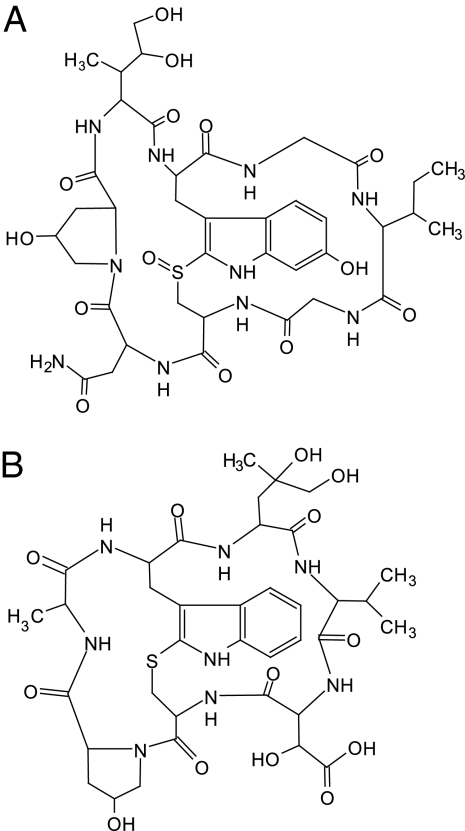
Fig. 1.
Fig. 1.
Structures of α-amanitin (A) and phallacidin (B). All of the amino acids have the l configuration except hydroxyAsp in phallacidin (Thr in phalloidin).
Fig. 2.
Fig. 2.
Fungi of the genus Amanita. (A) A. bisporigera (Oakland County, MI). (B) A. phalloides (Alameda County, CA). (C) Nondeadly species of Amanita. Shown from left to right are three specimens of A. gemmata, one specimen of A. muscaria, and two specimens of A. franchetii (Mendocino County, CA).
Fig. 3.
Fig. 3.
Nucleotide sequences of cDNAs for AMA1 and PHA1. (A) AMA1. The sequence of α-amanitin is underlined. Carets indicate the positions of the three introns. (B) PHA1. The sequence of phallacidin is underlined. Carets indicate the positions of the three introns.
Fig. 4.
Fig. 4.
Alignment of the cDNA nucleotide (A) and predicted amino acid sequences (B) of the coding regions of AMA1 and PHA1. The mature toxin sequences are underlined.
Fig. 5.
Fig. 5.
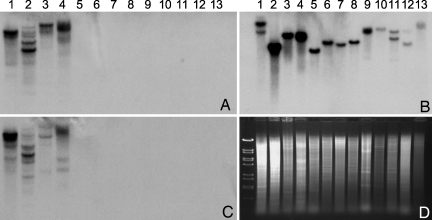
DNA blots of different species of Amanita. (A) Probed with AMA1 cDNA. (B) Probed with PHA1 cDNA. (C) Probed with a fragment of the β-tubulin gene isolated from A. bisporigera (see SI Text). (D) Ethidium-stained gel showing relative lane loading. Markers are λ phage DNA cut with BstEII. Species and provenances are as follows: lane 1, A. aff. suballiacea (Ingham County, MI); lane 2, A. bisporigera (Ingham County); lane 3, A. phalloides (Alameda County, CA); lane 4, A. ocreata (Sonoma County, CA); lane 5, A. novinupta (Sonoma County); lane 6, A. franchetii (Mendocino County, CA); lane 7, A. porphyria (Sonoma County); lane 8, a second isolate of A. franchetii (Sonoma County); lane 9, A. muscaria (Monterey County, CA); lane 10, A. gemmata (Mendocino County); lane 11, A. hemibapha (Mendocino County); lane 12, A. velosa (Napa County, CA); and lane 13, Amanital section Vaginatae (Mendocino County). Mushrooms represent sections Phalloideae (–4), Validae (–8), Amanita (9 and 10), Caesareae (11), and Vaginatae (12 and 13). Four separate gels were run; the lanes are in the same order on each gel, and approximately the same amount of DNA was loaded per lane. A and B are to the same scale, and C and D are to the same scale.
Fig. 6.
Fig. 6.
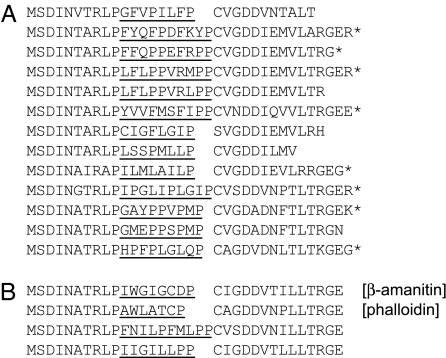
Sequences related to AMA1 and PHA1. (A) Related, predicted amino acid sequences identified in the A. bisporigera genome. (B) PCR products amplified from A. phalloides and A. ocreata (phalloidin) with degenerate primers based on the conserved sequences of AMA1 and PHA1. Spaces have been inserted after some of the toxin regions (underlined) to emphasize the conservation of the downstream sequences. Asterisks indicate stop codons.

References

    1. Bresinsky A, Besl H. A Colour Atlas of Poisonous Fungi: A Handbook for Pharmacists, Doctors and Biologists. Würzburg, Germany: Wolfe; 1990.
    1. Wieland T. Peptides of Poisonous Amanita Mushrooms. New York: Springer; 1986.
    1. Zhang P, Chen Z, Hu J, Wei B, Zhang Z, Hu W. FEMS Microbiol Lett. 2005;252:223–228. - PubMed
    1. Tulloss RE. Boll Gruppo Micologico G Bresadola. 2000;43:13–21.
    1. Weiβ M, Yang Z-L, Oberwinkler F. Can J Bot. 1998;76:1170–1179.

Publication types

MeSH terms

LinkOut - more resources