


Immunological control of chronic HIV-1 infection: HLA-mediated immune function and viral evolution in adolescents
- PMID: 18025875
- PMCID: PMC2268022
- DOI: 10.1097/QAD.0b013e3282f13823
Immunological control of chronic HIV-1 infection: HLA-mediated immune function and viral evolution in adolescents
Abstract
Background: Differential protein targeting by HIV-specific CD8 T cells is associated with disparate plasma viral loads; however, it is unclear if the quality of these responses differs depending upon the specificity of the targeted epitopes.
Methods: We examined HIV-specific CD8 T-cell responses in HIV-infected adolescents carrying either an HLA class I allele associated with a favorable prognosis (HLA-B*57) or an allele associated with usual disease progression (HLA-B*35 or HLA-B*53) using interferon-gamma ELISpot and ICS assays.
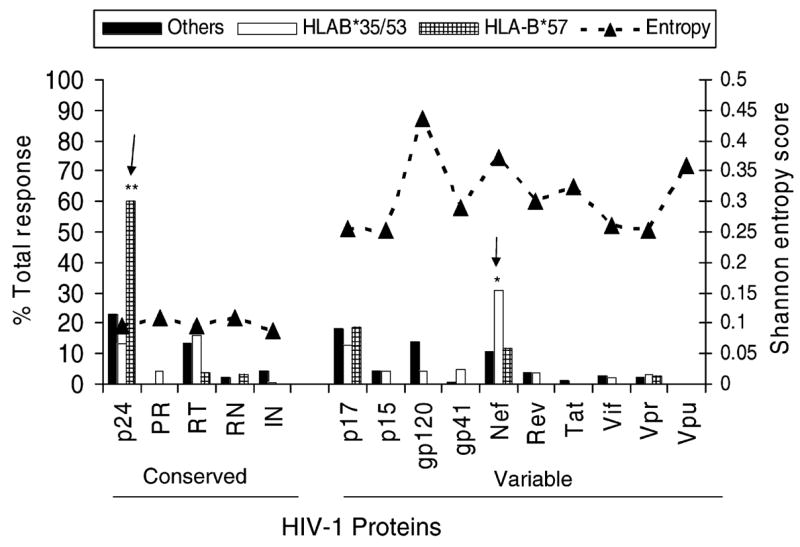
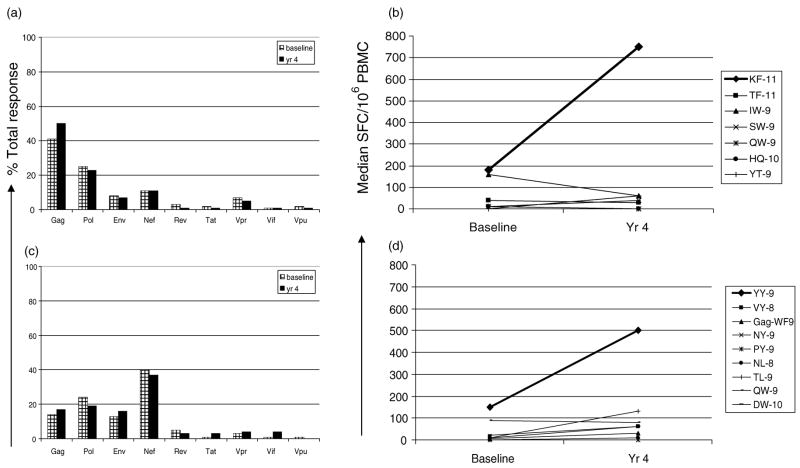
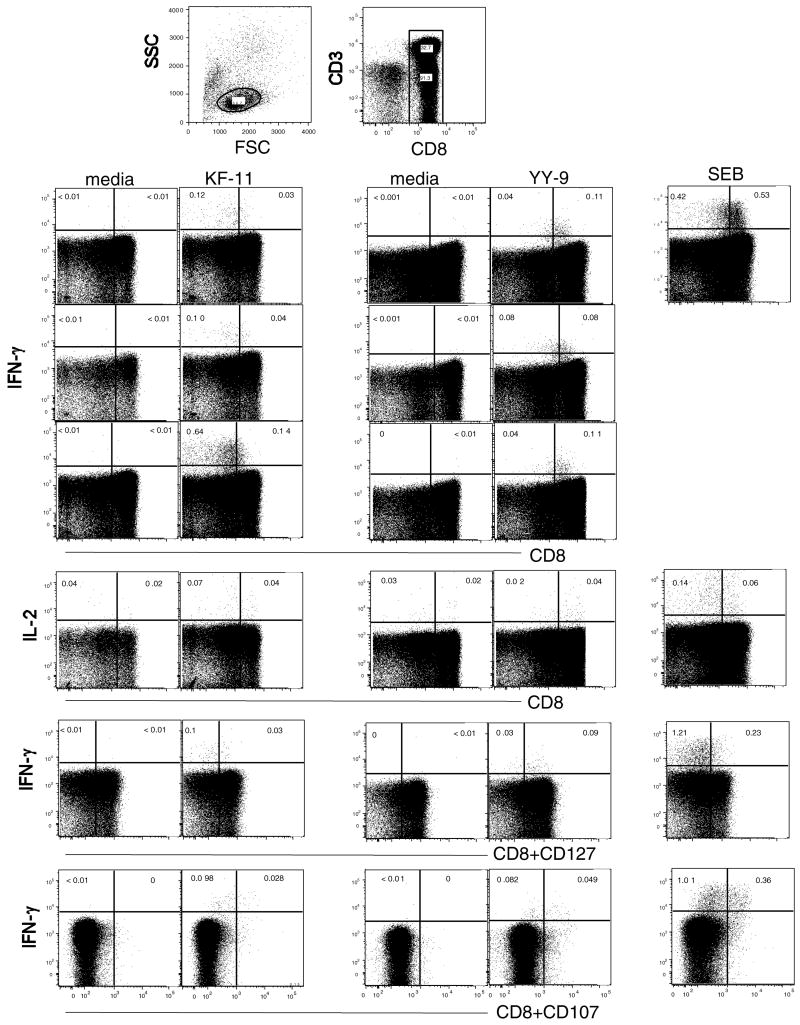
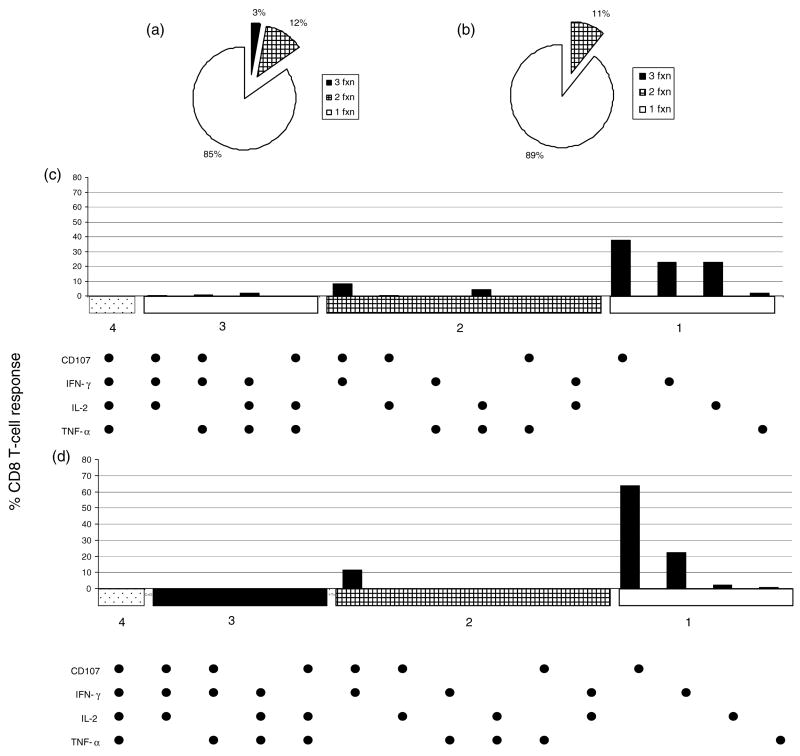
Results: In an interferon-gamma ELISpot assay, p24 was the dominant protein targeted by B*57 carriers while responses to Nef dominated in B*35 or B*53 positive carriers. This differential protein targeting did not change during 4 years of follow-up. In these chronically infected adolescents, there were no significant differences in the quality of the immunodominant T-cell responses between the B*57 and B*35/B*53 carriers as measured by peptide avidity, degranulation, and immune memory markers. There was a trend towards higher expression of interleukin-2 from B*57-KF11 restricted CD8 T cells although this difference was not significant. Nevertheless both B*57 and B*35/53-restricted responses were relatively potent as reflected by the propensity of CD8 T cells to escape in p24 and Nef, respectively.
Conclusions: Differential protein targeting rather than the quality of T-cell responses appears to be a major distinguishing feature of HIV-specific CD8 T cells induced in B*57 carriers. These data suggest that viral fitness costs associated with CD8 T-cell pressure is an important factor determining differences in the viral load among HIV-infected patients.
Figures
References
-
- Altfeld M, Addo MM, Rosenberg ES, Hecht FM, Lee PK, Vogel M. Influence of HLA-B57 on clinical presentation and viral control during acute HIV-1 infection. Aids. 2003;17:2581–2591. - PubMed
-
- Carrington M, Nelson GW, Martin MP, Kissner T, Vlahov D, Goedert JJ. HLA and HIV-1: heterozygote advantage and B*35-Cw*04 disadvantage. Science. 1999;283:1748–1752. - PubMed
-
- Hendel H, Caillat-Zucman S, Lebuanec H, Carrington M, O’Brien FS, Andrieu JM. New class I and II HLA alleles strongly associated with opposite patterns of progression to AIDS. J Immunol. 1999;162:6942–6946. - PubMed
-
- Kaslow RA, Carrington M, Apple R, Park L, Muñoz A, Saah AJ. Influence of combinations of human major histocompatibility complex genes on the course of HIV-1 infection. Nat Med. 1996;2:405–411. - PubMed
Publication types
MeSH terms
Substances
Grants and funding
- U01 HD040533/HD/NICHD NIH HHS/United States
- U01 HD040474/HD/NICHD NIH HHS/United States
- AI41951/AI/NIAID NIH HHS/United States
- R01 AI041951/AI/NIAID NIH HHS/United States
- M01 RR005096/RR/NCRR NIH HHS/United States
- R21 AI073103/AI/NIAID NIH HHS/United States
- R01 AI049126/AI/NIAID NIH HHS/United States
- U01 HD40533/HD/NICHD NIH HHS/United States
- M01 RR000240/RR/NCRR NIH HHS/United States
- U01 HD32830/HD/NICHD NIH HHS/United States
- A1073103-01/PHS HHS/United States
- R01 AI084772/AI/NIAID NIH HHS/United States
- R21 AI049126/AI/NIAID NIH HHS/United States
- R01 AI064060/AI/NIAID NIH HHS/United States
- A1064060/PHS HHS/United States
- M01 RR013297/RR/NCRR NIH HHS/United States
- AI49126/AI/NIAID NIH HHS/United States
LinkOut - more resources
Full Text Sources
Medical
Molecular Biology Databases
Research Materials
