


What is the business case for improving care for patients with complex conditions?
- PMID: 18026808
- PMCID: PMC2150614
- DOI: 10.1007/s11606-007-0293-2
What is the business case for improving care for patients with complex conditions?
Abstract
Introduction: Patients with complex conditions account for a disproportionate share of health care spending. Although evidence indicates that care for these patients could be provided more efficiently, the financial impact of mechanisms to improve the care they receive is unclear.
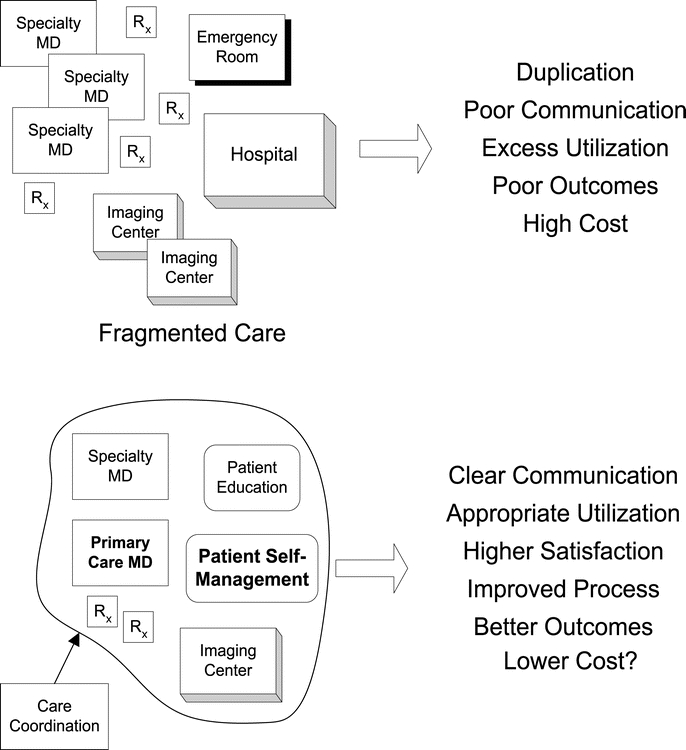
Design/methods: Numerous mechanisms-emphasizing patient self-management, care coordination, and evidence-based guidelines-aim to improve the quality of care and outcomes for patients with complex conditions. Assessing the overall "business case" for these mechanisms requires carefully estimating all relevant costs and financial benefits, then comparing them in present value terms. Mechanisms that are not cost-saving may still be implemented if they are cost-effective. We reviewed articles in peer-reviewed journals, as well as reports available on publicly accessible websites, which contained data about the business case for mechanisms to improve care for patients with complex conditions.
Main results: Published studies do not provide clear evidence that current mechanisms are cost saving. This literature also has several major methodological shortcomings with respect to providing an understanding of the business case for these mechanisms.
Conclusions: Further research using standardized methodologies is needed to understand the business case for mechanisms to improve care for patients with complex conditions. Implications for VA business case analyses include the necessity of establishing appropriate time horizons, scope of services, and target populations, as well as considering the impact of existing VA systems.
Figures
References
-
- Vogeli C, Shields A, Lee T, et al. Multiple chronic conditions: prevalence and implications for patient management, outcomes, and costs. Background paper for VA 2006 SOTA Conference “Managing Complexity in Chronic Care”, 2006.
-
- {'text': '', 'ref_index': 1, 'ids': [{'type': 'DOI', 'value': '10.1056/NEJMsb044133', 'is_inner': False, 'url': 'https://doi.org/10.1056/nejmsb044133'}, {'type': 'PubMed', 'value': '16034019', 'is_inner': True, 'url': 'https://pubmed.ncbi.nlm.nih.gov/16034019/'}]}
- Anderson GF. Medicare and chronic conditions. N Engl J Med. 2005;353(3):305–9. - PubMed
-
- {'text': '', 'ref_index': 1, 'ids': [{'type': 'PubMed', 'value': '15617366', 'is_inner': True, 'url': 'https://pubmed.ncbi.nlm.nih.gov/15617366/'}]}
- Yu W, Ravelo A, Wagner TH, Barnett PG. The relationships among age, chronic conditions, and healthcare costs. Am J Manag Care. 2004;10(12):909–16. - PubMed
-
- Dartmouth Atlas Project. The Care of Patients with Severe Chronic Illness: A Report on the Medicare Program by the Dartmouth Atlas Project. 2006, Center for the Evaluative Clinical Sciences: Hannover, NH.
-
- None
- Berenson RA. Challenging the Status Quo in Chronic Disease Care: Seven Case Studies. Oakland, CA: California Healthcare Foundation; 2006.
Publication types
MeSH terms
LinkOut - more resources
Full Text Sources
Medical
