


Increased toll-like receptor (TLR) 2 and TLR4 expression in monocytes from patients with type 1 diabetes: further evidence of a proinflammatory state
- PMID: 18029454
- PMCID: PMC2243229
- DOI: 10.1210/jc.2007-2185
Increased toll-like receptor (TLR) 2 and TLR4 expression in monocytes from patients with type 1 diabetes: further evidence of a proinflammatory state
Abstract
Context: Type 1 diabetes (T1DM) is associated with increased cardiovascular mortality. It is a pro-inflammatory state as evidenced by increased circulating biomarkers and monocyte activity. The toll-like receptors (TLRs) are pattern recognition receptors, expressed abundantly on monocytes. TLR2 and TLR4 are important in atherosclerosis. However, there is a paucity of data examining TLR2 and TLR4 expression in T1DM and examining its contribution to the proinflammatory state.
Objective: Thus, we examined TLR2 and TLR4 expression in monocytes from T1DM patients compared with controls (n = 31 per group).
Setting: The study was performed at the University of California Davis Medical Center.
Patients: Healthy controls (n = 31) and T1DM patients (n = 31) were included in the study.
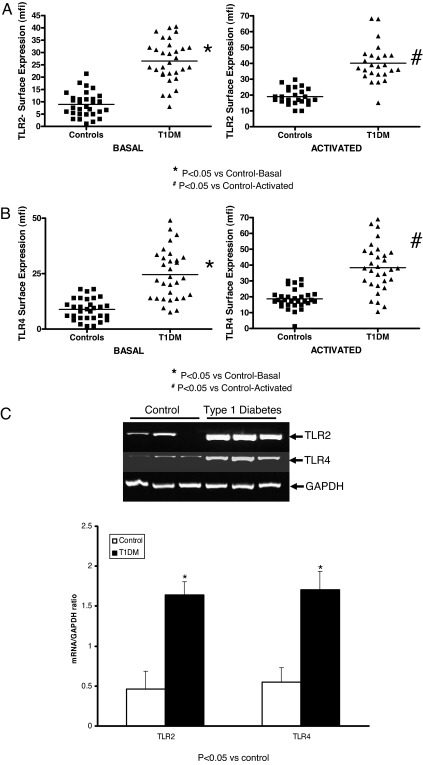
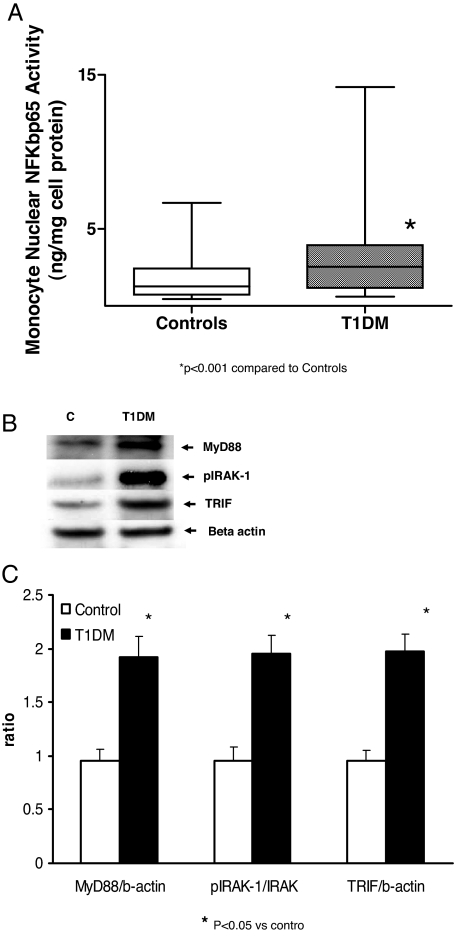
Results: TLR2 and TLR4 surface expression and mRNA were significantly increased in T1DM monocytes compared with controls. Downstream targets of TLR, nuclear factor kappaB, myeloid differentiation factor 88, Trif, and phosphorylated IL-1 receptor-associated kinase were significantly up-regulated in T1DM. Finally, the release of IL-1beta and TNF-alpha was significantly increased in monocytes from T1DM compared with controls and correlated with TLR2 and TLR4 expression (P < 0.005). In addition, TLR2 and TLR4 expression was significantly correlated to glycosylated hemoglobin, carboxymethyllysine, and nuclear factor kappaB (P < 0.02).
Conclusion: Thus, we make the novel observation that TLR2 and TLR4 expression and signaling are increased in T1DM and contribute to the proinflammatory state.
Figures
References
-
- Libby P, Nathan DM, Abraham K, Brunzell JD, Fradkin JE, Haffner SM, Hsueh W, Rewers M, Roberts BT, Savage PJ, Skarlatos S, Wassef M, Rabadan-Diehl C, National Heart, Lung, and Blood Institute, National Institute of Diabetes and Digestive and Kidney Diseases Working Group on Cardiovascular Complications of Type 1 Diabetes Mellitus 2005 Report of the National Heart, Lung, and Blood Institute-National Institute of Diabetes and Digestive and Kidney Diseases Working Group on Cardiovascular Complications of Type 1 Diabetes Mellitus. Circulation 111:3489–3493 - PubMed
-
- Schram MT, Chaturvedi N, Schalkwijk C, Giorgino F, Ebeling P, Fuller JH, Stehouwer CD, EURODIAB Prospective Complications Study 2003 Vascular risk factors and markers of endothelial function as determinants of inflammatory markers in type 1 diabetes: the EURODIAB Prospective Complications Study. Diabetes Care 26:2165–2173 - PubMed
-
- Schram MT, Chaturvedi N, Schalkwijk CG, Fuller JH, Stehouwer CD, EURODIAB Prospective Complications Study Group 2005 Markers of inflammation are cross-sectionally associated with microvascular complications and cardiovascular disease in type 1 diabetes–the EURODIAB Prospective Complications Study. Diabetologia 48:370–378 - PubMed
-
- Schalkwijk CG, Poland DC, van Dijk W, Kok A, Emeis JJ, Drager AM, Doni A, van Hinsbergh VW, Stehouwer CD 1999 Plasma concentration of C-reactive protein is increased in type I diabetic patients without clinical macroangiopathy and correlates with markers of endothelial dysfunction: evidence for chronic inflammation. Diabetologia 42:351–357 - PubMed
-
- Devaraj S, Glaser N, Griffen S, Wang-Polagruto J, Miguelino E, Jialal I 2006 Increased monocytic activity and biomarkers of inflammation in patients with type 1 diabetes. Diabetes 55:774–779 - PubMed
Publication types
MeSH terms
Substances
Grants and funding
LinkOut - more resources
Full Text Sources
Medical
