


Elucidating global epidemiology of Burkholderia multivorans in cases of cystic fibrosis by multilocus sequence typing
- PMID: 18032622
- PMCID: PMC2224285
- DOI: 10.1128/JCM.01818-07
Elucidating global epidemiology of Burkholderia multivorans in cases of cystic fibrosis by multilocus sequence typing
Abstract
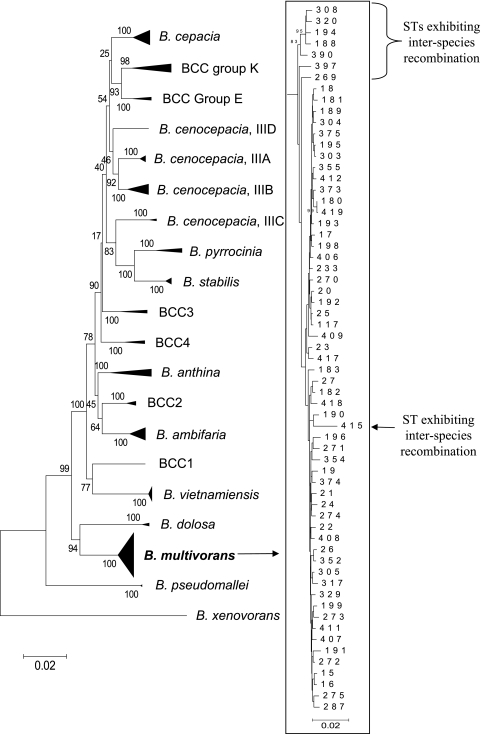
Burkholderia multivorans is a prominent B. cepacia complex (BCC) species causing infection in people with cystic fibrosis. Despite infection control measures being introduced to reduce the spread of BCC there is a continued emergence of infections by B. multivorans. Our objective was to analyze a global collection of B. multivorans isolates, comparing those from environmental and clinical sources with those from reported outbreaks. Multilocus sequence typing (MLST) was performed on 107 B. multivorans isolates to provide a detailed analysis of the global population biology of this species. MLST resolved 64 B. multivorans sequence types. Twelve of these were globally distributed and associated with human infection; two of these (ST-21 and ST-375) were also composed of environmental isolates. These global lineages included strains previously linked to large outbreaks (e.g., French epidemic clone ST-16). Though few environmental isolates of B. multivorans were available for analysis, of six strains identified, three were identical to strains recovered from cystic fibrosis (CF) infection. Although the ability of B. multivorans to cause CF outbreaks is known, our report here concerning the existence of globally distributed B. multivorans CF strains is a new observation for this emerging B. cepacia complex pathogen and suggests that certain strain types may be better adapted to human infection than others. Common transmission-associated risk factors were not obviously linked to the globally distributed strains; however, the overlap in strains recovered from water environments, industrial products, and human infection suggests that environmental sources may be an important reservoir for infection with B. multivorans.
Figures
References
-
- Baldwin, A., E. Mahenthiralingam, P. Drevinek, P. Vandamme, J. R. Govan, D. J. Waine, J. J. Lipuma, L. Chiarini, C. Dalmastri, D. Henry, D. P. Speert, D. Honeybourne, M. C. Maiden, and C. G. Dowson. 2007. Environmental Burkholderia cepacia complex isolates in human infection. Emerg. Infect. Dis. 13458-461. - PMC - PubMed
-
- Baldwin, A., E. Mahenthiralingam, K. M. Thickett, D. Honeybourne, M. C. Maiden, J. R. Govan, D. P. Speert, J. J. Lipuma, P. Vandamme, and C. G. Dowson. 2005. Multilocus sequence typing scheme that provides both species and strain differentiation for the Burkholderia cepacia complex. J. Clin. Microbiol. 434665-4673. - PMC - PubMed
-
- Biddick, R., T. Spilker, A. Martin, and J. J. LiPuma. 2003. Evidence of transmission of Burkholderia cepacia, Burkholderia multivorans, and Burkholderia dolosa among persons with cystic fibrosis. FEMS Microbiol. Lett. 22857-62. - PubMed
-
- Chen, J. S., K. A. Witzmann, T. Spilker, R. J. Fink, and J. J. LiPuma. 2001. Endemicity and inter-city spread of Burkholderia cepacia genomovar III in cystic fibrosis. J. Pediatr. 139643-649. - PubMed
Publication types
MeSH terms
Substances
LinkOut - more resources
Full Text Sources
Other Literature Sources
Medical
