


Comparison of usefulness of body mass index versus metabolic risk factors in predicting 10-year risk of cardiovascular events in women
- PMID: 18036364
- PMCID: PMC2098701
- DOI: 10.1016/j.amjcard.2007.06.073
Comparison of usefulness of body mass index versus metabolic risk factors in predicting 10-year risk of cardiovascular events in women
Abstract
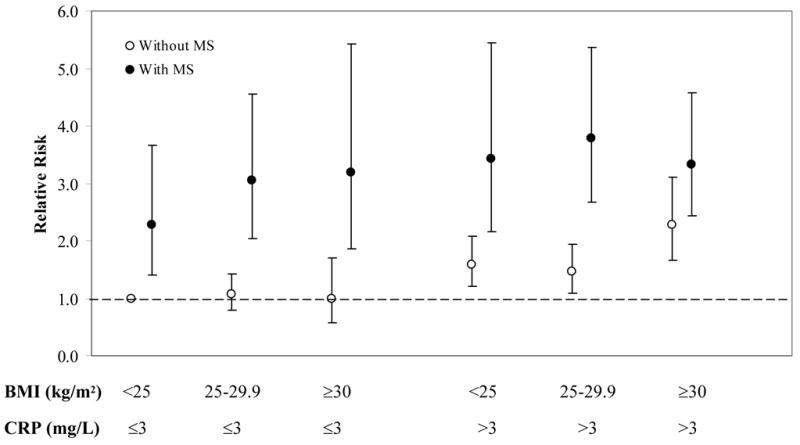
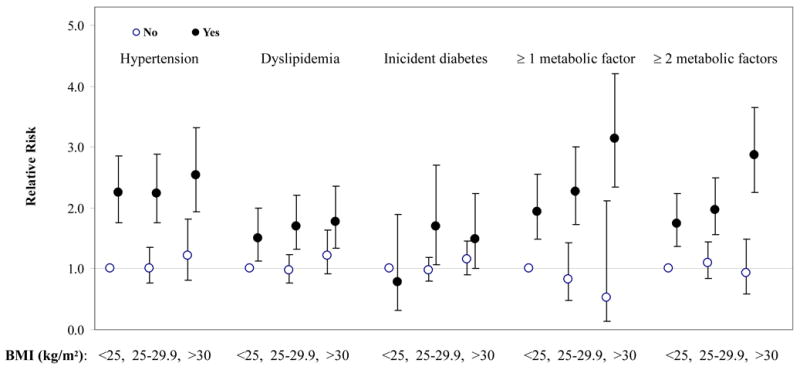
The objective of this study was to prospectively examine the comparative importance of body mass index (BMI) and metabolic syndrome (MS) related risk factors in predicting future risk of cardiovascular disease (CVD) in women. Of 25,626 women aged>or=45 years and free of CVD, cancer, and diabetes at baseline in the Women's Health Study, all women were classified into 6 groups according to 3 BMI categories (<25, 25 to 29.9, and >or=30 kg/m2) and the presence or absence of MS, defined using modified criteria of the National Cholesterol Education Program Adult Treatment Program III. During a median 10-year follow-up, 724 incident CVD events were documented. Compared with lean women without MS, multivariate relative risks of CVD, adjusting for age, physical activity, and other covariates, were 2.40 (95% confidence interval [CI] 1.71 to 3.37) for lean women who had MS, 1.08 (95% CI 0.87 to 1.33) for overweight women who had no MS, 3.01 (95% CI 2.30 to 3.94) for overweight women with MS, 1.58 (95% CI 1.21 to 2.08) for obese women without MS, and 2.89 (95% CI 2.19 to 3.80) for obese women with MS. Similar associations were evident for total coronary heart disease, but were not significant for total stroke. Overall, although C-reactive protein added additional prognostic information beyond BMI and MS, it did not fully account for the observed high risk of CVD associated with MS. In conclusion, MS may largely account for the increased risk of CVD associated with BMI in apparently healthy women.
Figures
References
-
- Manson JE, Willett WC, Stampfer MJ, Colditz GA, Hunter DJ, Hankinson SE, Hennekens CH, Speizer FE. Body weight and mortality among women. N Engl J Med. 1995;333:677–685. - PubMed
-
- Rexrode KM, Buring JE, Manson JE. Abdominal and total adiposity and risk of coronary heart disease in men. Int J Obes Relat Metab Disord. 2001;25:1047–1056. - PubMed
-
- Bonora E, Kiechl S, Willeit J, Oberhollenzer F, Egger G, Bonadonna RC, Muggeo M. Carotid atherosclerosis and coronary heart disease in the metabolic syndrome: prospective data from the Bruneck study. Diabetes Care. 2003;26:1251–1257. - PubMed
-
- Ford ES. The metabolic syndrome and mortality from cardiovascular disease and all-causes: findings from the National Health and Nutrition Examination Survey II Mortality Study. Atherosclerosis. 2004;173:309–314. - PubMed
-
- Lakka HM, Laaksonen DE, Lakka TA, Niskanen LK, Kumpusalo E, Tuomilehto J, Salonen JT. The metabolic syndrome and total and cardiovascular disease mortality in middle-aged men. JAMA. 2002;288:2709–2716. - PubMed
Publication types
MeSH terms
Substances
Grants and funding
LinkOut - more resources
Full Text Sources
Medical
Research Materials
