. 2008 Feb;190(3):1020-6.
doi: 10.1128/JB.01519-07. Epub 2007 Nov 26.

Expression of a uniquely regulated extracellular polysaccharide confers a large-capsule phenotype to Bacteroides fragilis

Affiliations

Expression of a uniquely regulated extracellular polysaccharide confers a large-capsule phenotype to Bacteroides fragilis

Maria Chatzidaki-Livanis et al. J Bacteriol. 2008 Feb.

Abstract

Bacteroides fragilis synthesizes eight distinct capsular polysaccharides, more than any described bacterium outside the order Bacteroidales. Here, we show that this organism also produces a high-molecular-weight extracellular polysaccharide (EPS). Expression of the EPS results in the formation of a large polysaccharide layer around the bacteria which prevents them from forming a tight pellet upon centrifugation and from entering a Percoll density gradient. Like expression of the capsular polysaccharides, expression of the EPS is phase variable and dictated by DNA inversion of its promoter. EPS expression is regulated at one level by the DNA invertase Tsr19, which is encoded by a gene immediately upstream of the EPS locus and inverts the EPS promoter, causing an on or off phenotype. Expression of the EPS is also regulated at another level, which dictates the amount of EPS produced. By analyzing a panel of tsr19 deletion mutants, we found that the number of inverted repeats (IRs) flanking the promoter is variable. Transcription into the EPS genes is greater in mutants with a single IR between the promoter and the downstream EPS genes than in mutants with more than one IR in this region, correlating with the synthesis of more EPS. By analyzing the relative orientations of the EPS promoter of bacteria obtained from human fecal samples, we showed that both DNA inversion and variation in the number of IRs are active processes of B. fragilis in the endogenous human intestinal ecosystem.


Figures
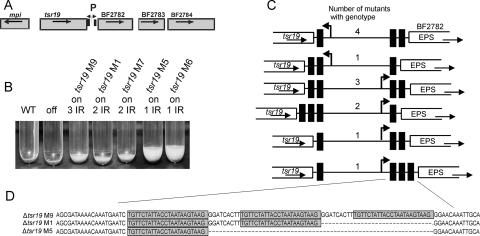
FIG. 1.
FIG. 1.
Phenotype and genotype of tsr19 deletion mutants. (A) Open reading frame map of the genetic region containing genes for the two DNA invertases, Mpi and Tsr19, and the downstream genes annotated as putatively involved in EPS production (BF2782 to BF2784). Black boxes represent IRs, and the arrow between them represents the invertible promoter. Arrows in genes indicate the direction of transcription. (B) Phenotypes of the tsr19 deletion mutants grown in culture overnight and pelleted by high-speed centrifugation. On and off indicate the direction in which the EPS promoter is locked relative to BF2782. The numbers of IRs between the promoter and the EPS genes are indicated for the locked-on mutants. WT, wild type. (C) Genotypes of the Δtsr19 mutants, showing the variation in the number of IRs. The number of mutants with each genotype is indicated. The black boxes represent IRs, and the arrow between them indicates the direction in which the promoter is locked. (D) Sequences of the IR regions between the promoter and the downstream EPS genes for three tsr19 mutants locked on for transcription of the downstream locus, Δtsr19 M9 (three IRs), Δtsr19 M1 (two IRs), and Δtsr19 M5 (one IR).
FIG. 2.
FIG. 2.
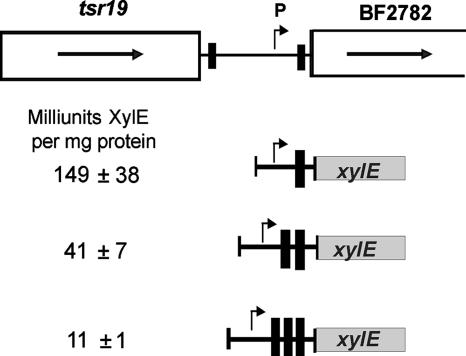
Number of IRs regulates transcription into BF2782: diagrams of the xylE transcriptional fusion clones that were created for analysis of transcription into BF2782. The diagram at the top shows the corresponding chromosomal region. Black boxes represent IRs; P is the promoter. Each clone includes DNA containing the promoter in the on orientation, one, two, or three IRs, and DNA up to 6 bp before the start codon of BF2782. The corresponding XylE activity resulting when each of the clones was placed in trans in the wild-type background is indicated.
FIG. 3.
FIG. 3.
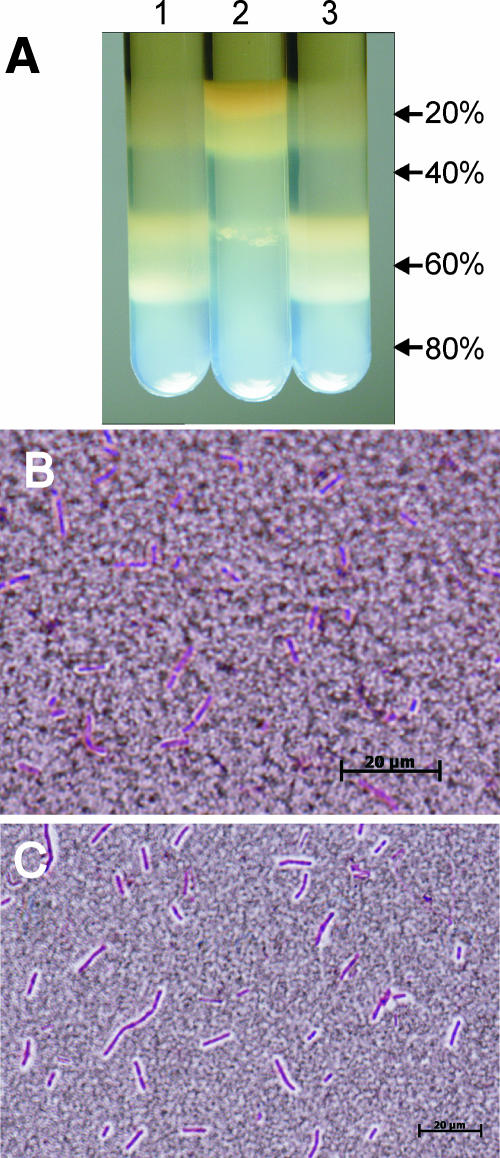
EPS locus confers a large capsule phenotype to the bacteria. (A) Percoll density gradient analysis of sedimentation of the wild type (tube 1), Δtsr19 M5 (tube 2), and Δtsr19 M3 (tube 3). The arrows on the right indicate the different concentrations of Percoll. (B and C) Light microscopy images of negatively stained overnight grown broth cultures of the wild type (B) and Δtsr19 M5 (C), showing small capsules surrounding the wild type and large capsules surrounding Δtsr19 M5.
FIG. 4.
FIG. 4.
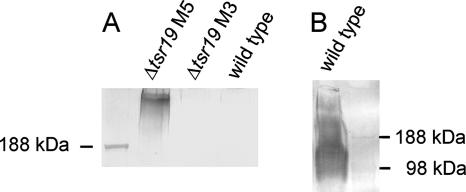
Analysis of EPS size. (A) Western immunoblot analysis of whole-cell lysates demonstrating that the locked-on mutant (Δtsr19 M5) synthesizes a very-high-molecular-weight EPS not produced by the locked-off mutant (Δtsr19 M3) or the wild type. (B) Western immunoblot analysis of a whole-cell lysate of wild-type bacteria showing heterogeneous capsular polysaccharide H as a representative of the capsular polysaccharides. The sizes of molecular mass standards are indicated on the right.
FIG. 5.
FIG. 5.
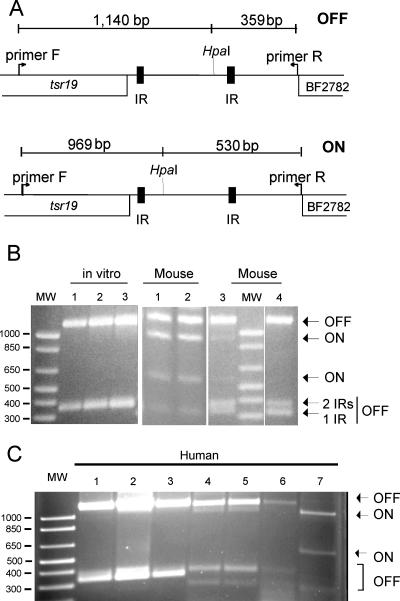
EPS promoter orientations of in vitro and in vivo samples. (A) Schematic diagram of the quantitative PCR-digestion assay used to determine EPS promoter orientation. (B) Ethidium bromide-stained agarose gels of the fragments resulting from PCR-digestion analysis of bacteria grown in culture or isolated from feces of mice monoassociated with the B. fragilis wild-type strain. The number of IRs determined to be present in each fragment is indicated. (C) PCR-digestion analysis of the B. fragilis EPS region from human fecal samples showing differences in promoter orientation and the number of IRs flanking the promoter. The sizes of molecular weight standards (MW) (in base pairs) are indicated on the left in panels B and C.

References

    1. Comstock, L. E., M. J. Coyne, A. O. Tzianabos, A. Pantosti, A. B. Onderdonk, and D. L. Kasper. 1999. Analysis of a capsular polysaccharide biosynthesis locus of Bacteroides fragilis. Infect. Immun. 673525-3532. - PMC - PubMed
    1. Coyne, M. J., and L. E. Comstock. Niche-specific features of the intestinal Bacteroidales. 2008. J. Bacteriol. 190736-742. - PMC - PubMed
    1. Coyne, M. J., B. Reinap, M. M. Lee, and L. E. Comstock. 2005. Human symbionts use a host-like pathway for surface fucosylation. Science 3071778-1781. - PubMed
    1. Coyne, M. J., K. G. Weinacht, C. M. Krinos, and L. E. Comstock. 2003. Mpi recombinase globally modulates the surface architecture of a human commensal bacterium. Proc. Natl. Acad. Sci. USA 10010446-10451. - PMC - PubMed
    1. Krinos, C. M., M. J. Coyne, K. G. Weinacht, A. O. Tzianabos, D. L. Kasper, and L. E. Comstock. 2001. Extensive surface diversity of a commensal microorganism by multiple DNA inversions. Nature 414555-558. - PubMed

Publication types

MeSH terms

LinkOut - more resources