


Review
doi: 10.1128/JB.01422-07.
Epub 2007 Nov 26.
Energy conservation via electron-transferring flavoprotein in anaerobic bacteria
Affiliations
- PMID: 18039764
- PMCID: PMC2223574
- DOI: 10.1128/JB.01422-07
Item in Clipboard
Review
Energy conservation via electron-transferring flavoprotein in anaerobic bacteria
J Bacteriol.
2008 Feb.
No abstract available
Figures
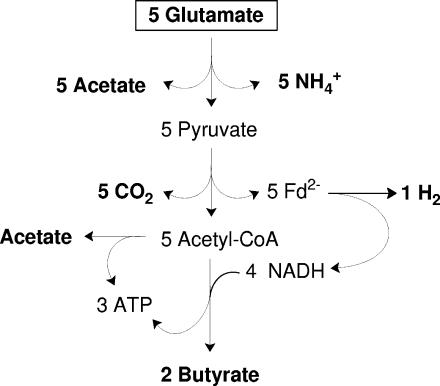
Traditional scheme of glutamate fermentation via 3-methylaspartate in C. tetanomorphum. Five pyruvates derived from 5 glutamates are oxidized by 5 ferredoxins to 5 CO2 and 5 acetyl-CoA. The 5 reduced ferredoxins (Fd2−) formed are reoxized by 2 H+ and 4 NAD+, yielding 1 H2 and 4 NADH, respectively. Four of the 5 acetyl-CoA formed are reduced by 4 NADH to 2 butyryl-CoA (see Fig. 2). Three ATP are generated from 2 butyryl-CoA and the remaining 1 acetyl-CoA (see Fig. 5).
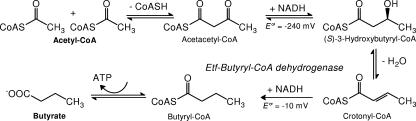
Butyrate synthesis from 2 acetyl-CoA in members of the genus Clostridium.
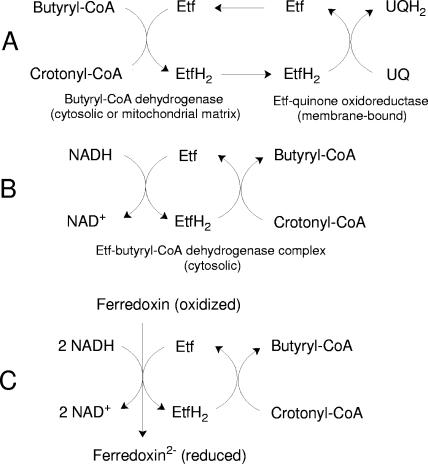
Different functions of Etf. (A) In aerobic organisms Etf transfers the electrons from butyryl-CoA dehydrogenase in the cytoplasm or mitochondrial matrix to ubiquinone (UQ), which is mediated by the integral membrane enzyme Etf-quinone oxidoreductase. (B) In anaerobic bacteria Etf transfers the electrons from NADH to the cytosolic butyryl-CoA dehydrogenase, which reduces crotonyl-CoA. (C) Additional reduction of ferredoxin by the Etf-butyryl-CoA dehydrogenase complex as proposed in this work.
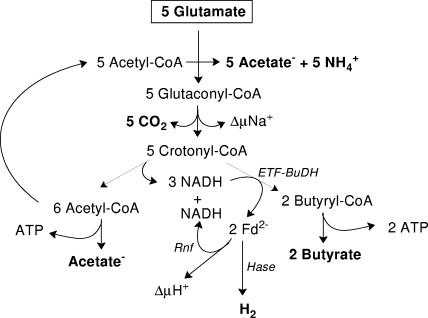
Hydroxyglutarate pathway of glutamate fermentation proposed here. Note that 3 of 5 crotonyl-CoA are oxidized to 6 acetyl-CoA by 3 NAD+. Two of the 3 NADH formed and the 1 NADH recycled are used to reduce 2 crotonyl-CoA to 2 butyryl-CoA, which drives the reduction of 2 ferredoxins by the other 2 NADH. One ferredoxin reduces protons to H2, and the other reduces NAD to NADH, which is recycled. Hase = hydrogenase (Hyd); ETF-BuDH, Etf-Bcd complex; Fd2−, reduced ferredoxin.
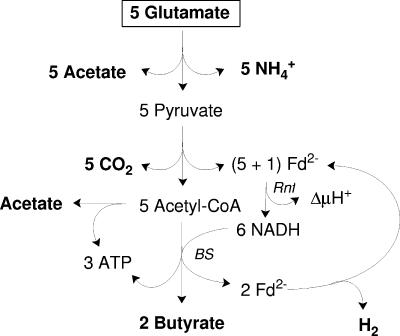
Methylasparate pathway of glutamate fermentation proposed here (see Fig. 1). Note that 4 acetyl-CoA are reduced by 4 NADH to 2 butyryl-CoA; the fifth NADH and the 1 recycled NADH are used to reduce 2 ferredoxins, driven by the reduction of crotonyl-CoA to butyryl-CoA. BS, butyrate-synthesizing enzymes, including the Etf-Bcd complex; Fd2−, reduced ferredoxin.
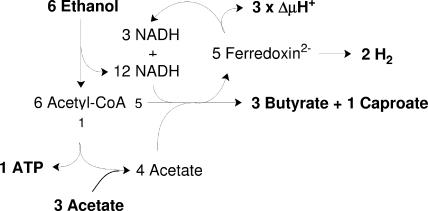
Proposed catabolism of C. kluyveri. Substrates and products are indicated by bold type.
References
-
- Barker, H. A. 1956. Bacterial fermentations. Wiley, New York, NY.
-
- Barker, H. A. 1961. Fermentations of nitrogenous organic compounds, p. 151-207. In I. C. Gunsalus and R. Y. Stanier (ed.), The bacteria, vol. 2. Academic Press Inc., New York, NY.
-
- Beatrix, B., K. Bendrat, S. Rospert, and W. Buckel. 1990. The biotin-dependent sodium ion pump glutaconyl-CoA decarboxylase from Fusobacterium nucleatum (subsp. nucleatum). Comparison with the glutaconyl-CoA decarboxylases from gram-positive bacteria. Arch. Microbiol. 154362-369. - PubMed
-
- Beckmann, J. D., and F. E. Frerman. 1985. Electron-transfer flavoprotein-ubiquinone oxidoreductase from pig liver: purification and molecular, redox, and catalytic properties. Biochemistry 243913-3921. - PubMed
-
- Boiangiu, C. D., E. Jayamani, D. Brügel, G. Herrmann, J. Kim, L. Forzi, R. Hedderich, I. Vgenopoulou, A. J. Pierik, J. Steuber, and W. Buckel. 2005. Sodium ion pumps and hydrogen production in glutamate fermenting anaerobic bacteria. J. Mol. Microbiol. Biotechnol. 10105-119. - PubMed
Publication types
MeSH terms
Substances
LinkOut - more resources
Full Text Sources
Other Literature Sources
Molecular Biology Databases
