


Comparison of seven techniques for typing international epidemic strains of Clostridium difficile: restriction endonuclease analysis, pulsed-field gel electrophoresis, PCR-ribotyping, multilocus sequence typing, multilocus variable-number tandem-repeat analysis, amplified fragment length polymorphism, and surface layer protein A gene sequence typing
- PMID: 18039796
- PMCID: PMC2238077
- DOI: 10.1128/JCM.01484-07
Comparison of seven techniques for typing international epidemic strains of Clostridium difficile: restriction endonuclease analysis, pulsed-field gel electrophoresis, PCR-ribotyping, multilocus sequence typing, multilocus variable-number tandem-repeat analysis, amplified fragment length polymorphism, and surface layer protein A gene sequence typing
Abstract
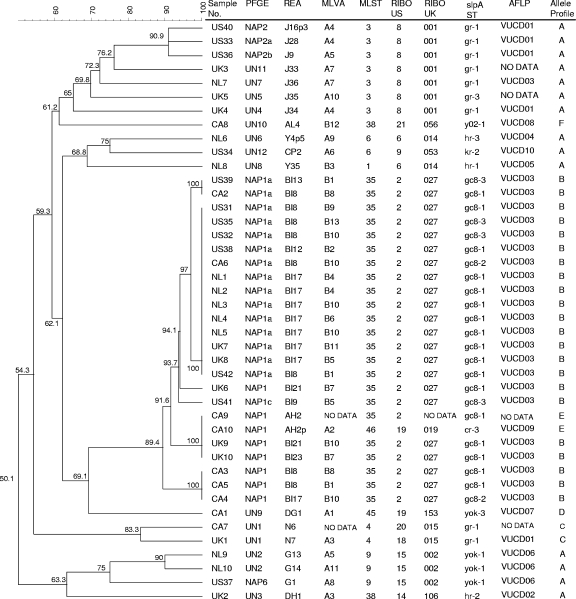
Using 42 isolates contributed by laboratories in Canada, The Netherlands, the United Kingdom, and the United States, we compared the results of analyses done with seven Clostridium difficile typing techniques: multilocus variable-number tandem-repeat analysis (MLVA), amplified fragment length polymorphism (AFLP), surface layer protein A gene sequence typing (slpAST), PCR-ribotyping, restriction endonuclease analysis (REA), multilocus sequence typing (MLST), and pulsed-field gel electrophoresis (PFGE). We assessed the discriminating ability and typeability of each technique as well as the agreement among techniques in grouping isolates by allele profile A (AP-A) through AP-F, which are defined by toxinotype, the presence of the binary toxin gene, and deletion in the tcdC gene. We found that all isolates were typeable by all techniques and that discrimination index scores for the techniques tested ranged from 0.964 to 0.631 in the following order: MLVA, REA, PFGE, slpAST, PCR-ribotyping, MLST, and AFLP. All the techniques were able to distinguish the current epidemic strain of C. difficile (BI/027/NAP1) from other strains. All of the techniques showed multiple types for AP-A (toxinotype 0, binary toxin negative, and no tcdC gene deletion). REA, slpAST, MLST, and PCR-ribotyping all included AP-B (toxinotype III, binary toxin positive, and an 18-bp deletion in tcdC) in a single group that excluded other APs. PFGE, AFLP, and MLVA grouped two, one, and two different non-AP-B isolates, respectively, with their AP-B isolates. All techniques appear to be capable of detecting outbreak strains, but only REA and MLVA showed sufficient discrimination to distinguish strains from different outbreaks.
Figures

References
-
- Barbut, F., B. Gariazzo, L. Bonné, V. Lalande, B. Burghoffer, R. Luiuz, and J.-C. Petit. 2007. Clinical features of Clostridium difficile-associated infections and molecular characterization of strains: results of a retrospective study, 2000-2004. Infect. Control Hosp. Epidemiol. 28131-139. - PubMed
-
- Bartlett, J. G., T. W. Chang, M. Gurwith, S. L. Gorbach, and A. B. Onderdonk. 1978. Antibiotic-associated pseudomembranous colitis due to toxin-producing clostridia. N. Engl. J. Med. 298531-534. - PubMed
-
- Bidet, P., F. Barbut, V. Lalande, B. Burghoffer, and J.-C. Petit. 1999. Development of a new PCR-ribotyping method for Clostridium difficile based on ribosomal RNA gene sequencing. FEMS Microbiol. Lett. 175261-266. - PubMed
-
- Brazier, J. S., M. E Mulligan, M. Delmee, S. Tabaqchali, and the International Clostridium difficile Study Group. 1997. Preliminary findings of the International Typing Study on Clostridium difficile. Clin. Infect. Dis. 25(Suppl. 2)S199-S201. - PubMed
Publication types
MeSH terms
Substances
LinkOut - more resources
Full Text Sources
Other Literature Sources
Miscellaneous
