Comparative Study
. 2007 Nov 27;8(1):87.
doi: 10.1186/1465-9921-8-87.

Characterization of the innate immune response to chronic aspiration in a novel rodent model

Affiliations
Comparative Study

Characterization of the innate immune response to chronic aspiration in a novel rodent model

James Z Appel 3rd et al. Respir Res. .

Abstract

Background: Although chronic aspiration has been associated with several pulmonary diseases, the inflammatory response has not been characterized. A novel rodent model of chronic aspiration was therefore developed in order to investigate the resulting innate immune response in the lung.

Methods: Gastric fluid or normal saline was instilled into the left lung of rats (n = 48) weekly for 4, 8, 12, or 16 weeks (n = 6 each group). Thereafter, bronchoalveolar lavage specimens were collected and cellular phenotypes and cytokine concentrations of IL-1alpha, IL-1beta, IL-2, IL-4, IL-6, IL-10, GM-CSF, IFN-gamma, TNF-alpha, and TGF-beta were determined.

Results: Following the administration of gastric fluid but not normal saline, histologic specimens exhibited prominent evidence of giant cells, fibrosis, lymphocytic bronchiolitis, and obliterative bronchiolitis. Bronchoalveolar lavage specimens from the left (treated) lungs exhibited consistently higher macrophages and T cells with an increased CD4:CD8 T cell ratio after treatment with gastric fluid compared to normal saline. The concentrations of IL-1alpha, IL-1beta, IL-2, TNF-alpha and TGF-beta were increased in bronchoalveolar lavage specimens following gastric fluid aspiration compared to normal saline.

Conclusion: This represents the first description of the pulmonary inflammatory response that results from chronic aspiration. Repetitive aspiration events can initiate an inflammatory response consisting of macrophages and T cells that is associated with increased TGF-beta, TNF-alpha, IL-1alpha, IL-1beta, IL-2 and fibrosis in the lung. Combined with the observation of gastric fluid-induced lymphocyitic bronchiolitis and obliterative bronchiolitis, these findings further support an association between chronic aspiration and pulmonary diseases, such as obliterative bronchiolitis, pulmonary fibrosis, and asthma.


Figures
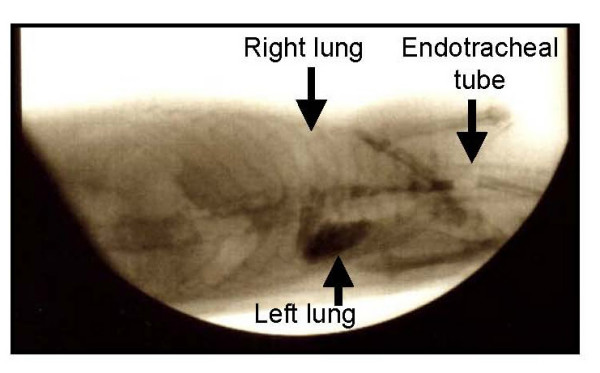
Figure 1
Figure 1
Instillation of fluid into the left lung. The instillation of gastrograffin into the distal trachea of sedated rats in the left lateral decubitus position resulted in consistent localization in the left lung, sparing the right.
Figure 2
Figure 2
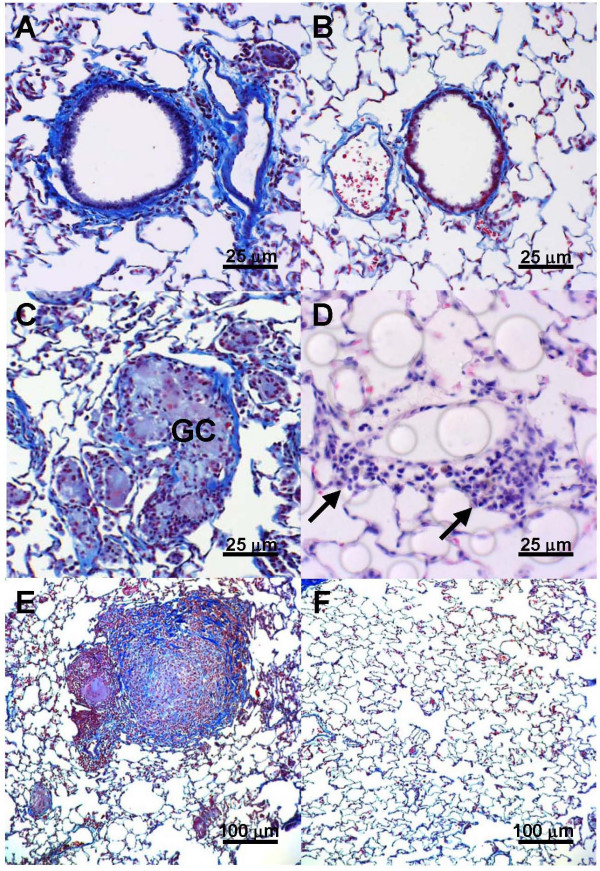
Histology following chronic gastric fluid aspiration. Evaluation of Masson trichrome-stained tissue demonstrated an increase in peribronchiolar and interstitial fibrosis in (a) left lung specimens after 8 weeks of gastric fluid aspiration compared to (b) lung specimens from untreated rats or rats receiving normal saline. Scattered cellular infiltrates were most apparent in left lungs following chronic aspiration of gastric fluid after 8 weeks and consisted primarily of (c) giant cells (GC), apparent in specimens stained with trichrome and (d) perivascular lymphocytes (arrows) as noted in specimens stained with H&E. In many trichrome-stained left lung specimens from rats receiving gastric fluid, (e) complete airway occlusion was observed reminiscent of lesions observed in lung transplant recipients exhibiting obliterative bronchiolitis (OB). Neither fibrosis nor cellular infiltrates were apparent in right lung specimens from rats undergoing gastric fluid aspiration for (f) 8 weeks or at other time points.
Figure 3
Figure 3
Fibrosis following gastric fluid aspiration. The fibrosis grade was evaluated as described in the Methods. The mean peribronchiolar fibrosis grade was significantly higher in left (treated) lung specimens compared to right (untreated) lung specimens after 4, 8, 12, and 16 weeks of gastric fluid aspiration. **p < 0.01, ***p < 0.001 based on two-tailed Student's t test.
Figure 4
Figure 4
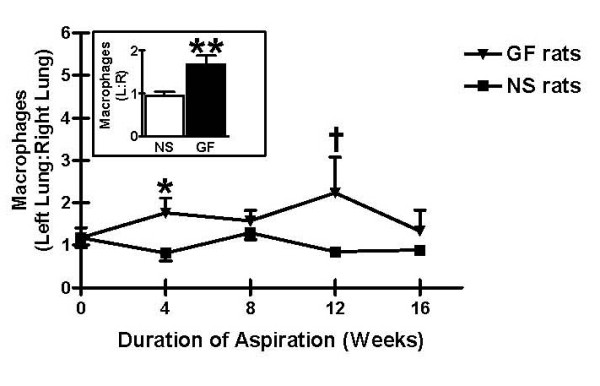
Macrophage infiltration following chronic aspiration of gastric fluid. The relative macrophage quantities in bronchoalveolar lavage (BAL) specimens following chronic aspiration of either gastric fluid or normal saline are shown. The ratio of macrophages in the left to the macrophage in the right lung is shown as a function of time. In the inset, the ratio of macrophages in the left to the macrophages in the right lung is shown for all rats, regardless of the duration of treatment. p < 0.10, *p < 0.05, **p < 0.01 based on two-tailed Student's t test.
Figure 5
Figure 5
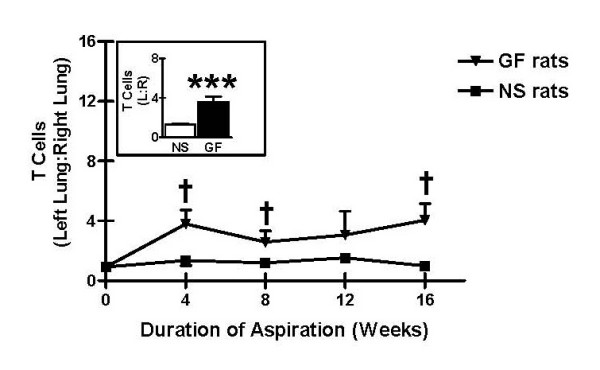
T-cell infiltrates as a result of chronic aspiration of gastric fluid. Relative T cell quantities in bronchoalveolar lavage (BAL) specimens following aspiration of either gastric fluid or normal saline are shown. Left:right lung T cell quantities were substantially higher in BAL specimens from rats receiving gastric fluid compared to rats receiving normal saline after 4, 8, 12, and 16 weeks of aspiration. p < 0.10, ***p < 0.001 based on two-tailed Student's t test.
Figure 6
Figure 6
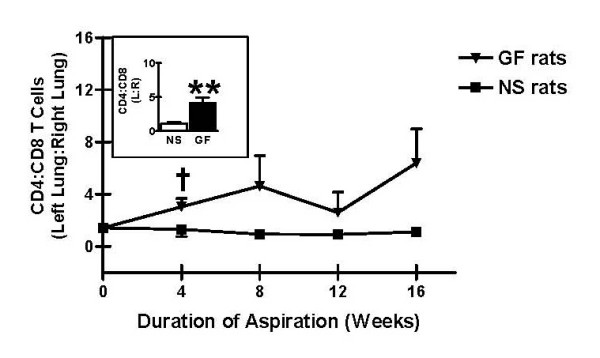
Changes in CD4:CD8 T cell ratios as a result of chronic aspiration of gastric fluid. Relative CD4:CD8 T cell ratios in bronchoalveolar lavage (BAL) specimens following aspiration of either gastric fluid or normal saline are shown. p < 0.10, **p < 0.01 based on two-tailed Student's t test.
Figure 7
Figure 7
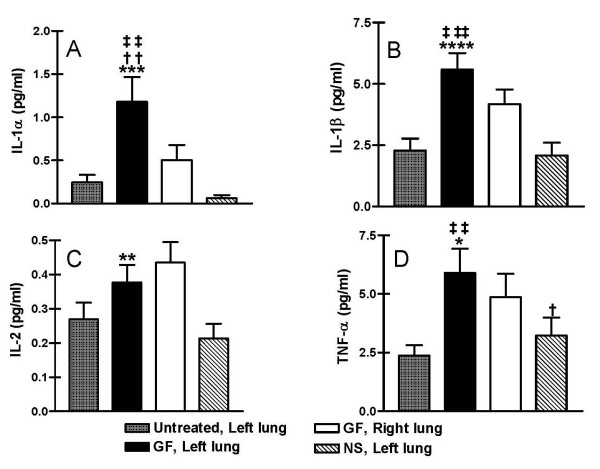
Cytokine response to chronic aspiration of gastric fluid. Cytokine levels were evaluated in the bronchoalveolar lavage (BAL) fluid from the left lung of rats receiving gastric fluid in their left lung, the left lung of rats receiving normal saline in their left lung, the right lung of rats receiving gastric fluid in their left lung, and the left lung of rats receiving no treatment. Levels of (a) IL-1alpha (b) IL-1beta, (c) IL-2 and (d) TNF-alpha are shown. ††p < 0.05 vs. right (untreated) lung after gastric fluid; *p < 0.10, **p < 0.05, ***p < 0.01, ****p < 0.001 vs. left (treated) lung after normal saline; ‡‡p < 0.05, ‡‡‡p < 0.01 vs. BAL from untreated rats based on two-tailed Student's t test.
Figure 8
Figure 8
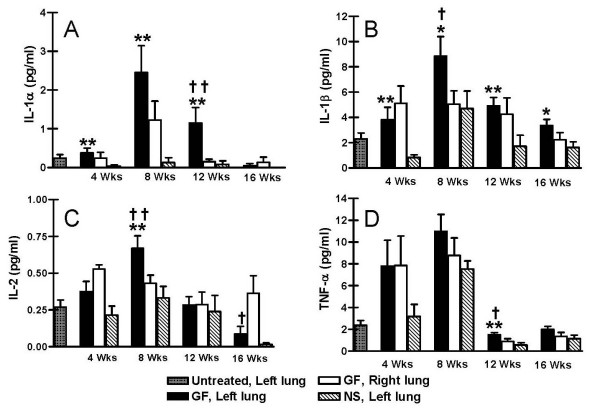
Cytokine response as a function of duration of gastric fluid aspiration. Cytokine levels in bronchoalveolar lavage (BAL) fluid are shown after 4, 8, 12 and 16 weeks of aspiration. Levels of (a) IL-1alpha, (b) IL-1beta, (c) IL-2, and (d) TNF-alpha are shown.p < 0.10, ††p < 0.05 vs. right (untreated) lung after gastric fluid; *p < 0.10, **p < 0.05 vs. left (treated) lung after normal saline based on two-tailed Student's t test.
Figure 9
Figure 9
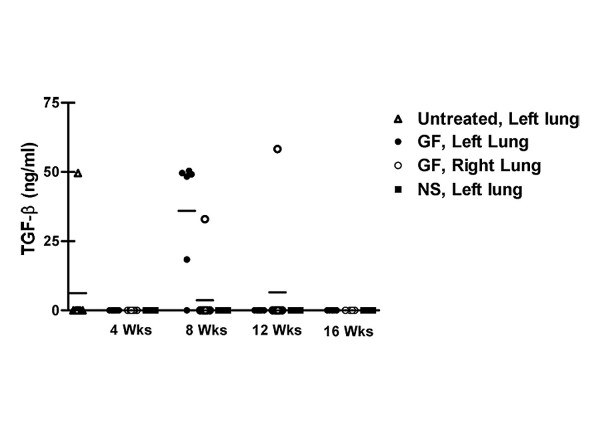
TGF-beta production in response to chronic aspiration of gastric fluid. TGF-beta was detected in BAL fluid from 5 of 6 rats after 8 weeks of gastric fluid aspiration. In contrast, TGF-beta was undetectable in almost all BAL specimens from untreated rats or from rats receiving normal saline (p < 0.0001 based on chi-square analysis).

References

    1. Tobin RW, Pope CE, 2nd, Pellegrini CA, Emond MJ, Sillery J, Raghu G. Increased prevalence of gastroesophageal reflux in patients with idiopathic pulmonary fibrosis. Am J Respir Crit Care Med. 1998;158(6):1804–1808. - PubMed
    1. Vaezi MF. Extraesophageal manifestations of gastroesophageal reflux disease. Clin Cornerstone. 2003;5(4):32–38. doi: 10.1016/S1098-3597(03)90097-4. discussion 39–40. - DOI - PubMed
    1. Harding SM. Recent clinical investigations examining the association of asthma and gastroesophageal reflux. Am J Med. 2003;115(Suppl 3A):39S–44S. doi: 10.1016/S0002-9343(03)00191-8. - DOI - PubMed
    1. Ducolone A, Vandevenne A, Jouin H, Grob JC, Coumaros D, Meyer C, Burghard G, Methlin G, Hollender L. Gastroesophageal reflux in patients with asthma and chronic bronchitis. Am Rev Respir Dis. 1987;135(2):327–332. - PubMed
    1. Ledson MJ, Tran J, Walshaw MJ. Prevalence and mechanisms of gastro-oesophageal reflux in adult cystic fibrosis patients. J R Soc Med. 1998;91(1):7–9. - PMC - PubMed

Publication types

MeSH terms