


Gestational age, birth weight, intrauterine growth, and the risk of epilepsy
- PMID: 18042672
- PMCID: PMC2632964
- DOI: 10.1093/aje/kwm316
Gestational age, birth weight, intrauterine growth, and the risk of epilepsy
Abstract
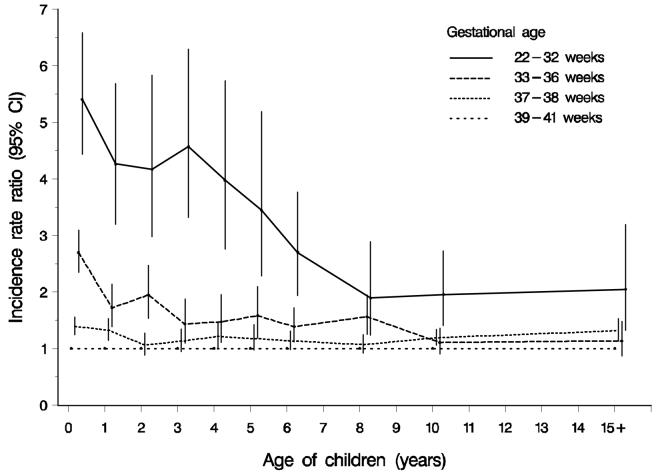
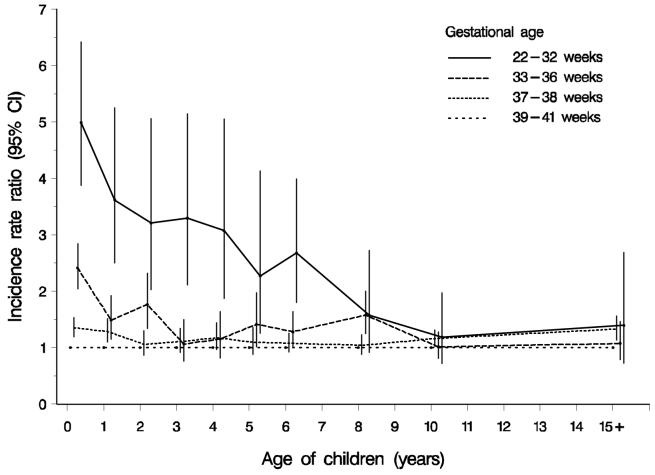
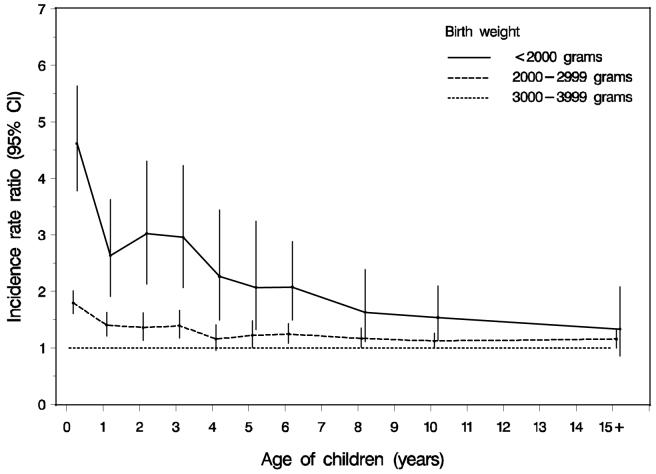
The authors evaluated the association between gestational age, birth weight, intrauterine growth, and epilepsy in a population-based cohort of 1.4 million singletons born in Denmark (1979-2002). A total of 14,334 inpatients (1979-2002) and outpatients (1995-2002) with epilepsy were registered in the Danish National Hospital Register. Children who were potentially growth restricted were identified through two methods: 1) sex-, birth-order-, and gestational-age-specific z score of birth weight; and 2) deviation from the expected birth weight estimated based on the birth weight of an older sibling. The incidence rates of epilepsy increased consistently with decreasing gestational age and birth weight. The incidence rate ratios of epilepsy in the first year of life were more than fivefold among children born at 22-32 weeks compared with 39-41 weeks and among children whose birth weight was <2,000 g compared with 3,000-3,999 g. The association was modified by age but remained into early adulthood. Incidence rate ratios of epilepsy were increased among children identified as growth restricted according to either of the two methods. In conclusion, short gestational age, low birth weight, and intrauterine growth restriction are associated with an increased risk of epilepsy.
Figures

Comment in
-
You've come a long way, baby: or have you?Epilepsy Curr. 2008 Sep-Oct;8(5):118-9. doi: 10.1111/j.1535-7511.2008.00262.x. Epilepsy Curr. 2008. PMID: 18852830 Free PMC article. No abstract available.
References
-
- Fisher RS, van Emde BW, Blume W, et al. Epileptic seizures and epilepsy: definitions proposed by the International League Against Epilepsy (ILAE) and the International Bureau for Epilepsy (IBE) Epilepsia. 2005;46:470–2. - PubMed
-
- Hauser WA. The prevalence and incidence of convulsive disorders in children. Epilepsia. 1994;35(Suppl 2):S1–S6. - PubMed
-
- Nelson KB, Ellenberg JH. Antecedents of cerebral palsy. Multivariate analysis of risk. N Engl J Med. 1986;315:81–6. - PubMed
-
- Brown AS, Begg MD, Gravenstein S, et al. Serologic evidence of prenatal influenza in the etiology of schizophrenia. Arch Gen Psychiatry. 2004;61:774–80. - PubMed
-
- Ellenberg JH, Nelson KB. Birth weight and gestational age in children with cerebral palsy or seizure disorders. Am J Dis Child. 1979;133:1044–8. - PubMed
