. 2008 Jan;135(1):123-31.
doi: 10.1242/dev.010744. Epub 2007 Nov 28.

A novel promoter-tethering element regulates enhancer-driven gene expression at the bithorax complex in the Drosophila embryo

Affiliations

A novel promoter-tethering element regulates enhancer-driven gene expression at the bithorax complex in the Drosophila embryo

Omar S Akbari et al. Development. 2008 Jan.

Abstract

A key question in our understanding of the cis-regulation of gene expression during embryonic development has been the molecular mechanism that directs enhancers to specific promoters within a gene complex. Promoter competition and insulators are thought to play a role in regulating these interactions. In the bithorax complex of Drosophila, the IAB5 enhancer is located 55 kb 3' of the Abdominal-B (Abd-B) promoter and 48 kb 5' of the abdominal-A (abd-A) promoter. Although roughly equidistant from the two promoters, IAB5 specifically interacts only with the Abdominal-B promoter, even though the enhancer and promoter are separated by at least two insulators. Here we demonstrate that a 255 bp element, located 40 bp 5' of the Abd-B transcriptional start site, has a novel cis-regulatory activity as it is able to tether IAB5 to the Abd-B promoter in transgenic embryos. The tethering element is sufficient to direct IAB5 to an ectopic promoter in competition assays. Deletion of the promoter-tethering element results in the redirection of enhancer-driven gene expression on transgenes. Taken together, these results provide evidence that specific long-range enhancer-promoter interactions in the bithorax complex are regulated by a tethering element 5' of the Abd-B promoter. We discuss a bioinformatic analysis of the tethering element across different Drosophila species and a possible molecular mechanism by which this element functions. We also examine existing evidence that this novel class of cis-regulatory elements might regulate enhancer-promoter specificity at other gene complexes.


Figures
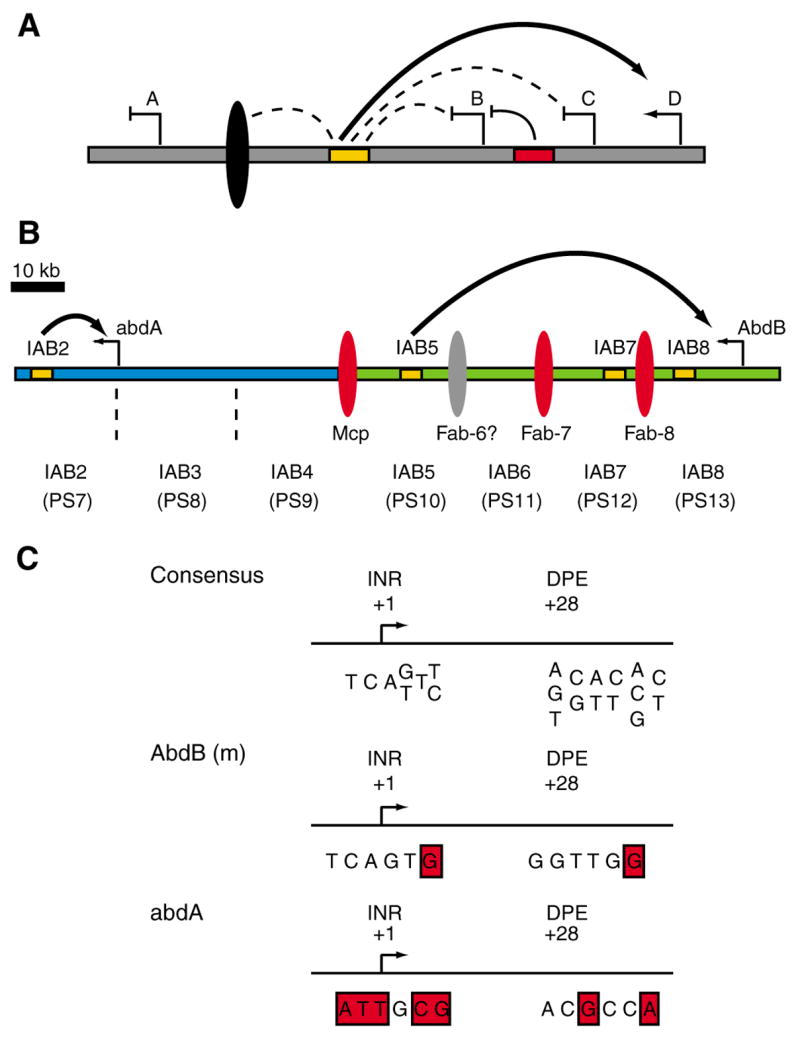
Fig. 1
Fig. 1. Molecular organization of cis-regulatory sequences at the Drosophila bithorax complex
(A) Regulation of promoter-enhancer interactions. The diagram depicts a common enhancer (orange rectangle) at a model gene complex. The enhancer is able to interact with any of the promoters A, B, C or D. An insulator DNA (black ellipse) located between the enhancer and gene A prevents the enhancer from interacting with gene A but leaves it free to activate other promoters. A silencer element (red rectangle) represses gene B in cell types where it would otherwise be activated by the enhancer. Promoter competition regulates the interaction of the enhancer with gene C and gene D. The enhancer can activate either gene, but prefers the core promoter region of gene D. (B) Summary of the Abd-B-abd-A region of the BX-C. The abd-A and Abd-B transcription start sites are indicated by leftward arrows. The intergenic region is ~100 kb in length. The iab regions that control expression of the two homeotic genes are indicated: IAB2–IAB8 (shown with respect to the corresponding embryonic parasegment). IAB2, IAB3 and IAB4 (shown in blue) regulate expression of abd-A. IAB5, IAB6, IAB7 and IAB8 (shown in green) direct Abd-B expression. The insulator DNAs that separate the different iab regions are marked by red ellipses. Characterized enhancers within the iab regions are shown as orange rectangles. The IAB5 enhancer is located 55 kb 3′ of the Abd-B promoter and 48 kb 5′ of the abd-A promoter, but only interacts with Abd-B over the intervening insulator sequences. The IAB2 enhancer is located 18 kb 3′ of the abd-A promoter and directs expression specifically from abd-A. (C) Core promoter sequences at abd-A and Abd-B. The consensus sites for initiator (INR) and downstream promoter elements (DPE) in Drosophila are shown (Butler and Kadonaga, 2002). The sequences from the Abd-B and abd-A promoters do not match these consensus sites (mismatches shown in red). In addition, neither of the homeotic promoters contains a recognizable TATA box, suggesting that the core promoter elements at Abd-B(m) and abd-A are not distinctive. Abd-B(m), morphogenetic transcript.
Fig. 2
Fig. 2. Enhancer-promoter interactions at the BX-C
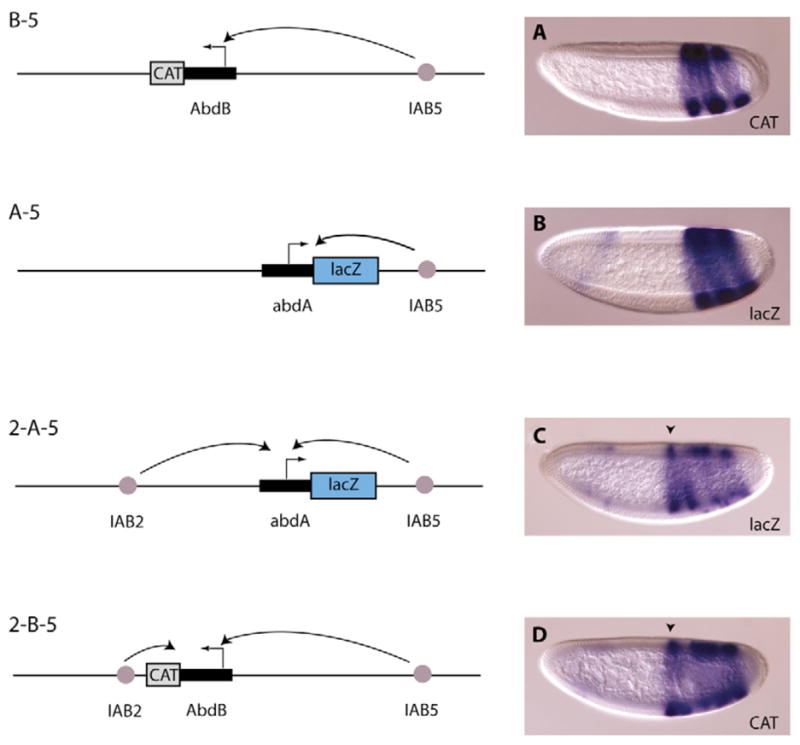
Transgenic embryos were hybridized with digoxigenin-labeled antisense RNA probes (diagrams on left). The embryos shown on the right are at blastoderm stage and orientated with anterior to the left and dorsal up. (A) On the B-5 construct the IAB5 enhancer directs expression of the Abd-B-CAT reporter gene in three characteristic stripes in presumptive abdominal segments 5, 7 and 9. (B) IAB5 is also able to interact with the abd-A promoter in the absence of a competing promoter, as it activates transcription from the abd-A-lacZ reporter gene. Ectopic expression of the lacZ and CAT reporter genes is also detected in the anterior of some transgenic embryos, as previously described (Ohtsuki et al., 1998; Zhou et al., 1999). (C,D) IAB2 and IAB5 will simultaneously activate expression from the abd-A or Abd-B promoter, indicated by a broad band of expression extending from presumptive abdominal segment 2 (indicated by black arrowhead) towards the posterior in 2-A-5 (C) and 2-B-5 (D) transgenic embryos. These expression patterns indicate that, in the absence of competing promoters, both homeotic gene promoters are responsive to interaction with the enhancers from the BX-C.
Fig. 3
Fig. 3. Regulatory specificity determines cis-interactions at the BX-C
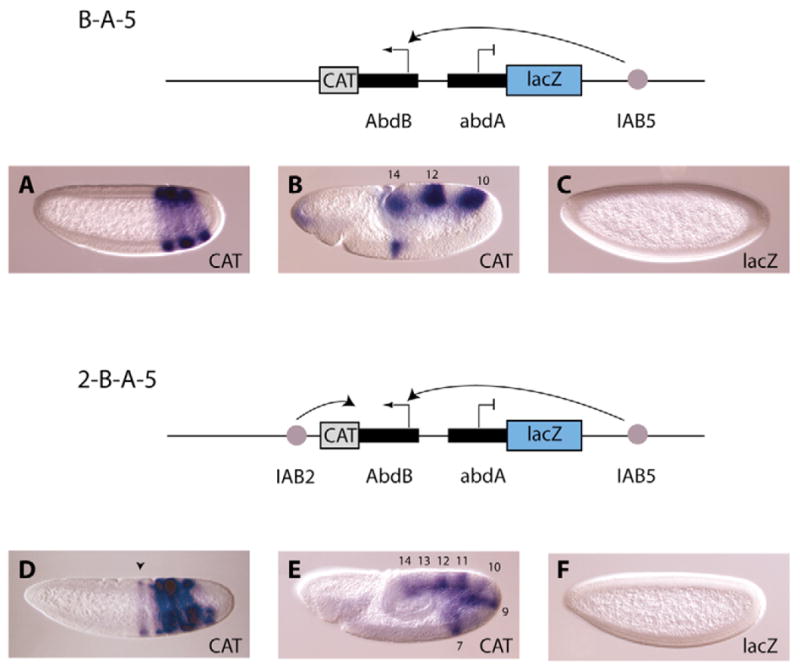
On the B-A-5 construct (top diagram), the IAB5 enhancer was placed 3′ of the proximal abd-A-lacZ reporter gene. The distal CAT gene is under the control of the Abd-B promoter. In this configuration the IAB5 enhancer selects Abd-B over abd-A, so that the Abd-B-CAT reporter exhibits a three-stripe IAB5 expression pattern in parasegments 10, 12 and 14; this is readily detected in blastoderm-stage embryos (A) and germband-elongation-stage embryos (B), whereas abd-A-lacZ is silent (C). By contrast, the IAB2 enhancer on the 2-B-A-5 construct (lower diagram) does not interact with its normal endogenous target (abd-A), but directs expression from the Abd-B-CAT gene in parasegments 7 (black arrow), 9, 11 and 13. In blastoderm-stage (D) and germ band elongation-stage embryos (E), a composite IAB2-IAB5-driven expression pattern is detected. The inactivity of the lacZ reporter on this construct (F) suggests that IAB2 only interacts with the most proximal promoter.
Fig. 4
Fig. 4. Anti-insulator activity in the Abd-B promoter
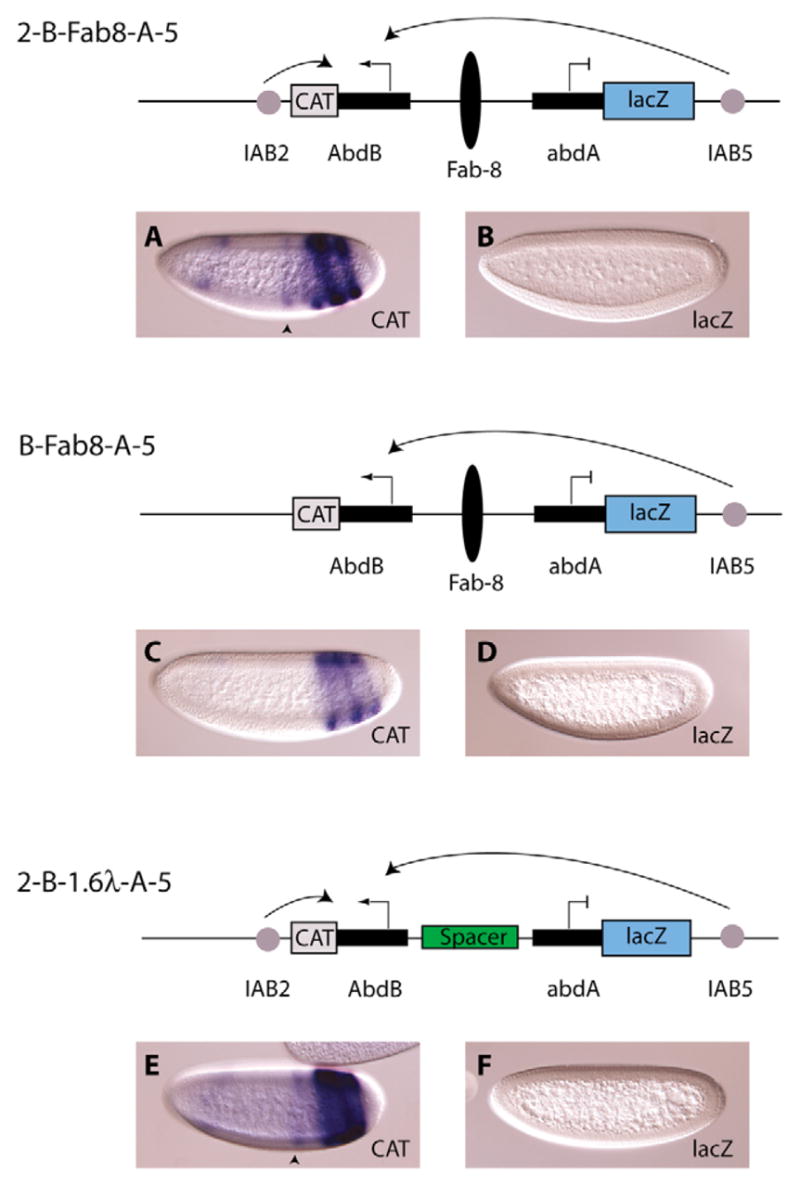
On the 2-B-Fab-8-A-5 construct (top diagram), the Fab-8 insulator was inserted between the two homeotic promoters. In this configuration both the IAB2 and IAB5 enhancers activate the Abd-B promoter, as CAT is expressed in the broad stripes, extending from parasegment 7 (black arrowhead) towards the posterior of the embryo (A), whereas no lacZ expression can be detected (B). To verify that IAB5 is activating expression from the Abd-B promoter, the IAB2 enhancer was removed to generate the B-Fab-8-A-5 construct (middle diagram). Transgenic embryos confirmed that IAB5 is indeed recruited the Abd-B promoter as CAT expression can be seen in a distinctive IAB5 pattern (C), whereas lacZ is not activated (D). To examine whether spacing had an effect on these interactions, a 1.6 kb λ-spacer DNA was placed between the two homeotic promoters on the 2-B-1.6λ-A-5 construct (bottom diagram). The addition of this λ-spacer did not modulate the activation of expression from the Abd-B promoter by the IAB2 and IAB5 enhancers (E) and no lacZ expression is detected (F).
Fig. 5
Fig. 5. Identification of the promoter-tethering element
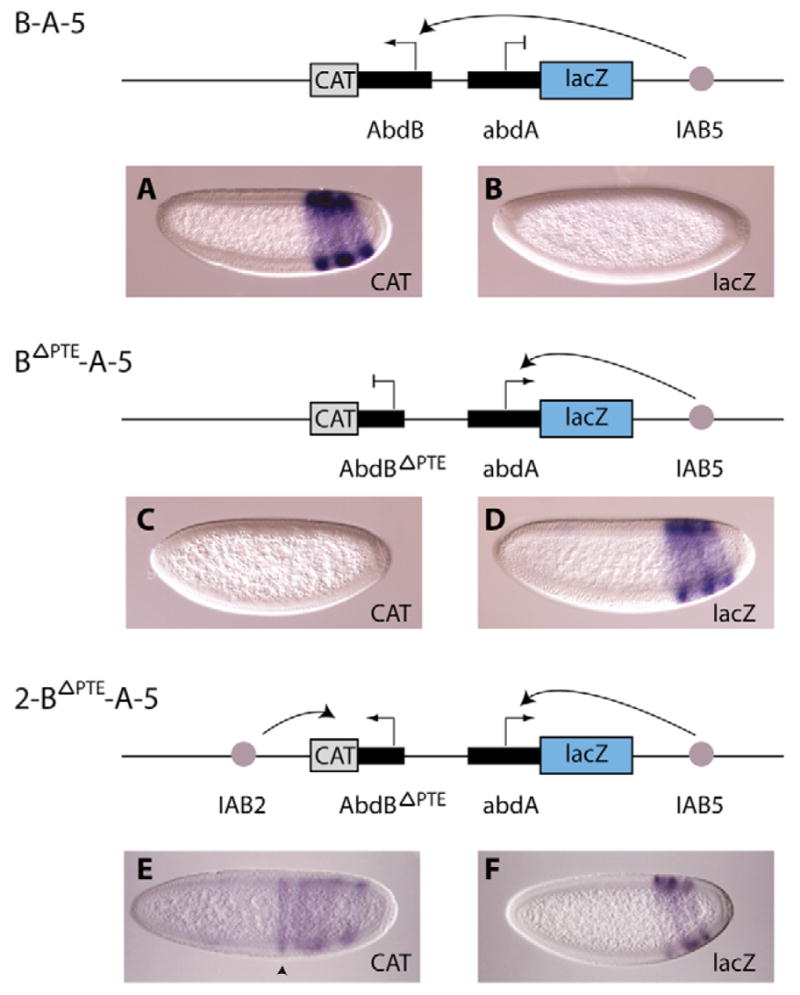
On the B-A-5 construct (top diagram), the IAB5 enhancer specifically bypasses the abd-A promoter (B) to activate expression from the Abd-B promoter (A). When the 255 bp region extending from −40 to −294 bp relative to the transcription start site is removed from the Abd-B promoter (BΔPTE-A-5 construct; middle diagram), the IAB5 enhancer is now re-directed to the abd-A promoter, as no CAT expression is detected (C) and strong lacZ expression is detected (D) in the majority of embryos. Extremely weak CAT expression in an IAB5-directed pattern was detected in a few transgenic embryos (data not shown). The integrity of the Abd-BΔPTE promoter was confirmed by insertion of the IAB2 enhancer 3′ of the Abd-BΔPTE-CAT reporter gene on the 2-BΔPTE-A-5 construct (bottom diagram). This resulted in IAB2 activation of the Abd-BΔPTE promoter indicated by an IAB2-driven CAT expression pattern in parasegments 7 (black arrowhead), 9, 11 and 13 in transgenic embryos (E), whereas lacZ is activated in an IAB5-driven expression pattern in the more posterior parasegments 10, 12 and 14 (F). Embryos exhibiting weaker staining are shown to clearly demonstrate the different expression patterns driven by the two IAB enhancers, although overall the expression in the 2-BΔPTE-A-5 embryos was comparable to other transgenic lines analyzed in this study.
Fig. 6
Fig. 6. The PTE is able to regulate expression of an ectopic promoter
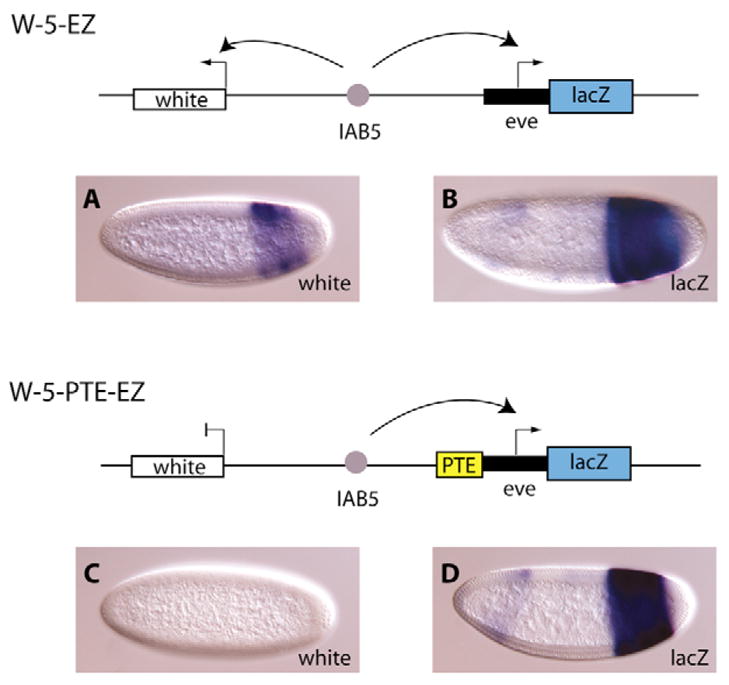
In the W-5-EZ construct (top diagram), the IAB5 enhancer is located between the white and even-skipped (eve) promoters. In this configuration, IAB5 is able to drive expression from white (A) and eve-lacZ (B). Insertion of the 255 bp PTE sequence adjacent to the eve-lacZ promoter in the W-5-PTE-EZ construct (bottom diagram) resulted in strong expression of lacZ (D) and an absence of expression of white (C), indicating that IAB5 is now exclusively activating the eve-lacZ promoter.
Fig. 7
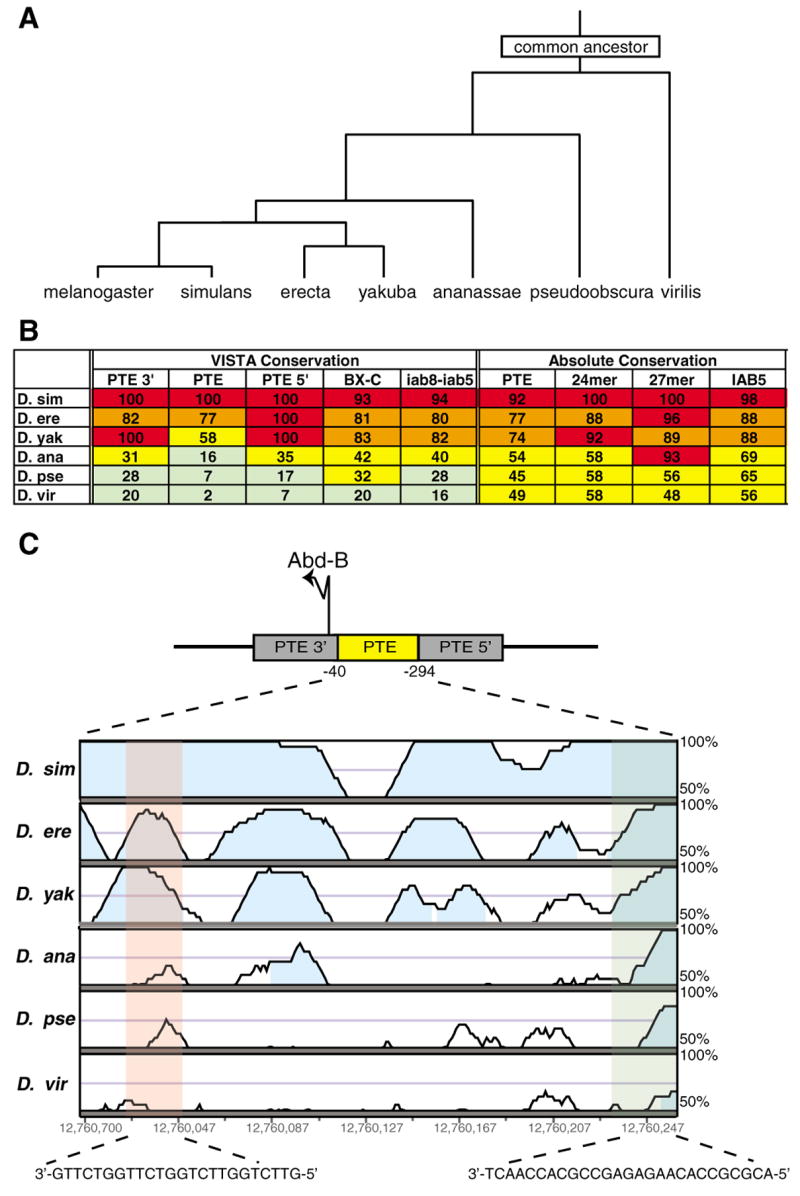
Fig. 7. Conservation of the PTE sequence across Drosophila species
(A) An informal consensus tree (Crosby et al., 2007) illustrating evolutionary relationships among Drosophila species. (B) Sequence conservation levels for the 255 bp PTE and PTE 5′ and PTE 3′ (which represent the 255 bp regions 5′ and 3′ of the PTE with respect to Abd-B). For comparison, the conservation within the entire bithorax complex (BX-C) and the complete chromosomal control regions that direct Abdominal-B gene expression (iab8-iab5) and the IAB5 enhancer are also shown. Level of conservation between D. melanogaster and six other Drosophila species is indicated by color code: >90% red, 70–89% orange, 30–69% yellow, <30% green for different sequences. Conservation values were calculated using VISTA genome browser (see Materials and methods). Absolute conservation is the total percentage of D. melanogaster nucleotides that were conserved in the homologous region identified by VISTA alignment from the other species examined. (C) VISTA plots of the alignments indicate that the level of conservation is variable across the length of the PTE sequence. Overall, the PTE is less highly conserved than neighboring sequences or the non-genic regions in the BX-C, but there are two short, highly conserved sequences within it, a 24-mer (pink) and a 27-mer (green). The height of the peaks in the plots represents the level of conservation over a 24 bp window. Regions at least 24 bp long that are >80% conserved are indicated in cyan.

References

    1. Akbari OS, Bousum A, Bae E, Drewell RA. Unraveling cis-regulatory mechanisms at the abdominal-A and Abdominal-B genes in the Drosophila bithorax complex. Dev Biol. 2006;293:294–304. - PubMed
    1. Bae E, Calhoun VC, Levine M, Lewis EB, Drewell RA. Characterization of the intergenic RNA profile at abdominal-A and Abdominal-B in the Drosophila bithorax complex. Proc Natl Acad Sci USA. 2002;99:16847–16852. - PMC - PubMed
    1. Barges S, Mihaly J, Galloni M, Hagstrom K, Muller M, Shanower G, Schedl P, Gyurkovics H, Karch F. The Fab-8 boundary defines the distal limit of the bithorax complex iab-7 domain and insulates iab-7 from initiation elements and a PRE in the adjacent iab-8 domain. Development. 2000;127:779–790. - PubMed
    1. Bell AC, Felsenfeld G. Methylation of a CTCF-dependent boundary controls imprinted expression of the Igf2 gene. Nature. 2000;405:482–485. - PubMed
    1. Busturia A, Bienz M. Silencers in abdominal-B, a homeotic Drosophila gene. EMBO J. 1993;12:1415–1425. - PMC - PubMed

Publication types

MeSH terms

LinkOut - more resources