. 2007 Dec;18(12):832-8.
doi: 10.1007/s00335-007-9075-8. Epub 2007 Nov 30.

Chromosome X modulates incidence of testicular germ cell tumors in Ter mice

Affiliations

Chromosome X modulates incidence of testicular germ cell tumors in Ter mice

Shirley Hammond et al. Mamm Genome. 2007 Dec.

Abstract

Germ cell tumor development in humans has been proposed to be part of testicular dysgenesis syndrome (TDS), which manifests as undescended testes, sterility, hypospadias, and, in extreme cases, as germ cell tumors. Males of the Ter mouse strain show interesting parallels to TDS because they either lack germ cells and are sterile or develop testicular germ cell tumors. We found that these defects in Ter mice are due to mutational inactivation of the Dead-end (Dnd1) gene. Here we report that chromosome X modulates germ cell tumor development in Ter mice. We tested whether the X or the Y chromosome influences tumor incidence. We used chromosome substitution strains to generate two new mouse strains: 129-Ter/Ter that carry either a C57BL/6J (B6)-derived chromosome (Chr) X or Y. We found that Ter/Ter males with B6-Chr X, but not B6-Chr Y, showed a significant shift in propensity from testicular tumor development to sterile testes phenotype. Thus, our studies provide unambiguous evidence that genetic factors from Chr X modulate the incidence of germ cell tumors in mice with inactivated Dnd1.


Figures
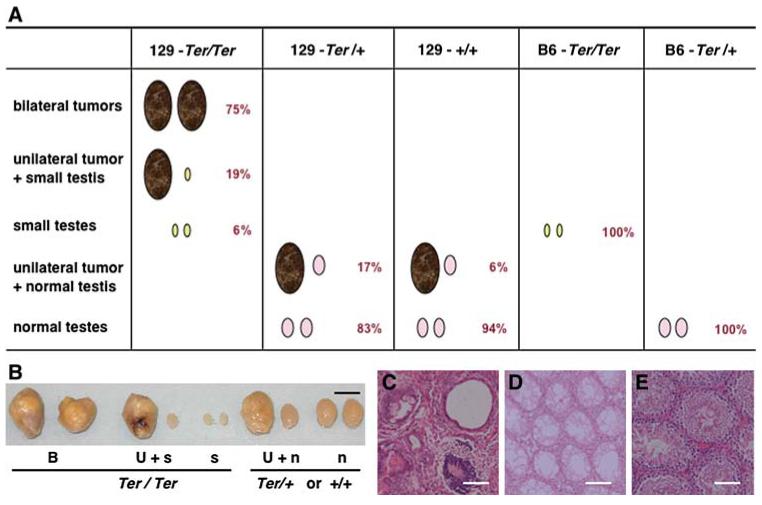
Fig. 1
Fig. 1
A Illustration of testicular phenotypes that distinguish Ter/Ter males from Ter/+ and +/+ males. Ter/Ter males on 129 strain background have bilateral tumors (75% of Ter/Ter males), unilateral tumors accompanied with small testis (19% of Ter/Ter males), and bilateral small testes (6% of Ter/Ter males) (Noguchi and Noguchi 1985). Seventeen percent of Ter/+ and 6% of 129-+/+ males develop unilateral testicular tumors with contralateral normal testes. The majority have normal testes. When Ter/Ter is congenic on the C57BL/6J strain (mice designated as B6.129-Ter/Ter or B6-Ter/Ter), 100% of B6-Ter/Ter mice develop bilateral small testes. In contrast, all B6-Ter/+ males have normal testes. B Testicular phenotypes of the Ter strain. Examples of bilateral tumors (B), unilateral tumor with contralateral small testis (U+s), bilateral small testes (s) from 129-Ter/Ter adult males compared to unilateral tumor with contralateral normal testis (U+n), or normal (n) testes from 129-Ter/+ and 129-+/+ mice. Black scale bar = 0.5 cm. C Histology of testicular tumor from male, adult 129-Ter/Ter showing differentiated cell types. D Histology of small testes with no germ cells from male, adult 129-Ter/Ter. E Histology of normal testes from male, adult 129-Ter/+ mice. White scale bar = 100 μm
Fig. 2
Fig. 2
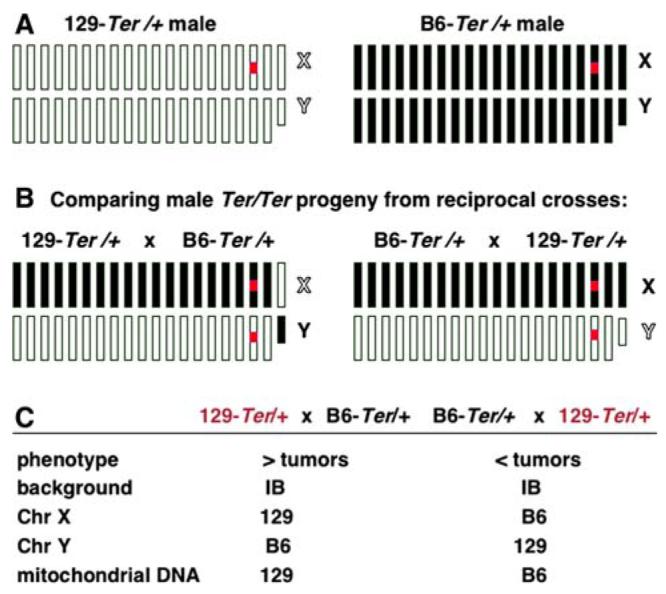
Parental effects on tumor development. A Diagram illustrating autosomal and sex chromosomes of 129-Ter/+ and B6-Ter/+ males. White boxes represent 129 chromosomes and black boxes represent C57BL/6J chromosomes. The X chromosome (marked X) is the 20th box and Y (marked Y) is represented by the smaller box. The red box represents the Ter (Dnd1Ter) mutation on Chr 18. B (left) Schematic diagram of chromosomes of male Ter/Ter progeny expected from reciprocal intercrosses of 129-Ter/+ female and B6-Ter/+ male. The progeny from both sets of crosses will be heterozygous for every autosome as represented by white and black boxes. The X chromosome will be derived from the 129 mother and the Y chromosome will be from the B6 father. (right) Chromosomes of progeny expected from the intercross B6-Ter/+female × 129-Ter/+ male. The X chromosome will be derived from B6 mother and the Y chromosome will be from the 129 father. C Summary of characteristics of progeny from the two crosses. IB refers to heterozygous for 129 and B6. Progeny from 129-Ter/+ female × B6-Ter/+ male cross have a higher incidence of tumors compared to those from the reciprocal cross whose parents are B6-Ter/+ female × 129-Ter/+ male
Fig. 3
Fig. 3
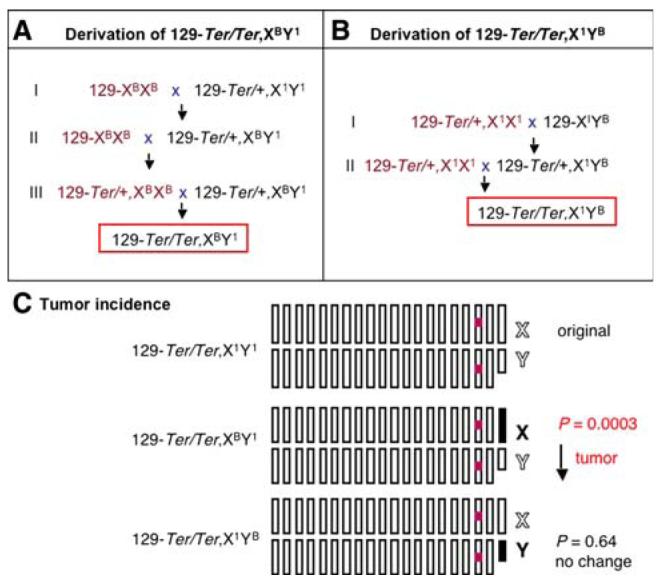
Derivation of 129-Ter/Ter males with B6-derived Chr X or Chr Y. A A three-generation cross was used to derive 129-Ter/Ter males with B6-derived Chr X. Intercrosses were set up to prevent recombination of the B6-derived Chr X during the crosses. For cross I, 129.B6-X (129-XBXB) females were intercrossed to male 129-Ter/+ (designated as 129-Ter/+,X1Y1). Male progeny were selected by genotyping for Ter/+. These males would carry B6-derived Chr X (129-Ter/+,XBY1). For the second cross (II), 129-Ter/+,XBY1 males were intercrossed with 129.B6-X (129-XBXB) females. Female progeny were selected for Ter/+. These females would carry two B6-derived Chr X (129-Ter/+,XBXB). In the final cross (III), 129-Ter/ +,XBXB females from II were crossed to 129-Ter/+,XBY1 males. Approximately 25% of the resulting progeny are expected to be Ter/Ter and carry B6-derived Chr X (129-Ter/Ter,XBY1) and display one of three testicular phenotypes shown in Fig. 1. B A two-generation cross was used to derive 129-Ter/Ter males with B6-derived Chr Y. For cross I, 129-Ter/+ females (designated as 129-Ter/+,X1X1) were intercrossed to male 129.B6-Y (129-XIYB). Male progeny were selected by genotyping for Ter/+. These males would carry B6-derived Chr Y (129-Ter/+,X1YB). For the second cross (II), 129-Ter/+ females were intercrossed with 129-Ter/+,X1YB males. Approximately 25% of the resulting progeny are expected to be Ter/Ter and carry B6-derived Chr Y (129-Ter/Ter,X1YB) and display one of three testicular phenotypes of Ter/Ter as shown in Fig. 1. C Summary of the incidence of testicular tumors in males of the new 129-Ter/Ter,XBY1 and 129-Ter/Ter,X1YB strains compared to the original 129-Ter/Ter strain (Noguchi and Noguchi 1985). The chromosomes of the original 129-Ter/Ter males (referred to as 129-Ter/Ter,X1Y1) and the new strains 129-Ter/Ter,XBY1 and 129-Ter/Ter,X1YB are shown. 129 chromosomes are represented by white boxes and B6 by black boxes. The X chromosome (marked X) is the 20th box and the Y (marked Y) is represented by the smaller box. The red box represents the Ter (Dnd1Ter) mutation

References

    1. Crockford GP, Linger R, Hockley S, Dudakia D, Johnson L, et al. Genome-wide linkage screen for testicular germ cell tumour susceptibility loci. Hum Mol Genet. 2006;15:443–451. - PubMed
    1. Henegarui O, Heerema NA, Thurston V, Jung S-H, Pera M, et al. Characterization of gains, losses, and regional amplification in testicular germ cell tumor cell lines by comparative genomic hybridization. Cancer Genet Cytogenet. 2004;148:14–20. - PubMed
    1. Holzik MFL, Hoekstra HJ, Sijmons RH, Sonneveld DJA, van der Steege G, et al. Re-analysis of the Xq27-Xq28 region suggests a weak association of an X-linked gene with sporadic testicular germ cell tumor wihout cryptorchidism. Eur J Cancer. 2006;42:1869–1874. - PubMed
    1. Horwich A, Shipley J, Huddart R. Testicular germ-cell cancer. Lancet. 2006;367:754–765. - PubMed
    1. Jacobsen R, Bostofte E, Engholm G, Hansen J, Olsen JH, et al. Risk of testicular cancer in men with abnormal semen characteristics: cohort study. BMJ. 2000;321:789–792. - PMC - PubMed

Publication types