


Being 40 or younger is an independent risk factor for relapse in operable breast cancer patients: the Saudi Arabia experience
- PMID: 18053234
- PMCID: PMC2222639
- DOI: 10.1186/1471-2407-7-222
Being 40 or younger is an independent risk factor for relapse in operable breast cancer patients: the Saudi Arabia experience
Abstract
Background: Breast cancer in young Saudi women is a crucial problem. According to the 2002 annual report of Saudi National Cancer Registry, breast cancers that developed before the age of 40 comprise 26.4% of all female breast cancers comparing to 6.5% in the USA. Breast cancer in young patients is often associated with a poorer prognosis, but there has been a scarcity of published data in the Middle East population.
Methods: Total of 867 breast cancer patients seen at King Faisal Specialist Hospital & Research Centre (KFSH&RC) between 1986 and 2002 were reviewed. Patients were divided in two age groups: < or = 40 years and above 40 years. The clinicopathological characteristics and treatment outcomes were compared between younger and older age groups.
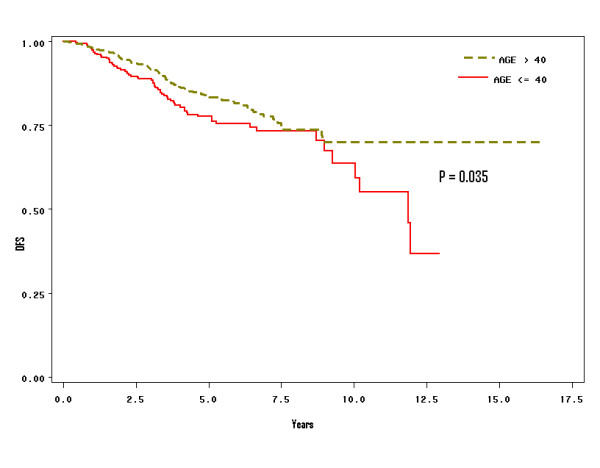
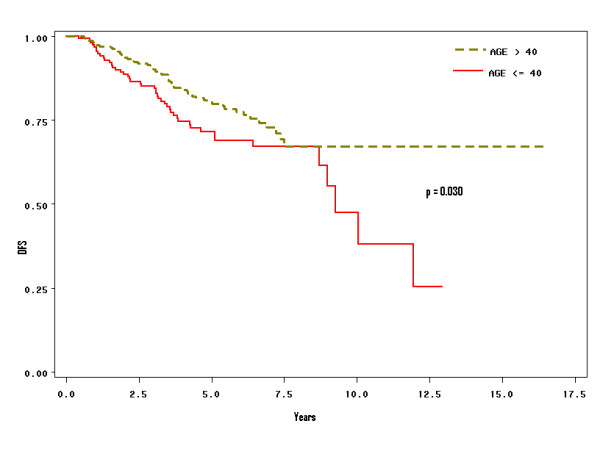
Results: Median age at presentation was 45 years. A total of 288 (33.2%) patients were aged < or = 40 years. Hormone receptors were positive in 69% of patients 40 and 78.2% of patients above 40 (p = 0.009). There was a significantly higher incidence of grade III tumor in younger patients compared to older patients (p = 0.0006). Stage, tumor size, lymphatic/vascular invasion, number of nodes and axillary lymph node status, did not differ significantly between the two age groups. Younger patients had a greater probability of recurrence at all time periods (p = 0.035). Young age had a negative impact on survival of patients with positive axillary lymph nodes (p = 0.030) but not on survival of patients with negative lymph nodes (p = 0.695). Stage, tumor size, nodal status and hormonal receptors had negative impact on survival. Adjuvant chemotherapy was administered to 87.9% of younger and 65.6% of older patients (p < 0.0001). In terms of hormone therapy, the proportion of tamoxifen treated patients was significantly lower in young age group (p < 0.0001). No significant difference in radiation therapy between the two groups.
Conclusion: Young age (< or = 40) is an independent risk factor for relapse in operable Saudi breast cancer patients. The fundamental biology of young age breast cancer patients needs to be elucidated.
Figures
References
-
- Tarone RE. Breast cancer trends among young women in the United States. Epidemiology (Cambridge, Mass) 2006;17:588–590. - PubMed
-
- Registry NC. Cancer Incidence Report Saudi Arabia 2002. Riyadh. 2007.
-
- Zabicki K, Colbert JA, Dominguez FJ, Gadd MA, Hughes KS, Jones JL, Specht MC, Michaelson JS, Smith BL. Breast cancer diagnosis in women < or = 40 versus 50 to 60 years: increasing size and stage disparity compared with older women over time. Ann Surg Oncol. 2006;13:1072–1077. doi: 10.1245/ASO.2006.03.055. - DOI - PubMed
-
- Bollet MA, Sigal-Zafrani B, Mazeau V, Savignoni A, de la Rochefordiere A, Vincent-Salomon A, Salmon R, Campana F, Kirova YM, Dendale R, et al. Age remains the first prognostic factor for loco-regional breast cancer recurrence in young (<40 years) women treated with breast conserving surgery first. Radiother Oncol. 2007;82:272–280. doi: 10.1016/j.radonc.2007.01.001. - DOI - PubMed
-
- Aryandono T, Harijadi , Soeripto Breast cancer in young women: prognostic factors and clinicopathological features. Asian Pac J Cancer Prev. 2006;7:451–454. - PubMed
Publication types
MeSH terms
Substances
LinkOut - more resources
Full Text Sources
Medical
