. 2007 Dec 5:8:451.
doi: 10.1186/1471-2164-8-451.

Continuous exposure to Plasmodium results in decreased susceptibility and transcriptomic divergence of the Anopheles gambiae immune system

Affiliations

Continuous exposure to Plasmodium results in decreased susceptibility and transcriptomic divergence of the Anopheles gambiae immune system

Ruth Aguilar et al. BMC Genomics. .

Abstract

Background: Plasmodium infection has been shown to compromise the fitness of the mosquito vector, reducing its fecundity and longevity. However, from an evolutionary perspective, the impact of Plasmodium infection as a selective pressure on the mosquito is largely unknown.

Results: In the present study we have addressed the effect of a continuous Plasmodium berghei infection on the resistance to infection and global gene expression in Anopheles gambiae. Exposure of A. gambiae to P. berghei-infected blood and infection for 16 generations resulted in a decreased susceptibility to infection, altered constitutive expression levels for approximately 2.4% of the mosquito's total transcriptome and a lower basal level of immune genes expression, including several anti-Plasmodium factors. The infection-responsiveness for several defense genes was elevated in the P. berghei exposed mosquito colonies.

Conclusion: Our study establishes the existence of a selective pressure exerted by the parasite P. berghei on the malaria vector A. gambiae that results in a decreased permissiveness to infection and changes in the mosquito transcriptome regulation that suggest a decreased constitutive immune gene activity but a more potent immune response upon Plasmodium challenge.


Figures
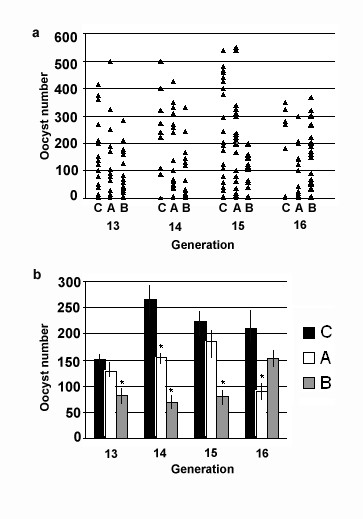
Figure 1
Figure 1
Oocysts numbers in four different generations (13–16) of control (C) and exposed lines (A and B) of Anopheles gambiae after infection with Plasmodium berghei. a: Individual values (each dot represents the oocysts number in the midgut of each mosquito). b: Average and standard error of each group of individual values for generations 13–16. Asterisks indicate statistically significant differences (Mann-Whitney test) with respect to control values (*P < 0.05). (see Additional File 3 Table).
Figure 2
Figure 2
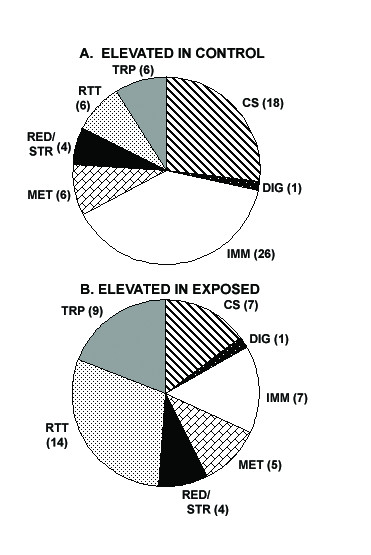
Pie charts showing functional gene class distributions of differentially expressed genes between naïve non-blood fed mosquitoes of the exposed lines (generations 13 to 16) and the non-exposed control lines (generations 15 and 16). The genes are classified in seven different groups according to their predicted functions and shown in two subdivisions, (A) genes that have higher expression levels in the naïve non-blood fed non-exposed control lines and (B) genes that have consistent higher expression levels in the generations 13 to 16 of the exposed lines. [CS: cytoskeletal and structural genes, DIG: digestion-related genes, IMM: immune genes, MET: genes involved in metabolism, RED/STR: redox and stress-related genes, R/T/T: replication/transcription/translation related genes, TRP: transport-related genes]. (see Additional Files 4 and 5 tables).
Figure 3
Figure 3
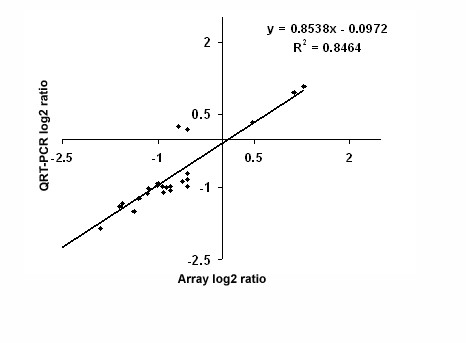
Validation of the microarray data by real-time PCR (qRT-PCR). Log2-transformed values from the microarray and qRT-PCR analyses of the TEP1, TEP4, two GSTs, one cytochrome P450, cecropin 3, and apolipoprotein D genes, from naïve mosquitoes of the exposed lines A and B, from generations 13–16 (see Additional File 6 table).
Figure 4
Figure 4
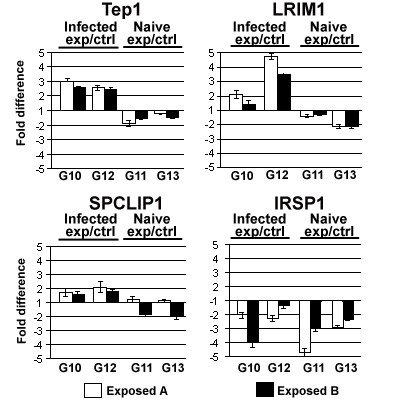
Comparison of expression of the anti-Plasmodium immune genes TEP1, LRIM1, SPCLIP1, and IRSP1 between exposed and non-exposed lines upon P. berghei infection (Infected) (24 hours after feeding on P. berghei infected blood) and at a non-infected non-fed state (Naïve). Expression levels were determined by qRT-PCR in exposed lines A (open box) and B (black box) of generations 10 and 12 (G10 and G12) from infected mosquitoes and generations 11 and 13 (G11 and G13) for the non-infected naïve mosquitoes. The threshold values (Ct) of the four genes were normalized against the A. gambiae S7 gene, and the -fold differences in transcript abundance (exposed/non-exposed) were calculated for each gene in the exposed lines A and B with respect to the control line and plotted as bar diagrams. All qRT-PCRs were repeated at least three times, and the mean values are shown in the graph with standard errors indicated (see Additional File 7 Table).

References

    1. Dimopoulos G, Kafatos FC, Waters AP, Sinden RE. Malaria parasites and the Anopheles mosquito. Chem Immunol. 2002;80:27–49. - PubMed
    1. Tahar R, Boudin C, Thiery I, Bourgouin C. Immune response of Anopheles gambiae to the early sporogonic stages of the human malaria parasite Plasmodium falciparum. Embo J. 2002;21:6673–6680. doi: 10.1093/emboj/cdf664. - DOI - PMC - PubMed
    1. Becker K, Tilley L, Vennerstrom JL, Roberts D, Rogerson S, Ginsburg H. Oxidative stress in malaria parasite-infected erythrocytes: host-parasite interactions. Int J Parasitol. 2004;34:163–189. doi: 10.1016/j.ijpara.2003.09.011. - DOI - PubMed
    1. Dong Y, Aguilar R, Xi Z, Warr E, Mongin E, Dimopoulos G. Anopheles gambiae immune responses to human and rodent Plasmodium parasite species. PLoS Pathog. 2006;2:e52. doi: 10.1371/journal.ppat.0020052. - DOI - PMC - PubMed
    1. Vernick KD, Fujioka H, Seeley DC, Tandler B, Aikawa M, Miller LH. Plasmodium gallinaceum: a refractory mechanism of ookinete killing in the mosquito, Anopheles gambiae. Exp Parasitol. 1995;80:583–595. doi: 10.1006/expr.1995.1074. - DOI - PubMed

Publication types

MeSH terms

Substances

LinkOut - more resources