


Improvement in survival associated with adult-to-adult living donor liver transplantation
- PMID: 18054553
- PMCID: PMC3170913
- DOI: 10.1053/j.gastro.2007.09.004
Improvement in survival associated with adult-to-adult living donor liver transplantation
Abstract
Background & aims: More than 2000 adult-to-adult living donor liver transplantations (LDLT) have been performed in the United States, yet the potential benefit to liver transplant candidates of undergoing LDLT compared with waiting for deceased donor liver transplantation (DDLT) is unknown. The aim of this study was to determine whether there is a survival benefit of adult LDLT.
Methods: Adults with chronic liver disease who had a potential living donor evaluated from January 1998 to February 2003 at 9 university-based hospitals were analyzed. Starting at the time of a potential donor's evaluation, we compared mortality after LDLT to mortality among those who remained on the waiting list or received DDLT. Median follow-up was 4.4 years. Comparisons were made by hazard ratios (HR) adjusted for LDLT candidate characteristics at the time of donor evaluation.
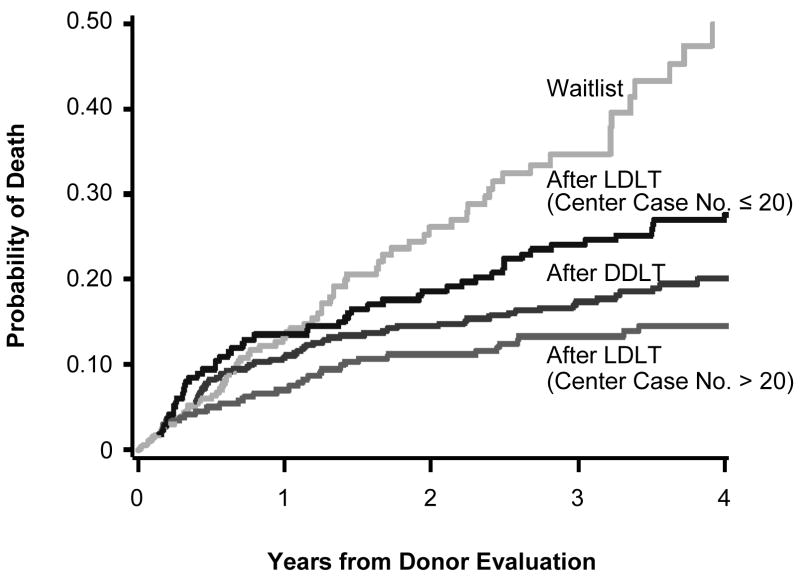
Results: Among 807 potential living donor recipients, 389 underwent LDLT, 249 underwent DDLT, 99 died without transplantation, and 70 were awaiting transplantation at last follow-up. Receipt of LDLT was associated with an adjusted mortality HR of 0.56 (95% confidence interval [CI]: 0.42-0.74; P < .001) relative to candidates who did not undergo LDLT. As centers gained greater experience (>20 LDLT), LDLT benefit was magnified, with a mortality HR of 0.35 (95% CI: 0.23-0.53; P < .001).
Conclusions: Adult LDLT was associated with lower mortality than the alternative of waiting for DDLT. This reduction in mortality was magnified as centers gained experience with LDLT. This reduction in transplant candidate mortality must be balanced against the risks undertaken by the living donors themselves.
Conflict of interest statement
No Conflicts of Interest exist.
Figures


Comment in
-
Live donor liver transplantation: is it better than waiting?Gastroenterology. 2007 Dec;133(6):2040-2. doi: 10.1053/j.gastro.2007.10.033. Gastroenterology. 2007. PMID: 18054574 No abstract available.
References
-
- 2005 Annual Report of the U.S. Organ Procurement and Transplantation Network and the Scientific Registry for Transplant Recipients: Transplant Data 1995–2004. Department of Health and Human Services, Health Resources and Services Administration, Office of Special Programs, Division of Transplantation; Rockville, MD: United Network for Organ Sharing; Richmond, VA: University Renal Research and Education Association; Ann Arbor, MI: 2006.
-
- Trotter JF, Wachs M, Everson GT, Kam I. Adult-to-adult transplantation of the right hepatic lobe from a living donor. N Engl J Med. 2002;346:1074–82. - PubMed
-
- Kim WR, Therneau TM, Benson JT, et al. Deaths on the liver transplant waiting list: an analysis of competing risks. Hepatol. 2006;43:345–51. - PubMed
-
- Russo MW, LaPointe-Rudow D, Kinkhabwala M, Emond J, Brown RS., Jr Impact of adult living donor liver transplantation on waiting time survival in candidates listed for liver transplantation. Am J Transplant. 2004;4:427–31. - PubMed
Publication types
MeSH terms
Grants and funding
- DK62505/DK/NIDDK NIH HHS/United States
- U01 DK062536/DK/NIDDK NIH HHS/United States
- U01-DK62444/DK/NIDDK NIH HHS/United States
- DK62484/DK/NIDDK NIH HHS/United States
- U01-DK62536/DK/NIDDK NIH HHS/United States
- DK62444/DK/NIDDK NIH HHS/United States
- U01-DK62505/DK/NIDDK NIH HHS/United States
- U01 DK062498/DK/NIDDK NIH HHS/United States
- U01 DK062484/DK/NIDDK NIH HHS/United States
- DK62531/DK/NIDDK NIH HHS/United States
- U01-DK62483/DK/NIDDK NIH HHS/United States
- U01 DK062483/DK/NIDDK NIH HHS/United States
- U01 DK062467/DK/NIDDK NIH HHS/United States
- DK62498/DK/NIDDK NIH HHS/United States
- U01 DK062496/DK/NIDDK NIH HHS/United States
- U01-DK62467/DK/NIDDK NIH HHS/United States
- U01 DK062531/DK/NIDDK NIH HHS/United States
- U01 DK062444/DK/NIDDK NIH HHS/United States
- U01-DK62531/DK/NIDDK NIH HHS/United States
- U01-DK62484/DK/NIDDK NIH HHS/United States
- U01 DK062505/DK/NIDDK NIH HHS/United States
- U01-DK62498/DK/NIDDK NIH HHS/United States
- DK62536/DK/NIDDK NIH HHS/United States
- U01-DK62494/DK/NIDDK NIH HHS/United States
- DK62494/DK/NIDDK NIH HHS/United States
- DK62467/DK/NIDDK NIH HHS/United States
- DK62483/DK/NIDDK NIH HHS/United States
- DK62496/DK/NIDDK NIH HHS/United States
- U01-DK62496/DK/NIDDK NIH HHS/United States
- U01 DK062494/DK/NIDDK NIH HHS/United States
LinkOut - more resources
Full Text Sources
Medical
