. 2008 Feb;146(2):748-61.
doi: 10.1104/pp.107.112060. Epub 2007 Nov 30.

Core genome responses involved in acclimation to high temperature

Affiliations

Core genome responses involved in acclimation to high temperature

Jane Larkindale et al. Plant Physiol. 2008 Feb.

Abstract

Plants can acclimate rapidly to environmental conditions, including high temperatures. To identify molecular events important for acquired thermotolerance, we compared viability and transcript profiles of Arabidopsis thaliana treated to severe heat stress (45 degrees C) without acclimation or following two different acclimation treatments. Notably, a gradual increase to 45 degrees C (22 degrees C to 45 degrees C over 6 h) led to higher survival and to more and higher-fold transcript changes than a step-wise acclimation (90 min at 38 degrees C plus 120 min at 22 degrees C before 45 degrees C). There were significant differences in the total spectrum of transcript changes in the two treatments, but core components of heat acclimation were apparent in the overlap between treatments, emphasizing the importance of performing transcriptome analysis in the context of physiological response. In addition to documenting increases in transcripts of specific genes involved in processes predicted to be required for thermotolerance (i.e. protection of proteins and of translation, limiting oxidative stress), we also found decreases in transcripts (i.e. for programmed cell death, basic metabolism, and biotic stress responses), which are likely equally important for acclimation. Similar protective effects may also be achieved differently, such as prevention of proline accumulation, which is toxic at elevated temperatures and which was reduced by both acclimation treatments but was associated with transcript changes predicted to either reduce proline synthesis or increase degradation in the two acclimation treatments. Finally, phenotypic analysis of T-DNA insertion mutants of genes identified in this analysis defined eight new genes involved in heat acclimation, including cytosolic ascorbate peroxidase and the transcription factors HsfA7a (heat shock transcription factor A7a) and NF-X1.


Figures
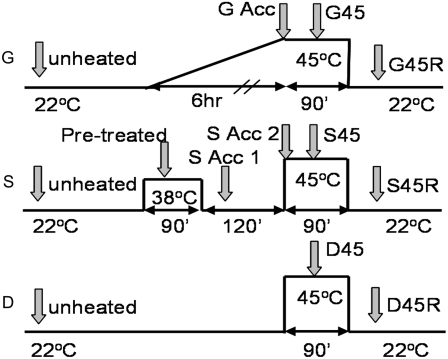
Figure 1.
Figure 1.
Heat treatments for comparison of acclimated and nonacclimated plants. Shaded arrows represent sampling times and their designations. All samples except unheated, G Acc, and S Acc2 were taken 30 min after the previous temperature transition. G Acc and S Acc2 were taken at the end of acclimation prior to the shift to 45°C.
Figure 2.
Figure 2.
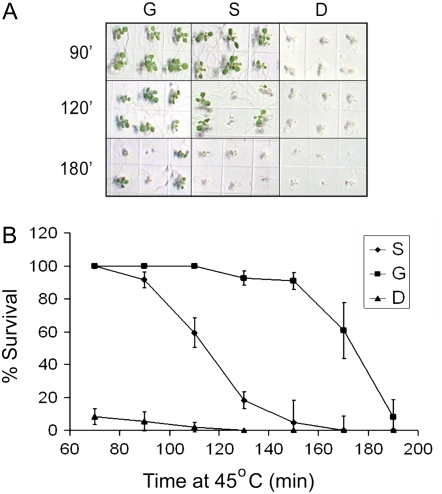
Thermotolerance of plants given different heat treatments. Percent survival of 7-d-old seedlings acclimated (G and S) or not (D) as shown in Figure 1 and then treated at 45°C for the indicated time. A, Appearance of plants at the time of scoring for viability after the indicated heat treatments. B, Graph showing numerical data. Error bars represent sd from three replicate experiments. [See online article for color version of this figure.]
Figure 3.
Figure 3.
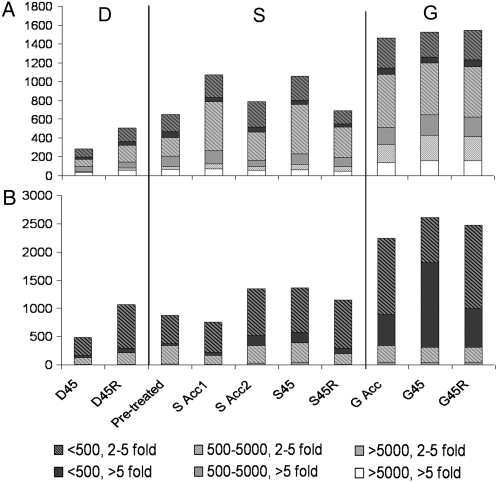
Large numbers of transcripts are increased or decreased by heat treatment. Number of transcripts increased (A) or decreased (B) at the indicated sampling time points as defined in Figure 1. Bars are divided to show classes of transcripts with 2- to 5-fold or >5-fold change in level and to show different absolute expression levels (<500, 500–5,000, >5,000 AU).
Figure 4.
Figure 4.
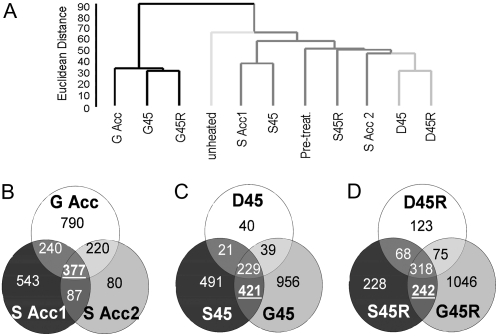
Comparison of transcripts increased by different heat treatments. A, Dendrogram showing relative similarity between different samples. Total array data were clustered using Euclidean distance and average linkage in BRB array tools. G, S, and D sample branches are each shown with differently shaded lines. B to D, Venn diagrams showing the intersections of total numbers of transcripts increased in different samples. B, Acclimation period samples. C, 45°C samples. D, Recovery samples.
Figure 5.
Figure 5.
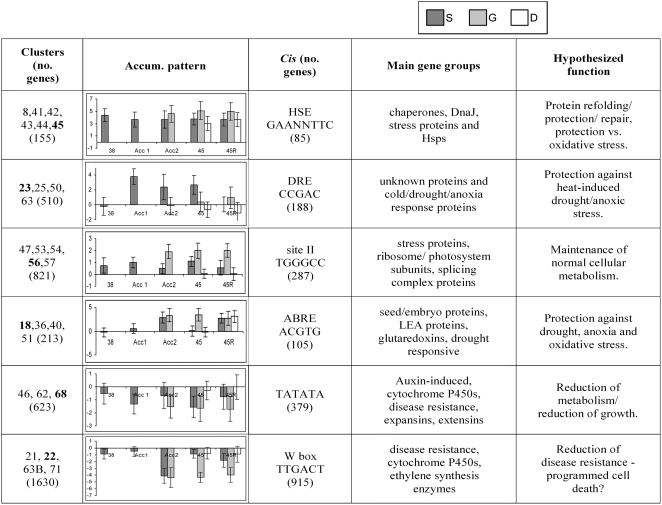
Summary of gene cluster data. This summary shows some of the bioinformatics data for the clusters discussed in the text. Clusters in column 1 are grouped based on cis-element analysis and show related expression behavior. The transcript accumulation pattern graphed in column 2 is for the cluster indicated in bold in column 1. These graphs show the average log fold-change (base 2) in transcript level at the time points indicated (as in Fig. 1) versus the unheated control. Dark gray bars, S acclimation; light gray bars, G acclimation (three time points; Acc2 includes the G Acc time point); white bars, D treatment (two time points). Error bars represent sd. The complete summary of gene clusters with expression graphs can be found in Supplemental Table S5.
Figure 6.
Figure 6.
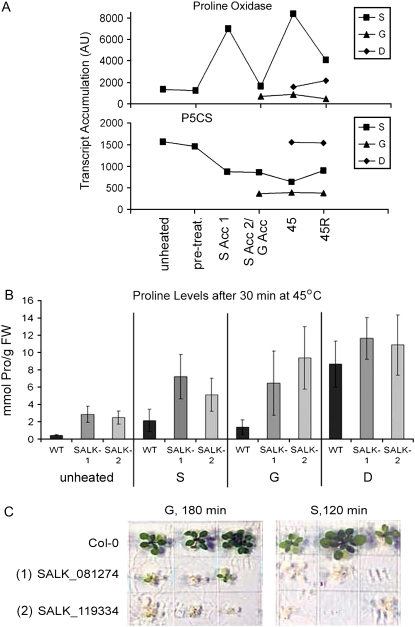
Regulation of Pro metabolism is important for heat tolerance. A, Pro oxidase (At3g30775) and P5CS (At3g55610) transcript levels for the different heat treatments. B, Levels of Pro in plants given the following treatments: unheated, S45, G45, and D45 (as in Fig. 1). Data are averages of five biological replicates, error bars represent sd. C, Survival of 7-d-old S- or G-acclimated plants stressed at 45°C for 120 or 180 min, respectively. Wild type (Col-0) and two Pro oxidase T-DNA insertion lines (Supplemental Fig. S4) are compared. [See online article for color version of this figure.]

References

    1. Alexandrov V, Ouchakov B, Poljansky G (1961) The thermal death of cells in relation to the problem of the adaptation of organisms to the temperature of the environment. Pathol Biol 9 849–854 - PubMed
    1. Azevedo C, Betsuyaku S, Peart J, Takahashi A, Noel L, Sadanandom A, Casais C, Parker J, Shirasu K (2006) Role of SGT1 in resistance protein accumulation in plant immunity. EMBO J 25 2007–2016 - PMC - PubMed
    1. Bates LS, Waldren RP, Teare ID (1973) Rapid determination of free proline for water-stress studies. Plant Soil 39 205–207
    1. Beere H (2004) ‘The stress of dying’: the role of heat shock proteins in the regulation of apoptosis. J Cell Sci 117 2641–2651 - PubMed
    1. Black AR, Subjeck JR (1989) Involvement of rRNA synthesis in the enhanced survival and recovery of protein synthesis seen in thermotolerance. J Cell Physiol 138 439–449 - PubMed

Publication types

Substances