


doi: 10.1128/AAC.00928-07.
Epub 2007 Dec 3.
Analysis of the beta-tubulin gene from Vittaforma corneae suggests benzimidazole resistance
Affiliations
- PMID: 18056284
- PMCID: PMC2224753
- DOI: 10.1128/AAC.00928-07
Item in Clipboard
Analysis of the beta-tubulin gene from Vittaforma corneae suggests benzimidazole resistance
Antimicrob Agents Chemother.
2008 Feb.
Abstract
We amplified, cloned, and sequenced the beta-tubulin gene of Vittaforma corneae, a microsporidium causing human infections. The beta-tubulin gene sequence has a substitution at Glu(198) (with glutamine), which is one of six amino acids reported to be associated with benzimidazole sensitivity. Benzimidazoles were assayed for antimicrosporidial activity and showed poor parasite inhibition.
Figures
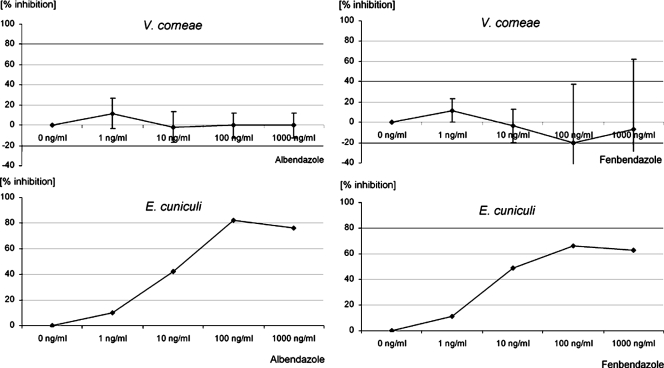
Dose-response curves for albendazole and fenbendazole. Values are means and standard deviations of three replications (V. corneae) or from one experiment (E. cuniculi).
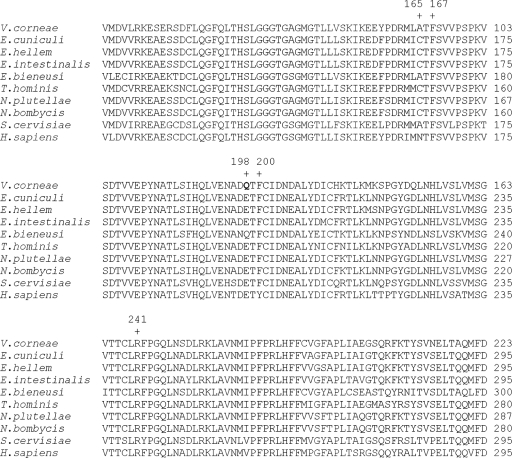
Clustal W alignment of partial β-tubulin amino acid sequences from V. corneae, E. cuniculi (GenBank accession no. NM_001040955), E. hellem (GenBank accession no. L47271), E. intestinalis (GenBank accession no. AF297876), E. bieneusi (GenBank accession no. DQ242640), Trachipleistophora hominis (GenBank accession no. AF162081), Nosema plutellae (GenBank accession no. DQ083404), Nosema bombycis (GenBank accession no. DQ663475), S. cerevisiae (GenBank accession no. V01296), and Homo sapiens (GenBank accession no. NM_178014). Single-letter amino acid abbreviations are used. Five of the six amino acids of β-tubulin that are reported to be associated with benzimidazole sensitivity (Ala165, Phe1167, Glu1198, Phe200, and Arg241; numbering based on the S. cerevisiae sequence shown) are indicated by plus signs. Glu198, which is associated with benzimidazole sensitivity, is changed to glutamine in V. corneae.
References
-
- Davis, R. M., R. L. Font, M. S. Keisler, and J. A. Shadduck. 1990. Corneal microsporidiosis. A case report including ultrastructural observations. Ophthalmology 97:953-957. - PubMed
-
- Deplazes, P., A. Mathis, M. van Saanen, A. Iten, R. Keller, I. Tanner, M. P. Glauser, R. Weber, and E. U. Canning. 1998. Dual microsporidial infection due to Vittaforma corneae and Encephalitozoon hellem in a patient with AIDS. Clin. Infect. Dis. 27:1521-1524. - PubMed
-
- Didier, E. S., J. A. Maddry, P. J. Brindley, M. E. Stovall, and P. J. Didier. 2005. Therapeutic strategies for human microsporidia infections. Expert Rev. Anti-infect. Ther. 3:419-434. - PubMed
Publication types
MeSH terms
Substances
Associated data
- Actions
LinkOut - more resources
Full Text Sources
